Last Updated on July 18, 2024 at 11:17 am
A reader wants to know, “What is the ideal corpus for retirement in India?”. There are two very different aspects to consider here. (1) Retirement Math is universal and independent of geography. Only the inputs would vary. (2) What we define as “ideal” is subjective.
Even in 2024, some people compute the retirement corpus necessary to generate a constant pension, disregarding inflation and are happy. The other extreme is the ultra-cautious, who will try to negate as many risks as possible to ensure the corpus never runs out and possibly leave a legacy behind.
So it is to define an idea corpus, but we can give several options to choose from using the comprehensive retirement planner in the freefincal robo advisor tool. We shall do this using the safe withdrawal rate.
The safe withdrawal rate, or SWR, refers to the amount of money that can be withdrawn annually from a retirement fund in the first year of retirement. This rate is calculated by dividing the initial withdrawal amount by the total money available for retirement.
🔥Secure your future with our Robo-advisory tool trusted by over 3,500 investors and advisors. From effortless retirement planning to funding your children’s biggest dreams, turn your financial goals into reality. 🔥
Subscribe for money management solutions via email! (Link takes you to our email sign-up form) Join 32,000+ readers in our community.
👉 New Tool Alert! NaviPlan: A Privacy-Focused Multi-asset Tracker and Goal Planner 👈
We implement the income bucket approach to mitigate the negative impact of poor investment performance during the initial retirement years. This approach ensures a reliable income for the first 15 years of retirement, adjusted for inflation. Meanwhile, the remaining funds and an emergency fund are divided into low-risk, medium-risk, and high-risk buckets. This strategy reduces the need for constant adjustments and uncertainties in managing these buckets.
Detailed illustrations are available here:
- I am 30 and wish to retire by 50; how should I plan my investments?
- Retirement plan review: Am I on track to retire by 50?
In addition, two further options are available.
- We can set up an income floor. That is, buy an annuity or an RBI bond for some of the annual expenses in the first year of retirement. This income is guaranteed for the lifetime of the younger spouse. See, for example, Creating the Ideal Retirement Plan with Income Flooring!
- We can periodically buy such bonds (bond ladder) or annuities (annuity ladder) to reduce the stress of managing retirement buckets. See: Use this annuity ladder calculator to plan retirement with multiple pension streams.
Assumptions and inputs
- Age 30; Age of spouse: 28
- Current monthly expenses that will persist in retirement: Rs 50,000
- Retirement age: 55
- Years to retirement 25
- Total average monthly expenses (annual/12): 50,000
- Percentage by which your monthly investments can increase each year (until you have accumulated enough for retirement): 10%
- Post-tax return expected from equity investments 10%
- Post-tax return expected from current taxable fixed income 5%
- Rate of return expected from current tax-free fixed income 6%
- Inflation before retirement 7%
- The assumed life expectancy of the younger spouse: 90
- Inflation during retirement: 6%
- Monthly expenses in the first year of retirement: Rs. 2,71,372
- Years in retirement (until younger spouse reaches age 90) 37
- For convenience, the corpus already accumulated is assumed to be zero.
Result 1: Corpus required with no income flooring or laddered annuity: Rs. 9.82 Crores. Withdrawal rate: 3.31% (withdrawal rate here only refers to the value for the first year of retirement). This is the bare minimum ideal corpus required. Anything less than this is not ideal.
Result 2: Corpus required with 100% income flooring (single monthly annuity = monthly expenses in the first year of retirement): Rs. 13.08 Crores. Withdrawal rate: 2.49%. This is the next-level ideal retirement corpus. The income flooring will provide excellent emotional and financial security.
Result 3: Corpus required with annuity laddering: Rs. 25.40 Crores. Withdrawal rate: 1.28%.
This is an example. The steps can be altered as desired via the inputs in the robo tool.
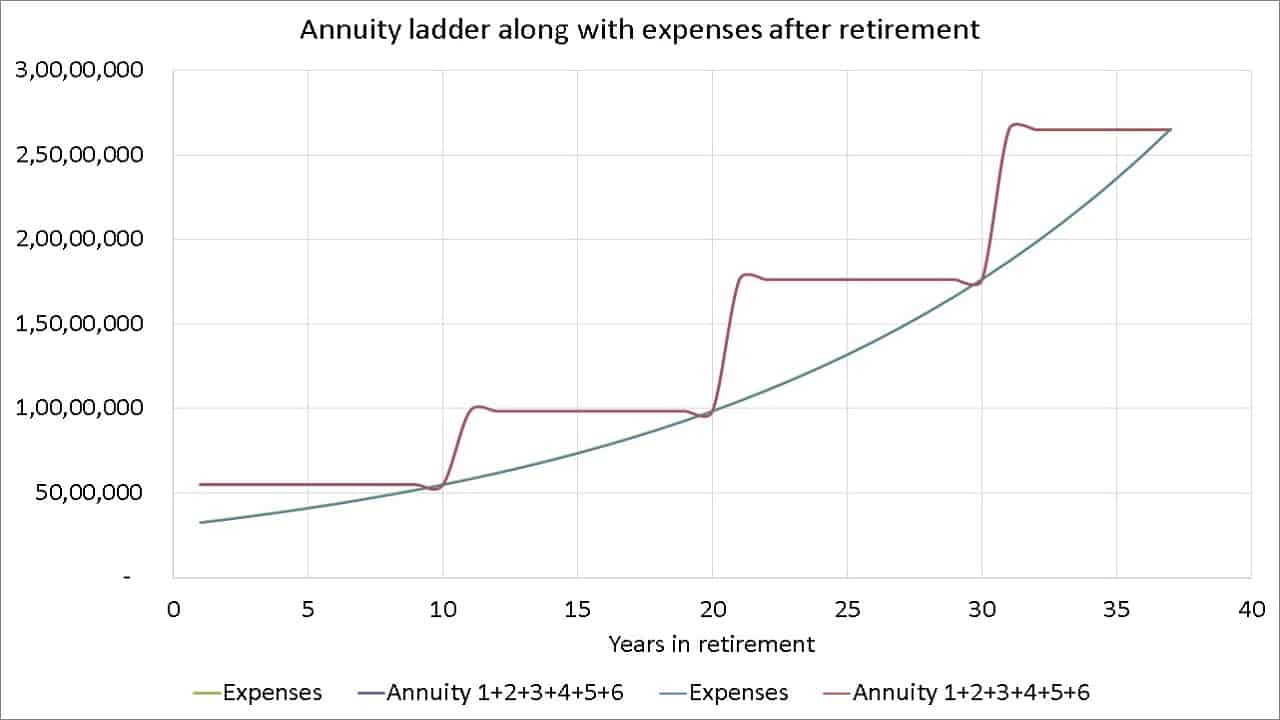
This is the “ultimate” ideal retirement corpus. The laddered annuities (purchased every decade or so) will combat inflation, enhance security and reduce the burden of managing the corpus in old age. It is hard to achieve, but we can strive towards this once we have some experience and confidence as our corpus grows.