Statements like, “Our analysis shows that, over the long term, the stock market shows poor returns for only two out of every ten periods. This means that the probability of losing money is quite small”, are wrong. You cannot, well, must not associate probabilities with stock market returns.
Just because one has two numbers – the number of negative outcomes and the total number of outcomes – does not mean the ratio forms a probability! You can define a probability only when you know all the possible outcomes.
Take the case of dice used in gambling. A single die is a cube with six numbered sides. If you want the die to show a six when you throw, the probability is 1/6. The formula is the number of desired results (1) divided by the total possible results (6).
You can throw the dice a billion times and always get one of those six results. The stock market does not work that way. You may have studied thousands of 15-year periods but have no idea how the next 15 would pan out.
It is silly to claim that the probability of negative returns over the next 15 years is 5% or 10% or whatever. This is because no one can tell whether we would fall between the positive and negative returns bin.
🔥Secure your future with our Robo-advisory tool trusted by over 3,500 investors and advisors. From effortless retirement planning to funding your children’s biggest dreams, turn your financial goals into reality. 🔥
Subscribe for money management solutions via email! (Link takes you to our email sign-up form) Join 32,000+ readers in our community.
👉 New Tool Alert! NaviPlan: A Privacy-Focused Multi-asset Tracker and Goal Planner 👈
There are only two things we can infer:
- We can look at the maximum loss and mentally prepare ourselves that the future could, at the very least, resemble the past. Our experience could be less or more losses, but at least we have some number to appreciate risk.
- We can tell ourselves although there are no guarantees of success – the Stock market always moves up in the long term, but returns move up and down! – we have a reasonable chance of success – Why should I invest in equity mutual funds when there is no guarantee of returns?
Some people argue, “Why can’t I say that the probability of failure is low? After all, it helps me invest”. Probability is supposed to have a technical definition. If we choose to make bespoke definitions, then it is the equivalent of claiming, “Why should I say that the sun rises in the East? In my world, it rises North by North West.”
Would you rather learn the truth – that there are no guarantees of success, no probabilities, and learn goal-based risk management – or would you rather cling to fairy tales and ride your luck?
Here is dramatic evidence of why we must not use probabilities or odds ( = probability of success divided by the probability of failure) for stock market returns.
We use double-moving averages in our tactical asset allocation model. Via extensive backtesting, we have established that the model reasonably works (see links below) with Indian gilts, the Nasdaq 100, the S&P 500 and gold.
- Is it possible to time entry and exit from gilt mutual funds for better returns?
- Testing a double moving average market timing model (part 1): Nasdaq 100
- Testing a double moving average market timing model with S&P 500 (Part 2)
- Testing a double moving average market timing model with gold (Part 3)
The strategy worked exceedingly well for the S&P 500 over 122 years, including wars, recessions, and political crises. If I had created some “probability” from this and expected the same in the Indian market, particularly the Sensex or the Nifty, I would have been disappointed greatly.
The March 2020 crash was so sharp, and the recovery so sudden that the strategy failed spectacularly. It has still not recovered!
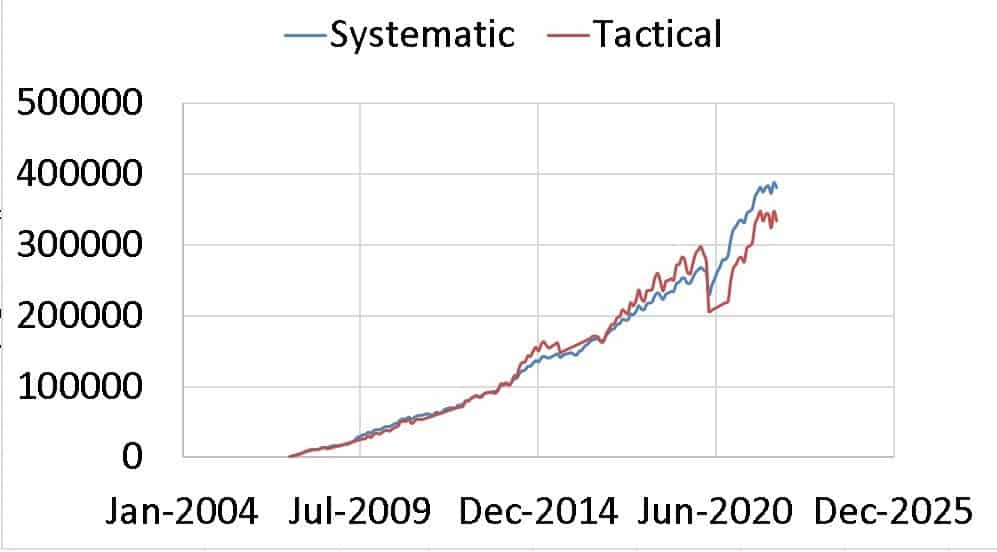
Full details are here: A risk in market timing that 122 years of backtesting failed to reveal! Any probability measure based on past data up until March 2020 was entirely useless in predicting the future from that point on for the Sensex or Nifty.
We must stop and fully appreciate the disclaimer – Past performance is no
guarantee of future results! Any and all analysis we make is based on past data, which has no bearing on future results. This is especially true of probability. We need to stop using it.