Last Updated on September 15, 2025 at 11:59 am
Portfolio rebalancing refers to resetting your asset allocation (equity: fixed income ratio) from time to time – typically once a year – to lower risk in your portfolio. In this post, I show backtesting results and discuss exactly how much is the risk reduction and in spite of tax and exit loads, it is totally worthwhile to rebalance the portfolio.
This post is part of Resolve – a series of steps on investing and portfolio management.
Step1: How to quickly select equity mutual funds and build a diversified portfolio
Step 2: How to Quickly Decide: Should I stay invested or exit my mutual fund?
🔥Secure your future with our Robo-advisory tool trusted by over 3,500 investors and advisors. From effortless retirement planning to funding your children’s biggest dreams, turn your financial goals into reality. 🔥
Subscribe for money management solutions via email! (Link takes you to our email sign-up form) Join 32,000+ readers in our community.
👉 New Tool Alert! NaviPlan: A Privacy-Focused Multi-asset Tracker and Goal Planner 👈
Step 4: Why we need to gradually pull out of equity investments well before we need the money!
Step 5: How much equity should I hold in my portfolio?
Step 6: this post.
What is asset allocation?
You decide the asset classes that you want to invest in, say equity and fixed income. You have an expectation of return for the duration of investment and an expectation of risk. Based on this you decide how much equity should be there in your portfolio and how much-fixed income. First, let us have a look at the basics of asset allocation.
Then as discussed earlier: how much equity should I have in my portfolio?
What is portfolio rebalancing?
Suppose you start with 60% equity and 40% fixed income and after one year, you have 80% equity and 20% fixed income (bumper returns from stock market). You sell the excess 20% from equity and buy more fixed income and reset the asset allocation back to 60:40. The basics are explained here.
Remember portfolio rebalancing requires the maturity to partially pull out of a well-performing asset class and shift it to another asset class!
Previous posts about rebalancing:
The What, Why, How and When of Portfolio Rebalancing With Calculators to Boot
How to Rebalance Your Investment Portfolio
Understanding Volatility of Investment Returns with a Portfolio Rebalancing Simulator
Why should I rebalance?
Reduce risk in the portfolio. Remember risk is real-time and return is in hindsight. Rebalancing reduced risk in real time and keeps the investor calm as we will see below.
It is clear to me now that many investors want better returns and lower risk without selling and buying because of taxation and exit load fears. This is as immature as checking the portfolio each day.
Example 1: 10-year duration; Equity 60%; Fixed Income 40%
Here equity is Franklin India Blue Chip Fund and Fixed Income is Franklin Dynamic Accrual Fund (previously Templeton India Income Fund)

Top left: Returns (XIRR) are compared between systematic investing (60:40) with rebalancing each year and no rebalancing.
Top right: The max drawdown or max fall the portfolio saw is compared. The more negative, the worse!
Bottom left: The fluctuation in monthly returns (standard deviation) is compared. The higher, the more volatile.
Bottom right: Total no of months, the portfolio “fell” leading to negative monthly returns.
Annual rebalancing clearly has a lower risk. I have removed 4% from the final value to account for tax and exit load. This is the reason why the rebalanced returns are bit lower.
Example 2: 10-year duration; Equity 70%; Fixed Income 30%

Again the same benefit. Please don’t be childish and assume: “the un-rebalanced return is anyway good so why should I rebalance?” Let me repeat: returns are in hindsight (you will know only at the end) and risk is in real time (every day).
Example 3: 15-year duration; Equity 60%; Fixed Income 40%
This is from scenario considered here: How to reduce risk in an investment portfolio. This is the asset allocation plan.
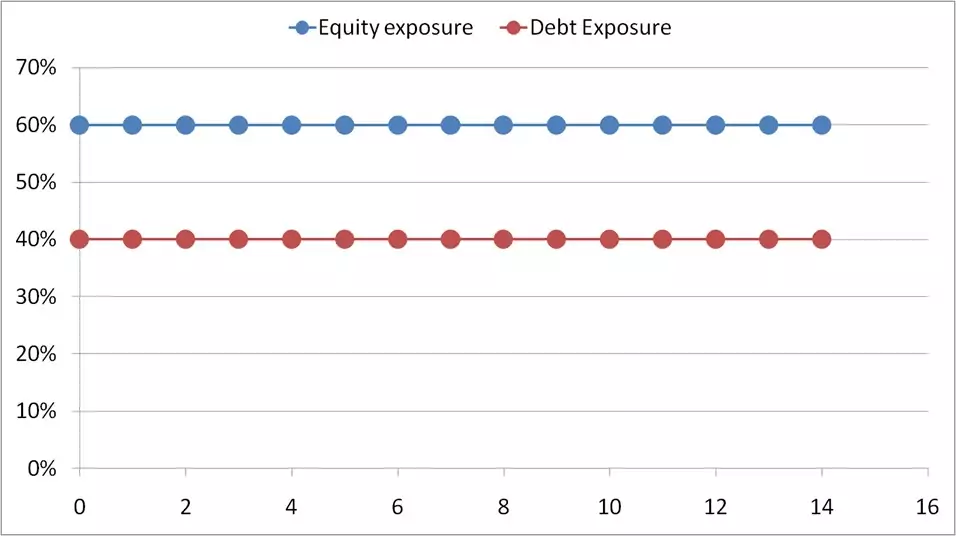
The max fall in the portfolio is compared for annual rebalancing to 60:40 and no rebalancing.
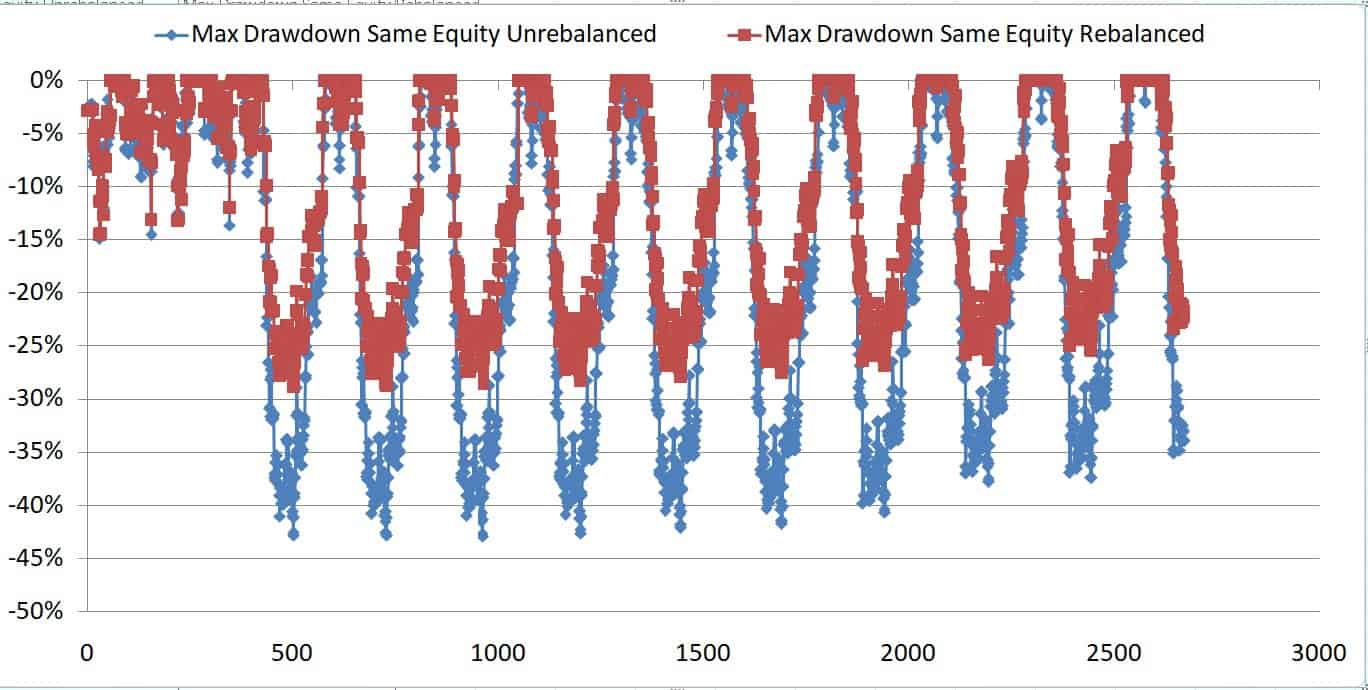
The drawdown risk is lowered by 10% due to simple annual rebalancing.
Example 4: 15-year duration; Decreasing Equity
This is the step-down strategy used. Read more: Why we need to gradually pull out of equity investments well before we need the money!
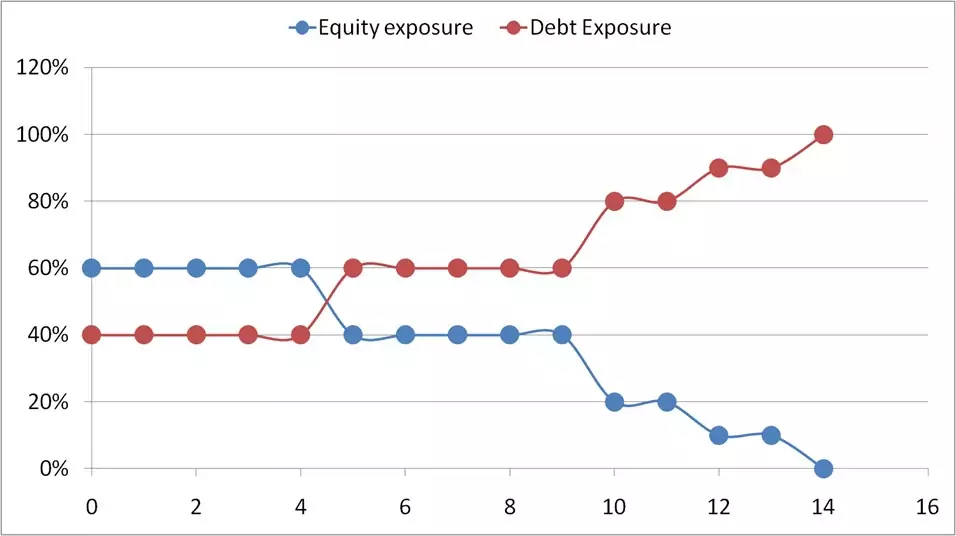
So here rebalancing means: for the 1st five years, the portfolio is annual reset to 60:40 and in 6th year to 40:60 (equity = 40) and then reset at 40:60 for next 4 years and then down to 20:80 ( equity = 20) and so on.
No rebalancing means: Starting at 60:40, and rebalance to 40:60 only in the 6th year and rebalance to 20:80 only 11th year and so on. No rebalancing is done in between
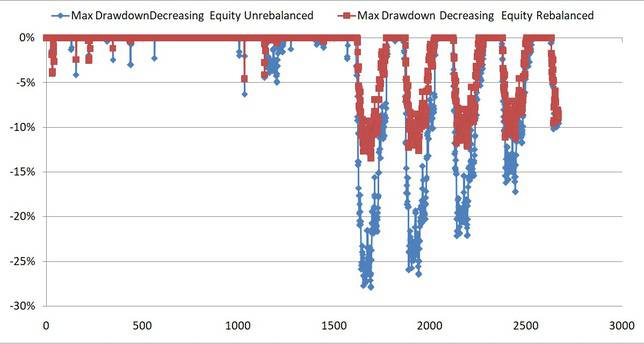
Here again, the benefit is a 10% reduction in risk.
So the message is clear, forget about tax, forget about exit load. Whether you follow a decreasing equity strategy or a constant equity strategy, reset your portfolio asset allocation once a year and sleep peacefully. No need to time the market, no need to worry about market outlook and all that nonsense. Of course, first you should have a strategy in place and only then can you worry about rebalancing. Do you?