Last Updated on April 14, 2026 at 11:04 am
The Motilal Oswal Value Index (MOVI) allows the investor to change equity and fixed income levels as per MOVI values. In this post, I try to understand how the MOVI is calculated.
This is only an academic post about the MOVI and is neither a recommendation to use MOVI or Motilal Oswal Mutual Funds.
MOVI-based indexing is a form of dynamic asset allocation. There are funds like
- Franklin PE-based fund which uses only PE levels.
- IDFC Dynamic Equity Fund that uses a combination of PE and 200-day moving averages.
- DSP BR dynamic asset allocation fund which uses Yield Gap
- Other funds can be found here: Performance of Dynamic Asset Allocation Mutual Funds
How the MOVI is calculated
🔥Secure your future with our Robo-advisory tool trusted by over 3,500 investors and advisors. From effortless retirement planning to funding your children’s biggest dreams, turn your financial goals into reality. 🔥
Subscribe for money management solutions via email! (Link takes you to our email sign-up form) Join 32,000+ readers in our community.
👉 New Tool Alert! NaviPlan: A Privacy-Focused Multi-asset Tracker and Goal Planner 👈
Information on this is quite sketchy. All we know is that it is a combination of the Nifty PE, PB and Dividend Yield. The 90-day moving average of the MOVI is used for dynamic asset allocation.
MOVI Chart
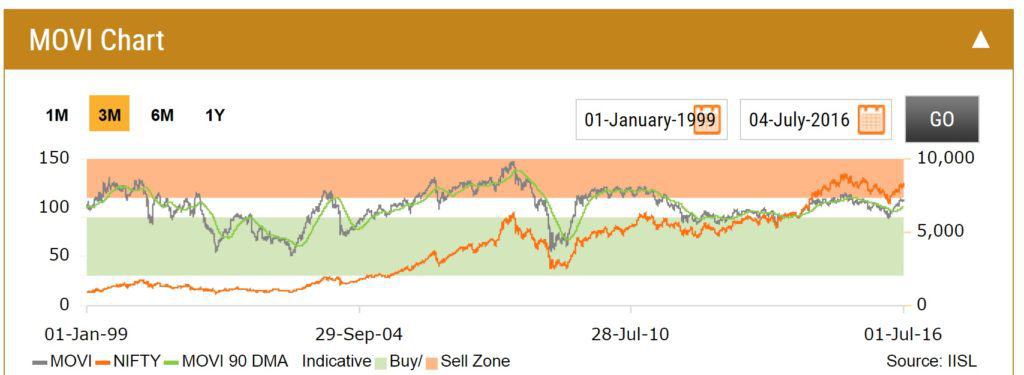
I have tried to come up with a formula for the MOVI by looking at the above chart and using Nifty PE,PB and DY values.
My guess (not a random one) is, the MOVI has a form which is similar to
MOVI ~ LOG((PE+PB)/DY). Where the Log stands for Logarithm and ~ stands for ‘approximately’.
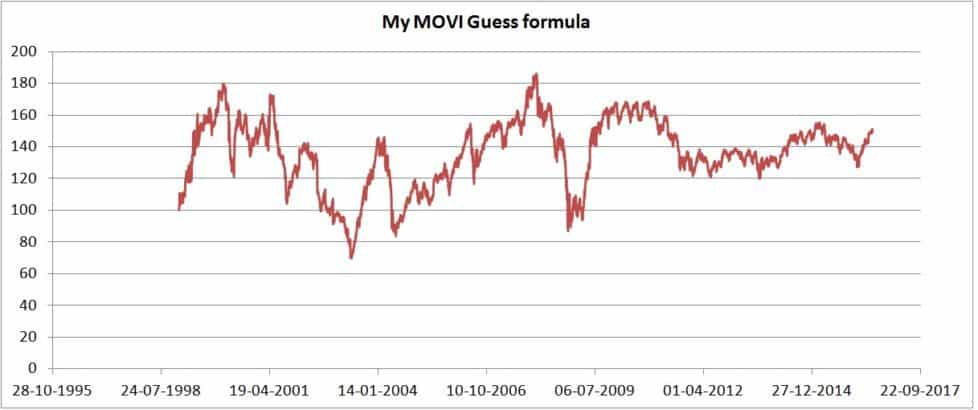
The overall behaviour is very close to the actual MOVI chart, by are higher by about 1.3-1.5 times. This guess formula is good enough to come up with an independent asset allocation strategy. However, that is not quite necessary as we have the actual MOVI itself!
This is a better MOVI chart
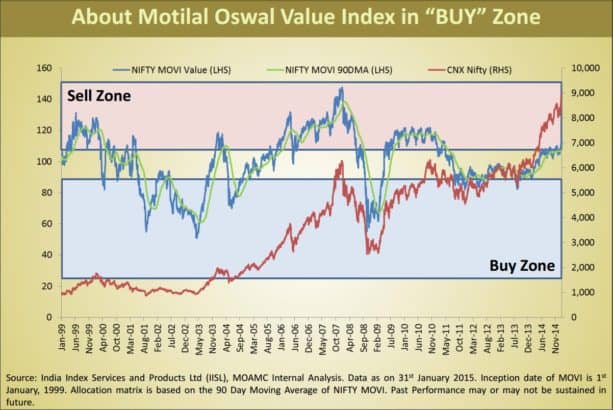
The asset allocation matrix as per MOVI levels is given below.
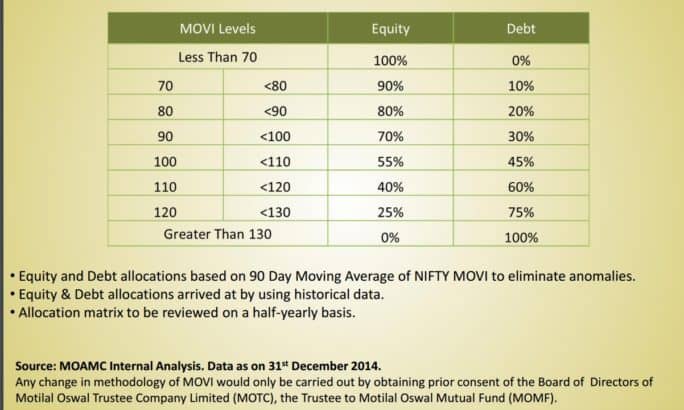
The MOVI-based strategy or any of the other strategies noted above is likely to result in a better risk-adjusted return. It may not always result in a better absolute return, as this comprehensive study shows: Is it possible to time the market?