A reader says, “I created a financial plan using your robo-advisory tool. It was quite useful to understand where I stand, but I am now scared because I do not have enough to invest for my long-term goals. What should I do?”
This is a fairly common situation; most of us start our investment journey this way. There is nothing to despair about. Here are some options to consider.
1. Consider clubbing all long-term goals together (greater than 10Y away) and investing in a single portfolio for them. This unified portfolio will reduce the total investment to be made.
The unified portfolio approach assumes that once one goal is completed, more money will be available for investment. This is why the initial investment is lower than the independent portfolio approach.
The freefincal robo advisory tool offers independent and unified portfolio planning options with scheduled withdrawals (curved arrows). This is a screenshot from the tool.
🔥Secure your future with our Robo-advisory tool trusted by over 3,500 investors and advisors. From effortless retirement planning to funding your children’s biggest dreams, turn your financial goals into reality. 🔥
Subscribe for money management solutions via email! (Link takes you to our email sign-up form) Join 32,000+ readers in our community.
👉 New Tool Alert! NaviPlan: A Privacy-Focused Multi-asset Tracker and Goal Planner 👈
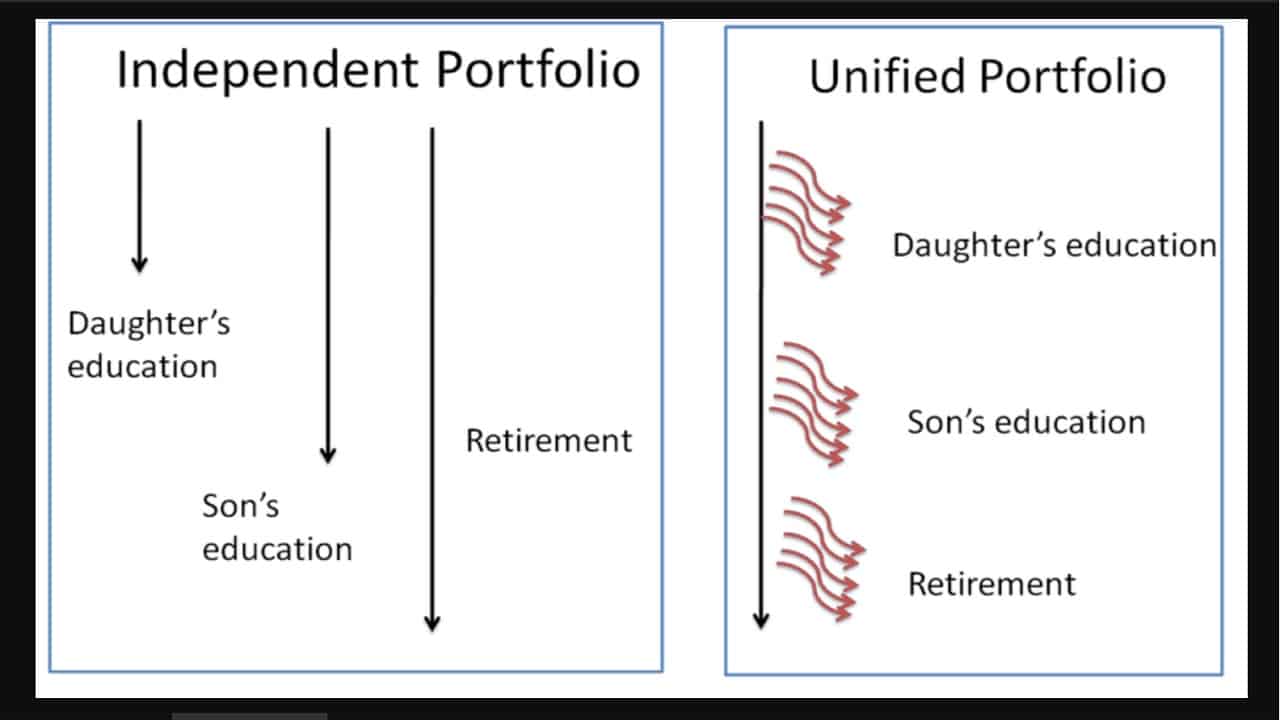
The risk in choosing the unified portfolio is we depend on higher cash flow in future which may or may not pan out. However, it offers some hope to get started, so it is an acceptable risk to handle.
Suppose you have your daughter’s college education goal deadline 10Y from now and your retirement 20Y away. You will make gradual withdrawals from the unified portfolio, say from years 5/6 to 10 and put that money in a safe instrument to fund your daughter’s college fees. The rest of the portfolio and future investments continue to grow for retirement.
2. Reduce the target corpus for your Daughter’s college education. Down the line, with some luck, your portfolio may do better than expected and due to your skills and effort, you may end up with a higher-paying job. You can rethink this later on. Else you will have to fund this with an education loan.
3. Reduce the lifestyle you are aiming for in retirement. The ideal retirement plan ensures your current lifestyle does not change in future, but if you do not have enough to fund it, then we have no other option. As mentioned above, the future can pan out better, and we can get back on track.
4. Check your inputs and assumptions. Often investors include EMIs and expenses made for children, parents or in-laws in the retirement plan. These should be excluded. Also, if you consider a lower inflation rate, say 5% before retirement and 4% after. This is not ideal, but if it can motivate us to get started, it is not a terrible choice. A similar exercise can also be done with other long-term goals.
5. Postponing retirement is the final resort, but this is not in our control. There are other options, like a reverse mortgage, but this cannot be relied on when retirement is far away. See: Can reverse mortgages be used as an income source after retirement?
Regardless of whether we can afford to invest enough or not, we must try to increase our income as much as possible. Easier said than done but try, we must. See: Passive income is a crucial part of your retirement plan: How to get started.