A retirement bucket strategy is an approach by which the retirement corpus is split into 3-4 buckets of varying risk. As retirement progresses and market conditions change, the retiree is expected to manage the buckets. That is, transfer money from one bucket to another to ensure the expenses (indexed to inflation, with some room for emergencies) are met and the corpus does not run out in the retiree’s lifetime.
Regular readers may be aware that we have done extensive work with retirement buckets. For those who are new, these resources may help.
- What is a retirement bucket strategy? How to implement it?
- How to deploy money in a retirement bucket strategy
- List of investments suitable for building a retirement bucket strategy
You may also see these retirement planning Illustrations made with the freefincal robo advisor tool:
- Retirement plan review: Am I on track to retire by 50?
- I am 30 and wish to retire by 50. How should I plan my investments?
- Can I retire by age 55? Retirement Planning Case Study
- Case Study: Achieving Financial Freedom for Early Retirement
- How should I plan if I want to retire in 20 years?
- Is it possible to combine a bucket strategy with income laddering after retirement?
Over the years, our research has focused on ways to simplify bucket strategy management and reduce churn among the buckets in retirement, especially at old age (when the retiree may not have their physical and mental faculties intact).
With this aim, over the years, we have implemented the following changes to the robo-advisor tool.
🔥Secure your future with our Robo-advisory tool trusted by over 3,500 investors and advisors. From effortless retirement planning to funding your children’s biggest dreams, turn your financial goals into reality. 🔥
Subscribe for money management solutions via email! (Link takes you to our email sign-up form) Join 32,000+ readers in our community.
👉 New Tool Alert! NaviPlan: A Privacy-Focused Multi-asset Tracker and Goal Planner 👈
- Including three pre-existing pension or income sources (dividends, rent, etc).
- Including an additional annuity referred to as an income floor. This guarantees a life of up to 100% of the annual income in the first year of retirement.
- Annuity laddering – Multiple annuities purchased every decade of retirement to minimise churn significantly
We have been thinking about an alternate method of bucket management, which we would like to discuss in this article.
The freefincal robo advisor incorporates an income bucket in retirement planning. This income bucket has a corpus that can provide for inflation-indexed income for the first 15 years in retirement. This significantly reduces the sequence of returns risk and allows the remaining corpus to grow in other buckets (see illustrations linked above).
Now consider the following scenario. We have 30 years in retirement.
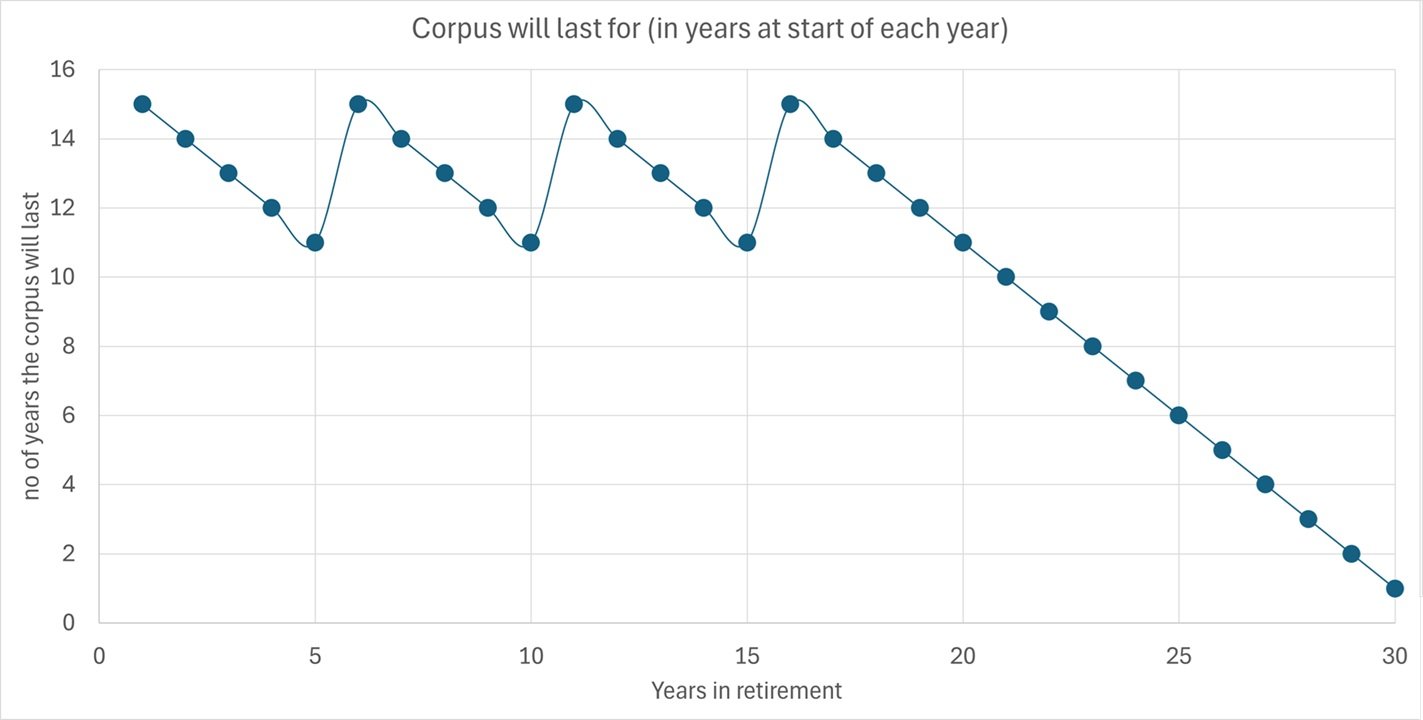
- Year 1: The income bucket has 15Y worth of funds. For ease of discussion, we shall refer to this as only 15Y. The remaining corpus grows in 2-3 buckets of different risk.
- End of year 5 or start of year 6: The income bucket will now have 10Y worth of funds. We now shift some funds from the remaining buckets to the income bucket to top it up to 15Y. This is the first churn among buckets.
- End of year 10 or start of year 11: The income bucket will now have 10Y worth of funds. We now shift some funds from the remaining buckets to the income bucket to top it up to 15Y. This is the second churn among buckets.
- End of year 15 or start of year 16: The income bucket will now have 10Y worth of funds. We now shift some funds from the remaining buckets to the income bucket to top it up to 15Y. This is the third churn among buckets.
- With this third churn, we completely shift all funds into the income bucket. For the last 15 years in retirement, the income bucket has provided a steady income. There is only a single bucket. This is ideal when the retiree is at an advanced stage and simplicity is preferable.
This process is illustrated in this graph.
Advantages
- Minimal churn. The buckets do not need to be touched each year. Over the course of 30 years, there are only three transfers.
- High safety. For the first 15 years in retirement, the income bucket will always hold between 15 years’ and 11 years’ worth of inflation-indexed income. So market conditions will not keep the retiree awake.
Disadvantages
- The price for safety is always higher. The withdrawal rate (annual expenses in the first year divided by total corpus required) will be close to 3% (or just below)
You can always vary the parameters. For example, the first churn can be done when the income bucket has reduced from 15Y (initially) to 5Y (instead of 10Y) in the above example. If you have thoughts on this strategy, you can write to us via this contact page.
A calculator based on this idea is in development. It will be made available to our robo advisor users.