We discuss how to deploy money in a retirement bucket strategy.
A bucket strategy is a post-retirement investment plan to manage inflation-protected withdrawals (income) and investments for the near and long term. So, we have investments purely for income generation (regular withdrawal), fixed income, and equity investments.
Retirement buckets are mental partitions of these investments. The primary rule in our robo-advisor tool is that the retiree should have enough money to generate inflation-proof income for the first 15 years of retirement. If this is not available, creating a bucket strategy is quite risky. A few years of poor market returns, especially in the first few years of retirement, can wipe out much of the corpus.
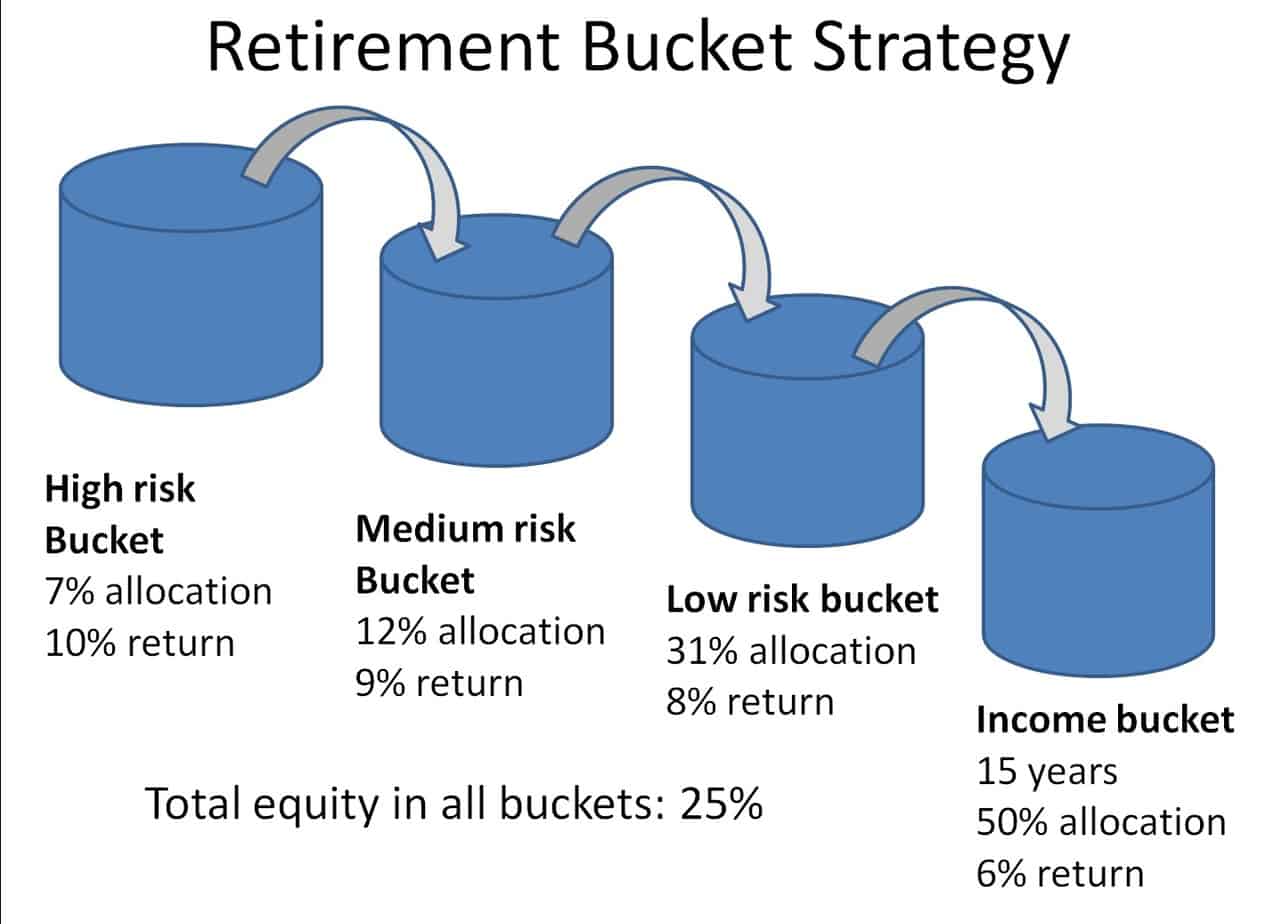
The robo tool divides the retirement corpus into five buckets. That is, the retirement corpus will be divided into five parts. This is only one of many ways to construct a bucket strategy. The idea here is to minimise active management and shift funds from one bucket to another unless necessary. The following assumes 45 years in retirement. The percentages are specific to the set of inputs and should not be used by everyone.
- An emergency bucket to handle unexpected expenses. Example: 5%
- An Income bucket for guaranteed income for the first 15 years of retirement. During this time, investments are made in the following three buckets. Example: About 40-45%. This is the bucket mentioned in the reader’s question.
- Corpus is from a low-risk bucket that provides retirement income from year 16 to year 26. To provide this income, the low-risk bucket will have an asset allocation of 30% equity and 70% debt during the investment period (years 1 to 15 of retirement). Say about 25%.
- Corpus from a medium-risk bucket will provide retirement income from years 27 to 35. To provide this income, this bucket shall have an asset allocation of 50% equity and 50% debt during the investment period (year 1 to year 26). Say about 10-15%.
- Corpus from a high-risk bucket will provide retirement income from years 36 to 45. To provide this income, this bucket shall have an asset allocation of 70% equity and 30% debt during the investment period (year 1 to year 35). Say about 10-15%.
- After 15 years, the low-risk bucket will be turned into 100% debt and provide income for about 11 years. After that, the other buckets will also be progressively used. One can always customize this usage after retirement.
Examples of this strategy are available here: I am 30 and wish to retire by 50; how should I plan my investments? Or How much do I need to retire by 45 in India?
🔥Secure your future with our Robo-advisory tool trusted by over 3,500 investors and advisors. From effortless retirement planning to funding your children’s biggest dreams, turn your financial goals into reality. 🔥
Subscribe for money management solutions via email! (Link takes you to our email sign-up form) Join 32,000+ readers in our community.
👉 New Tool Alert! NaviPlan: A Privacy-Focused Multi-asset Tracker and Goal Planner 👈
This is a schematic from a published illustration: Creating a retirement income plan for 27-year-old Amar. Please note that bucket allocations will change per the user’s age profile, which will be auto-determined by the robo-advisor tool.
Financial instruments for the buckets
Income bucket:
- Pension. Guaranteeing some percentage of our expenses via a pension is always advisable. This is known as income flooring. Read more about it: Creating the “ideal” retirement plan with income flooring!
- Multiple pension streams are an option for those with a large corpus: How to use income laddering with annuities to plan for retirement.
- Fixed deposit ladders or bond income ladders. A series of fixed deposits or short-term bonds mature in successive years. They can be used to provide income each month (or every six months in the case of bonds) or after maturity (as applicable).
- See: How I used RBI Retail Direct to buy government bonds and create an income source.
- Post office monthly income schemes, Senior Citizen Savings Scheme and all the usual suspects!
- PPF (after the first 15 years). See: Can I withdraw 7% each year from my PPF account as a source of income?
- Money market mutual funds, liquid funds, or arbitrage funds. These funds will have NAV volatility and short-term losses during market turbulence and crashes.
- A stable equity portfolio offering decent dividends can also work for those with experience.
While the income bucket has multiple components, the low-risk, medium-risk and high-risk buckets only vary in equity allocation. Their main purpose is the same: capital appreciation. The main difference is the duration of the investment. In the above example, the low-risk bucket has a tenure of 15 years.
The bulk of the low-risk bucket is expected to grow untouched (hopefully) for 15 years. Similarly, the medium-risk bucket has an expected tenure of 25 years, and the high-risk bucket has a tenure of 35 years in the above example.
Depending on market conditions, the retiree may shift some funds from one bucket to another in the intervening period. For example, from the high-risk bucket to the low-risk bucket when there is a bumper return or from the medium-risk bucket to the high-risk bucket when there is a significant dip.
The low, medium and high-risk buckets can always be constructed with simple index and short-term debt funds. However, the stakes are higher after retirement, so hybrid fund options can also be considered for equity.
- Equity part: Direct equity, Nifty or Sensex index funds, Balanced advantage funds, dynamic asset allocation funds, or aggressive hybrid funds can be used. These can even include funds that swing from equity-like to debt-like in terms of taxation. For fund recommendations, see Handpicked List of Mutual Funds (PlumbLine).
- Fixed income: PPF, fixed deposits, a mix of money market funds, arbitrage funds, gilts funds, corporate bond funds or even a conservative hybrid fund like Parag Parikh Conservative Hybrid Fund.
Lower volatility should be the main parameter for the low-risk bucket. So, a dynamic asset allocation or balanced advantage fund can dominate the equity of low or medium-risk buckets. Fixed deposits, PPF and short-term funds can dominate the debt portion of the low-risk bucket.
There are multiple ways to mix and match equity and fixed-income instruments. The key to doing this depends on the retirees’ experience and, more importantly, appreciation of visible and invisible risks.