Last Updated on May 16, 2022 at 2:15 pm
In this article, we shall explain what is income laddering or annuity laddering and how to use it for retirement planning. In preparation for this article, we had earlier published a series of introductory texts. We recommend that new readers go through these first.
- Part 1: What are the annuity rates of LIC Jeevan Akshay VII from Feb 2022?
- Part 2: How LIC annuity rates have changed over the last 20 years
- Part 3: I need a pension: Should I buy an annuity or a govt bond?
- Part 4: How can I use my corpus to get a pension at the best return?
Income laddering in general means a series of cash flows that become available at different points of time in the future. Typically bonds or fixed deposits are used for income laddering. A series of FDs started today and maturing every few years from now is one example of an income ladder. Also, see: Income Ladder Calculator.
Income laddering from annuities (immediate pension plans sold by insurers*) exploits the idea that the return provided by an insurer increases with age.
* There are deferred annuity plans also sold. These provide a pension after X years. We will discuss the pros and cons of these products in a later article.
🔥Secure your future with our Robo-advisory tool trusted by over 3,500 investors and advisors. From effortless retirement planning to funding your children’s biggest dreams, turn your financial goals into reality. 🔥
Subscribe for money management solutions via email! (Link takes you to our email sign-up form) Join 32,000+ readers in our community.
👉 New Tool Alert! NaviPlan: A Privacy-Focused Multi-asset Tracker and Goal Planner 👈
Before we begin, there are important caveats to consider.
- The annuity rates shown below for different ages are current rates. They will likely be lower when we get to that age. This decrease must be factored into the calculation in an approximate way. We have done this.
- Annuities are taxed as per slab rates and these keep changing year to year. We have not factored tax into our discussion, but it is crucial to do so.
- When we buy the first annuity, a simple “annuity of life” is sufficient as shown earlier (see part 4 above). However, when buying at later stages of retirement, other options may be more efficient. This must be considered. In this example, we only use the annuity rates for “annuity for life”.
Let us first look at the annuity rates for the “for life” option from LIC Jeevan Akshay.
| Age of entry | LIC Jeevan Akshay VII from Feb 2022 |
| 30 | 6.205 |
| 40 | 6.535 |
| 45 | 6.795 |
| 50 | 7.155 |
| 55 | 7.645 |
| 60 | 8.325 |
| 65 | 9.245 |
| 70 | 10.685 |
| 75 | 13.225 |
| 80 | 17.225 |
Notice that the older the annuitant, the higher the interest rate. We can exploit this in the following way.
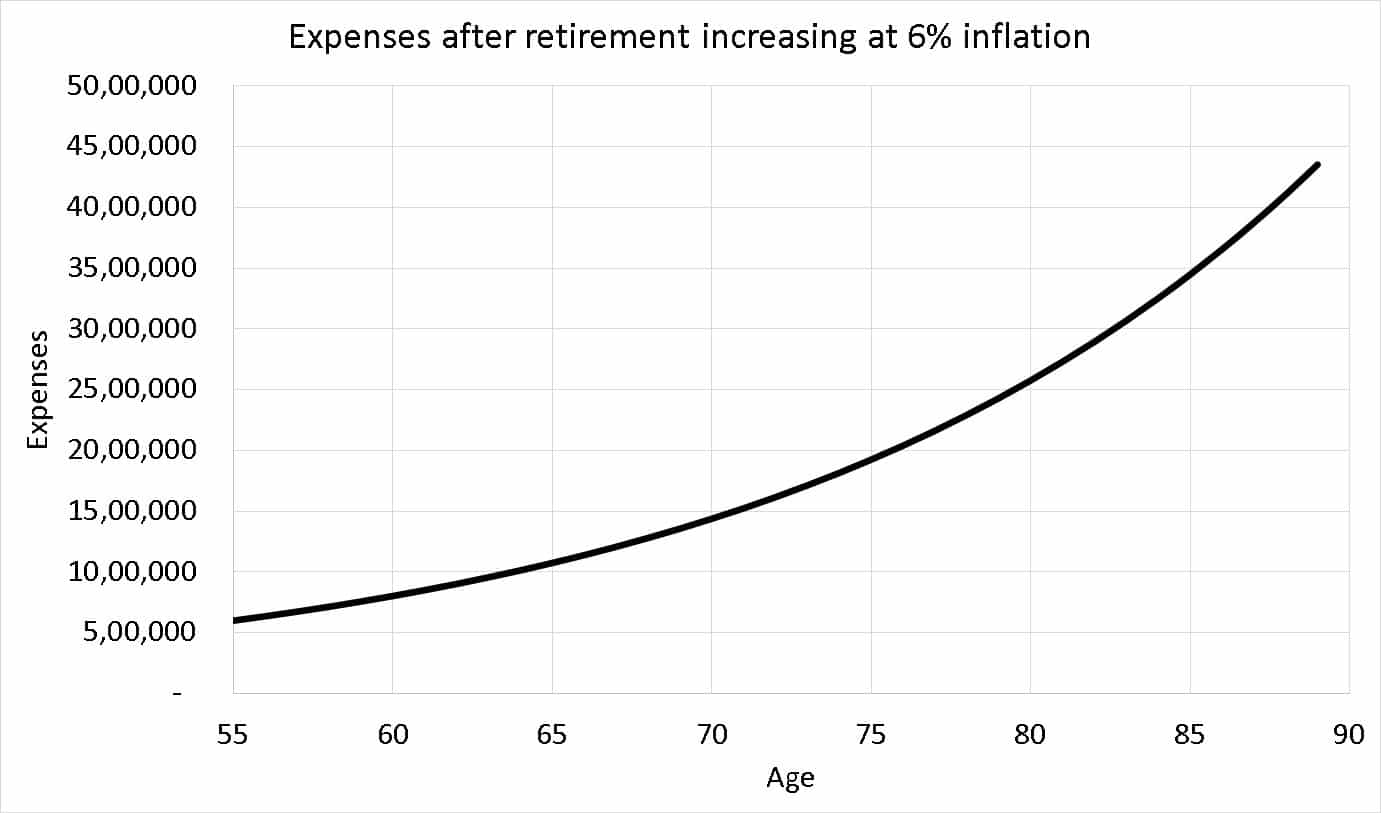
Consider a 55-year-old with Rs. 6,00,000 as annual expenses and 6% inflation. This is how his expenses will increase until age 90.
There are three ways to manage these expenses.
- Entirely using the bucket strategy method explained before: Retirement plan review: Am I on track to retire by 50?
- Using a combination of a single annuity policy and bucket strategy (aka income flooring). See: How to beat inflation after retirement along with guaranteed pension
- Using a combination of multiple annuities and a bucket strategy (aka income laddering or annuity laddering).
In the income flooring method, we buy a single annuity at the start of retirement and manage the remaining expenses using the bucket strategy.
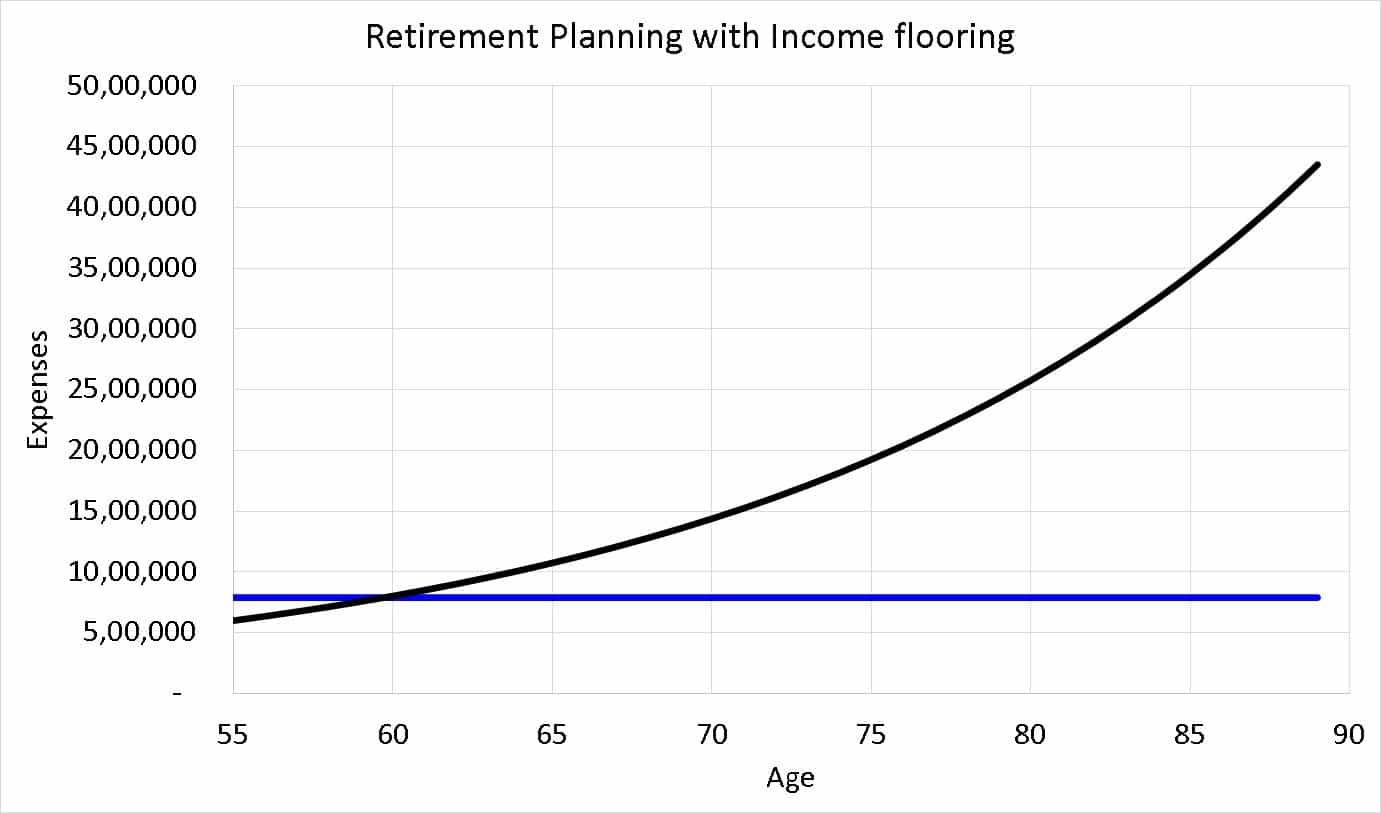
This (annual) pension amount can be equal to the annual expenses in the first year or the average of the first 10 years’ expenses (shown above) or any amount you like.
In the income laddering or annuity laddering approach, we progressively buy annuities at higher and higher interest rates (due to the age of the retiree) and manage the balance expenses with a bucket strategy.
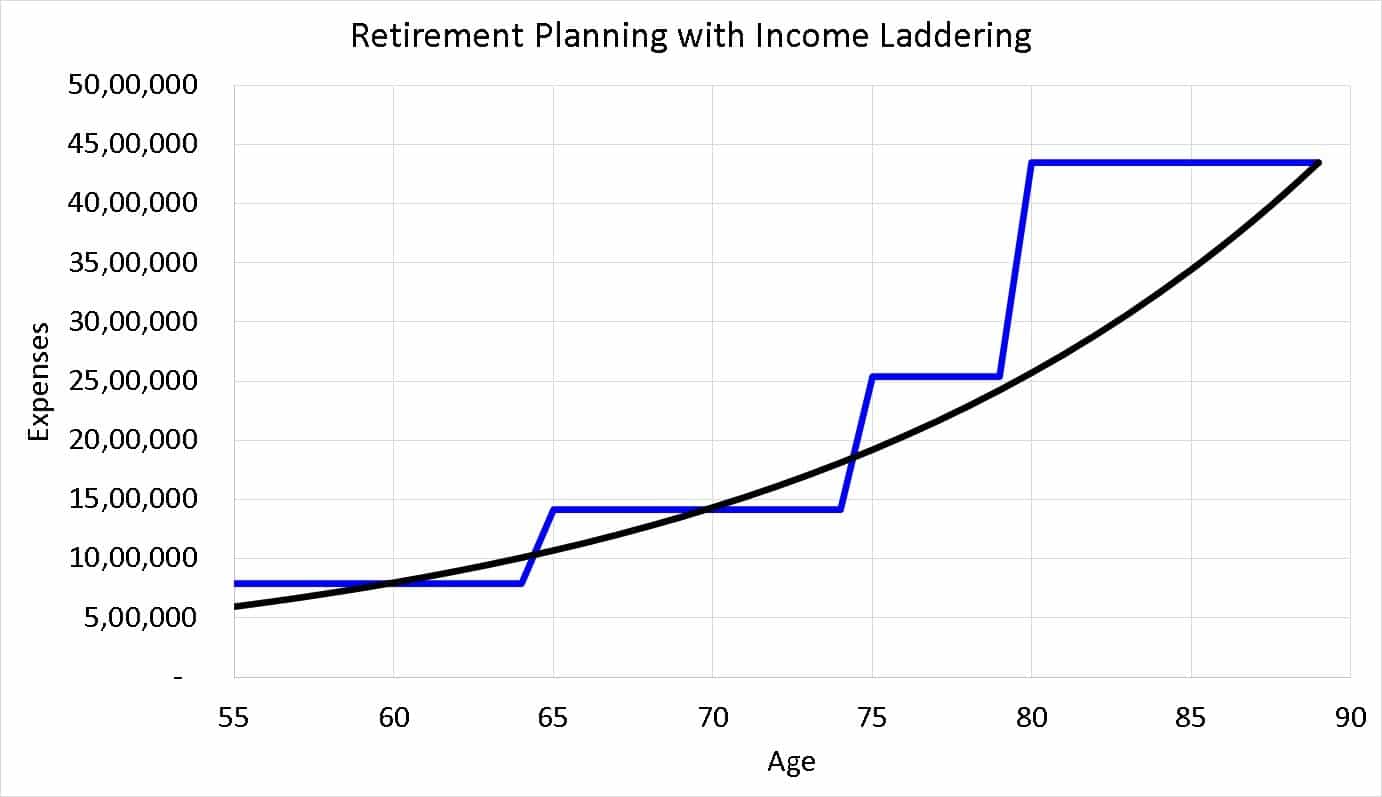
In the above picture, a total of four annuities are purchased
- At age 55 with an annual pension equal to the average of the first 10 years of annual expenses
- At age 65 with an annual pension equal to the average of the next 10 years of annual expenses (after accounting for the 1st annuity)
- At age 75 with an annual pension equal to the average of the next 10 years of annual expenses (after accounting for the 1st and 2nd annuities)
- At age 80, with an annual pension equal to the project annual expense at age 90 (after accounting for the 1st, 2nd and 3rd annuities)
The pension can be adjusted at will depending on the comfort level and corpus available to the retiree.
Retirement planning with income laddering has both advantages and disadvantages.
Pros
- Money management post-retirement (reliance on bucket strategy) is lower (but not eliminated).
- At an older age, most of the corpus can be in liquid, safe fixed income.
Cons
- The overall corpus required would be higher (ballpark estimates indicate a 25-40% higher corpus, which could be higher or lower depending on inputs)
- Tax inefficient as the pensions would be taxed as per slab.
- Estimating future annuity yields would be hard even at the start of retirement and quite impossible well before retirement.
- The annuities require maintenance with life certificates to be furnished once a year.
A screenshot of the spreadsheet calculation is shown below. The average of the entries in the red rectangle is the pension from the first annuity.
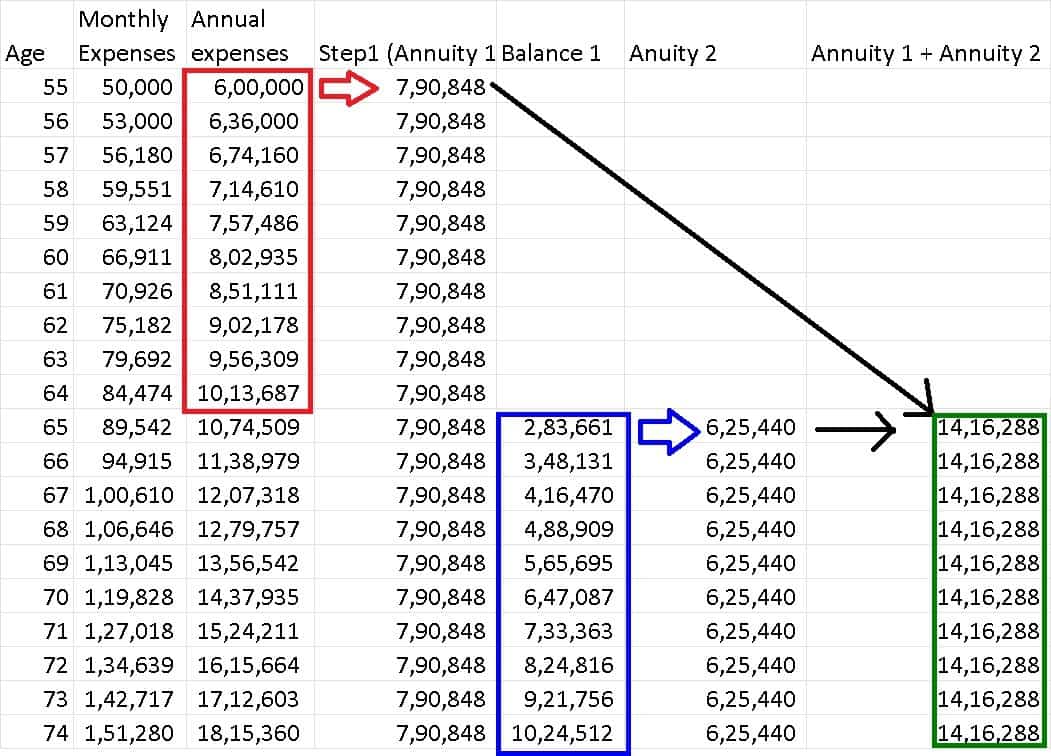
From ages 65 to 74. the excess annual expenses are found (entries in the blue rectangle) and their average becomes the second annuity. The sum of the first and second annuities is shown in the green rectangle.
So how do we compute the corpus? A detailed annuity laddering calculator will soon be part of our robo advisory tool as a standalone module. Here are some glimpses.
- The first annuity rate for a 55-year-old is 7.645%. Assuming an effective rate of about 12% for those in the 20% slab, the corpus needed after tax is about Rs. 1.39 crores (including GST).
- The second annuity will only be purchased 10 years from now. So we take today’s rate and depreciate it by about 2% a year. Also, we have 10 years of investment time. So the amount required (after tax) is about Rs. 70 lakhs
- Similarly, we need about Rs. 44 lakhs for the third annuity and Rs. 34 lakhs for the fourth.
- Then we consider the balance expenses each year not covered by annuities.
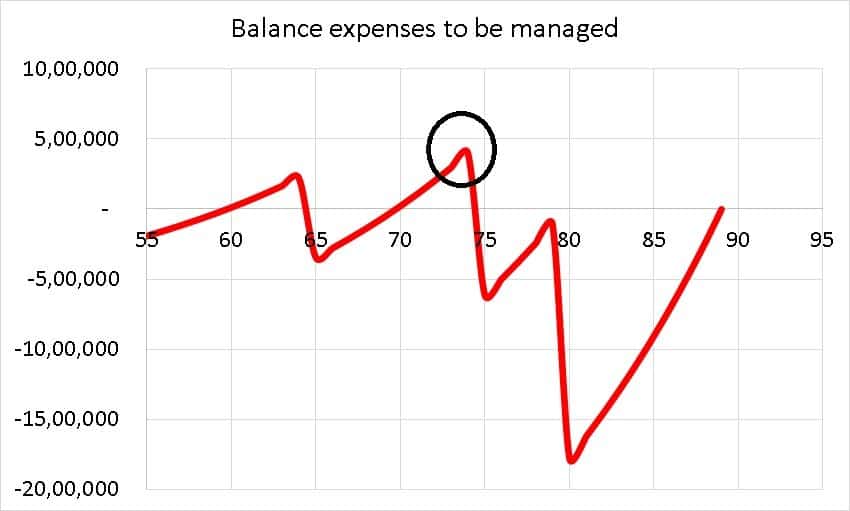
Chart of balance expenses to be managed If we invest Rs.10 lakhs (twice the amount marked above) at the start of retirement, it should be enough to cover these extra expenses.
- So that is a total of about Rs. 2.95 Crores or about 3 crores
- We shall have an emergency bucket = 5% of the above sum = Rs. 15 lakhs
- So that is a grand sum of Rs. 3.15 Crores.
- If we had used a bucket strategy without any annuity, the robo tool indicates that the corpus will be about 31% lower. That is the price of “assured income” with annuities!
Annuity laddering or income laddering is an option that one should consider only after achieving comfortable financial independence or at the time of retirement. Only then the inputs (esp. annuity rates and tax slabs) would be reasonably accurate. For those far away from retirement, a diversified bucket strategy would suffice.
It must be understood that retirement planning is a journey and as we reach higher rungs of experience and wealth, we consider additional possibilities. See for example I thought a pension was unnecessary but age taught me a retirement planning lesson!
Update: Our robo advisory tool now has a stand-alone annuity laddering calculator module.