The cost inflation index for the financial year 2026-2027 is 384, representing a 2.13% increase. We compile 46 years of cost inflation index data to understand the devastating consequences of inflation and why our singular focus should be on beating inflation for our long term goals.
The cost inflation index (CII) is not a measure of true price inflation in India – in fact, no such metric released by the govt is. The CII inflates the purchase price of taxed assets under long-term capital gains with indexation. See, for example: My property sale capital gains tax is 50% lower thanks to indexation benefits.
Therfore, the CII is an approximate measure of the decrease in the value of our networth with the express understanding that the actual decrease in value would be much higher. This is because many services like healthcare and education are unregulated and have much higher inflation. In addition, due to the availability of new products and services, new expenses are added.
The CII initially had a base year of 1981-1982 with a value of 100. The govt then changed the base year to 2001-02. Both datasets are available here: Cost Inflation Index Historical Data. This study will use the combined dataset (46 years: 1980-81 to 2026-2027).
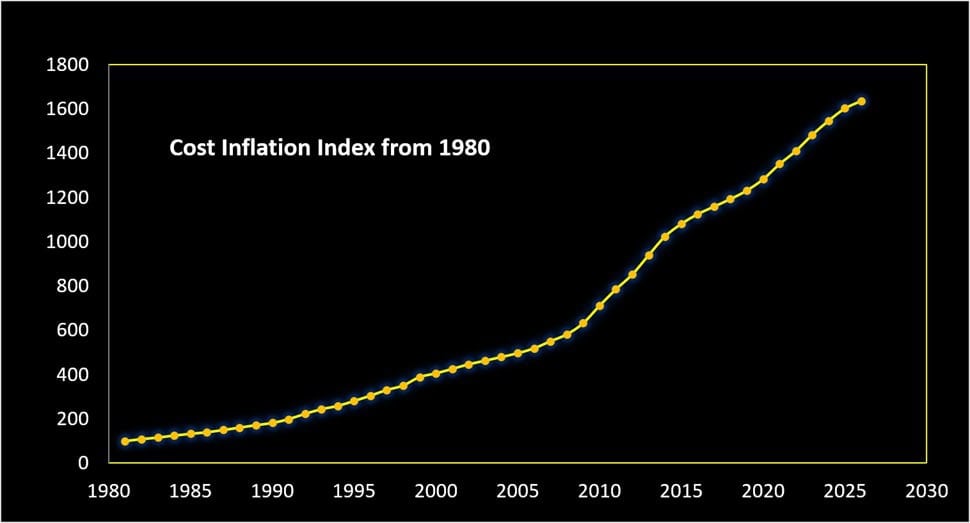
In the 45 years that have elapsed, the CII has increased from 100 to 1636 (this is on the combined scale and will not match the latest CII date). This can be stated in many ways. Some readers tend to prefer this version:
🔥Secure your future with our Robo-advisory tool trusted by over 3,500 investors and advisors. From effortless retirement planning to funding your children’s biggest dreams, turn your financial goals into reality. 🔥
Subscribe for money management solutions via email! (Link takes you to our email sign-up form) Join 32,000+ readers in our community.
👉 New Tool Alert! NaviPlan: A Privacy-Focused Multi-asset Tracker and Goal Planner 👈
Something that was priced Rs. 1000 in 1981 will now cost at least Rs. 16,364
This is, of course, the literal meaning of inflation = price increase. I prefer to focus on the effect of inflation on purchasing power. This is well conveyed by the Tamil word for inflation: பணவீக்கம் (or literally money becoming weaker).
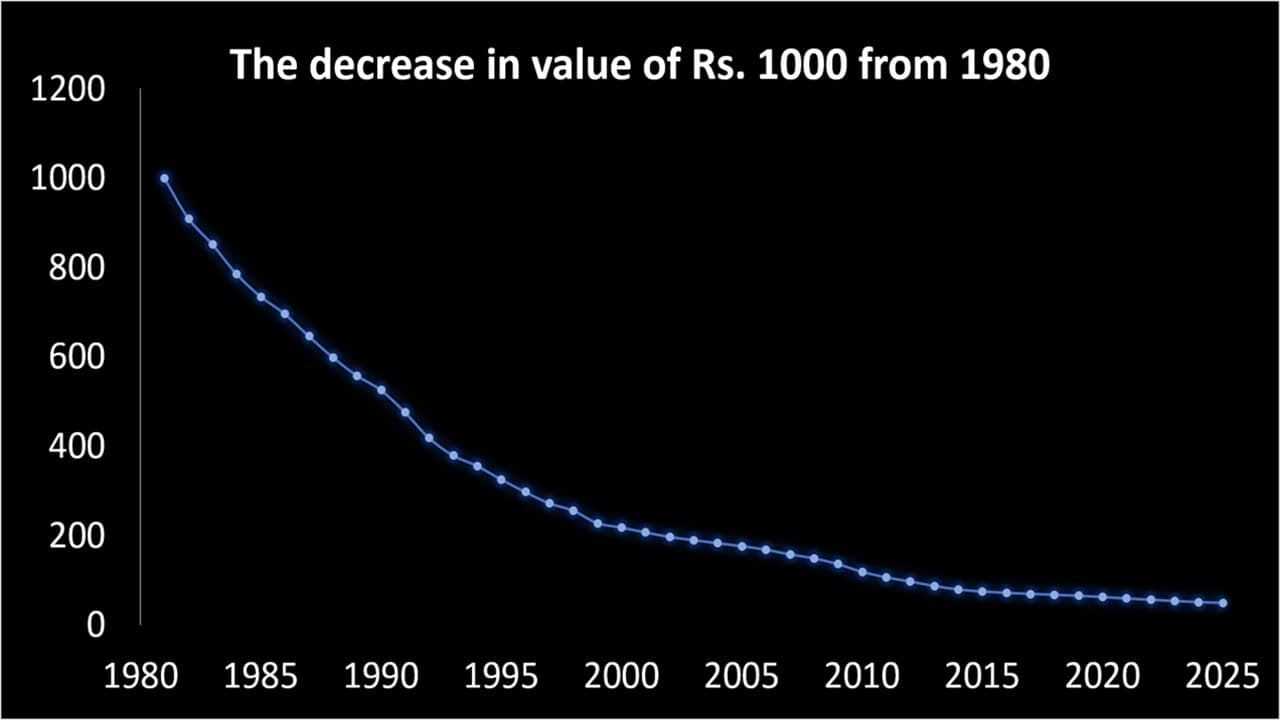
A purchasing power of Rs. 1000 in 1981 (which was significant) has been reduced to just Rs. 49.18 today
The two statements are completely identical, but I prefer the latter as it is a bit more dramatic, highlighting the risk of chasing safety in investments. One can add zeros to the statement to get “Rs. one lakh has reduced to just Rs. 4918.2 over 46 years”.
Some argue, “But our salaries have increased significantly during this time!”. Well, it had better increase! Else, we would be in trouble. But that is missing the point.
The point is that this decrease in spending power will continue after our salary goes to zero at retirement. So we need a plan to (1) invest right so that we can keep spending as we do after retirement and (2) create income sources (active and passive) to supplement our income (before and after retirement). See: How to build the ideal retirement portfolio.
This graph is a grim reminder of the task ahead of us.
It is important to remind ourselves that our actual inflation can be much higher, even for a frugal existence. Here is an example: Inflation in India: Some Real Numbers. This is the growth of the cost inflation index over the last 45 years.
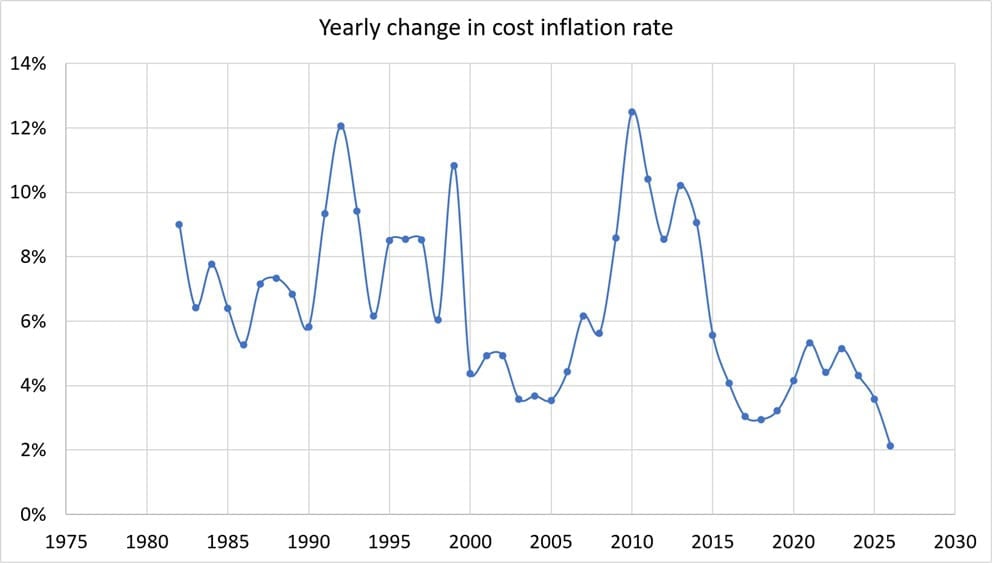
These are the annual rates of inflation. Although there is a downward trend in the rates, cost inflation can rapidly increase from time to time.
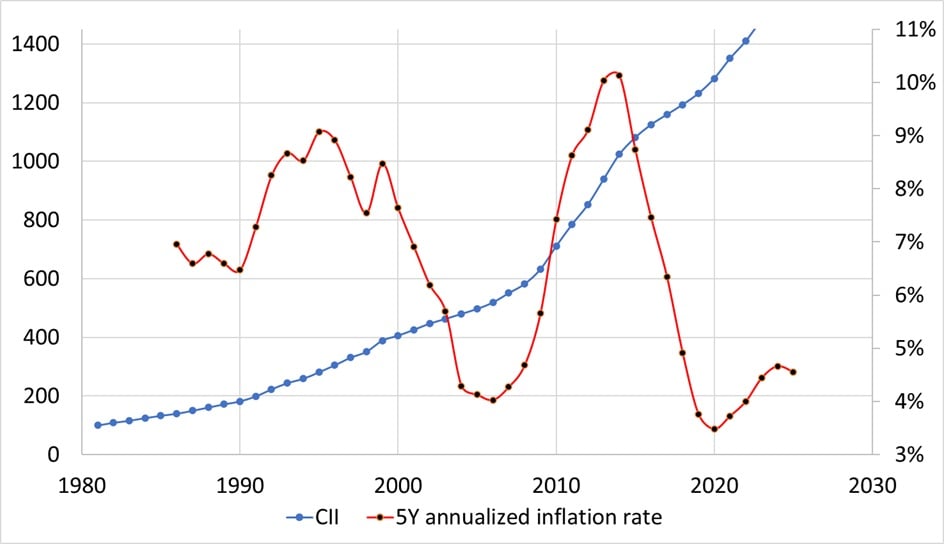
Since 2018, the 5Y cost inflation rate has been less than 5%. Have your essential expenses been only at that level over the last 3-4 years? Even in the unlikely event this is true, it will not last long, as this, too, is cyclical.
As discussed in this video, if we do not safeguard our investment by taking adequate risks to try and beat inflation when we are young, we may be unable to buy even a roadside chai.
How do we protect our money?
Yes, we must invest in equity when we are young to combat inflation. However, this alone is not enough! Long-term investing in equity will not always be successful. See, for example: What return can I expect from a Nifty 50 SIP over the next ten years?
- We need a plan to increase our income. See, for example, Passive income is a crucial part of your retirement plan: How to get started.
- In particular, we need to manage risk systematically and craft the right variable asset allocation plan to help us meet our future goals regardless of market conditions.
- We need to stick to the plan, increase investments as much as possible each year, and manage risk systematically in a goal-based manner each year.
A higher income, the right investments, and active risk management are the only ways to protect against inflation, degrading the future value of our networth.