We explain the difference between profit booking and rebalancing using mutual funds in simple language for newbies,
Profit-booking is a colloquial trade name for selling stocks or mutual funds. Let us understand profit booking with an example. Suppose you purchased 100 stocks for Rs. 10. The initial investment value is Rs. 1000. After many months, the stock price is now Rs. 24.56. So the investment value is Rs. 2456. Our minds see this Rs. 1000 + Rs. 1456. Suppose you wish to “book” this profit of Rs. 1456.
This is not a bank account where you can withdraw this amount. You will have to sell some shares. Now 1456/24.56 = 59.28. You cannot sell 59.28 shares. It must either be 59 stocks or 60 stocks. Fractional units can be sold in mutual funds, but the logic is the same.
If you sell 59 shares at 24.56, you get Rs. 1449. Is this a “profit” booking? This Rs. 1449 has two components: (59 x 10) + (59 x 14.56). Here, 59 x 10 = 590, the money invested or the principal. The stock price appreciation is Rs. 14.56, and the gain is (59 x 14.56). Thus, every sale or redemption of stocks or mutual funds will always have two components: the principal +/- capital gain or loss.
This idea of Rs. 1000 appreciating to Rs. 2456 and removing Rs. 1456 as “profit” is incorrect mental accounting (just like we hope 2021 will be better than 2020 because a microorganism can differentiate between Dec 31st and Jan 1st as we do).
🔥Secure your future with our Robo-advisory tool trusted by over 3,500 investors and advisors. From effortless retirement planning to funding your children’s biggest dreams, turn your financial goals into reality. 🔥
Subscribe for money management solutions via email! (Link takes you to our email sign-up form) Join 32,000+ readers in our community.
👉 New Tool Alert! NaviPlan: A Privacy-Focused Multi-asset Tracker and Goal Planner 👈
We had discussed that good returns from years and years of stock market investing are determined by just two or three big up moves: 44-year Sensex return is 17%, but half of that came from just four years! The 270% annual gain because of the Harshad Mehta scam still haunts the Sensex. Remove this, and returns are poor.
Sensex or Nifty has seen some 80% annual returns during the 2000s, including the recovery from the 2008 financial crisis. It is a no-brainer that we need to be invested in the market during these big return years. Otherwise, our overall return is going to be poor.
Let us now consider another example of such “profit booking”, but let us do so with an asset allocation in mind. We want to invest 50% of our money in equity and 50% in fixed income. After each year, we find out how much this allocation has changed and “correct” it by booking profit from equity and buying more fixed income or by booking profit from fixed income and buying more equity as per the situation.
Let us consider the growth of a portfolio over five years. We shall assume a 7% return per year from fixed income to keep things simple. We shall ignore taxes and exit loads to keep things simple. For equity, we shall assume the following sequence of return:
- After year 1: 37.07%
- After year 2: -29.42%
- After year 3: -1.85%
- After year 4: -11.98%
- After year 5: 86.33%
These are real returns from the Sensex. A person who started investing in April 1999 would have gone through this journey. These are randomly chosen, and the results obtained are also, therefore, random. In real-time, no one can tell which strategy will work better. Please do not read too much into the numbers. The idea is to show how “profit booking” works.
The figure below shows how Rs. 1000 invested each year(!) changes for given equity and debt (fixed income) annual returns. We start with 50% equity and 50% fixed income but notice how the debt asset allocation swings from 44% to 60% because of return fluctuations in equity.
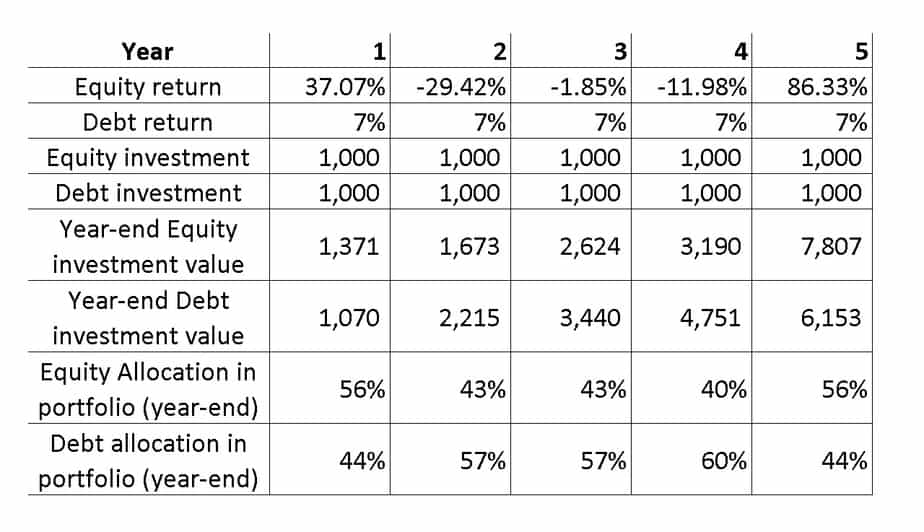
We would like to ensure the year-start asset allocation is always 50% equity and 50% debt. At the start of year one, the invested value was Rs. 1000 in equity and Rs. 1000 in debt. At the end of year one, equity became Rs. 1,371 and debt Rs. 1070.
Suppose we “book profit” (with the above-explained meaning) of Rs. 151 from equity and invest it in debt at the start of year two (= end of year one). The equity allocation is Rs. 1220, the debt allocation is also Rs. 1220. So, we have now reset the allocation from 56% equity to 50% equity by some “profit booking”.
Now, many people do not like this term. It sounds crass, not to mention it is mental accounting and wrong. So, we shall henceforth refer to this “reset” as portfolio rebalancing. The table below shows the evolution of the portfolio after four years of annual rebalancing (end of years 2,3,4 and 5).
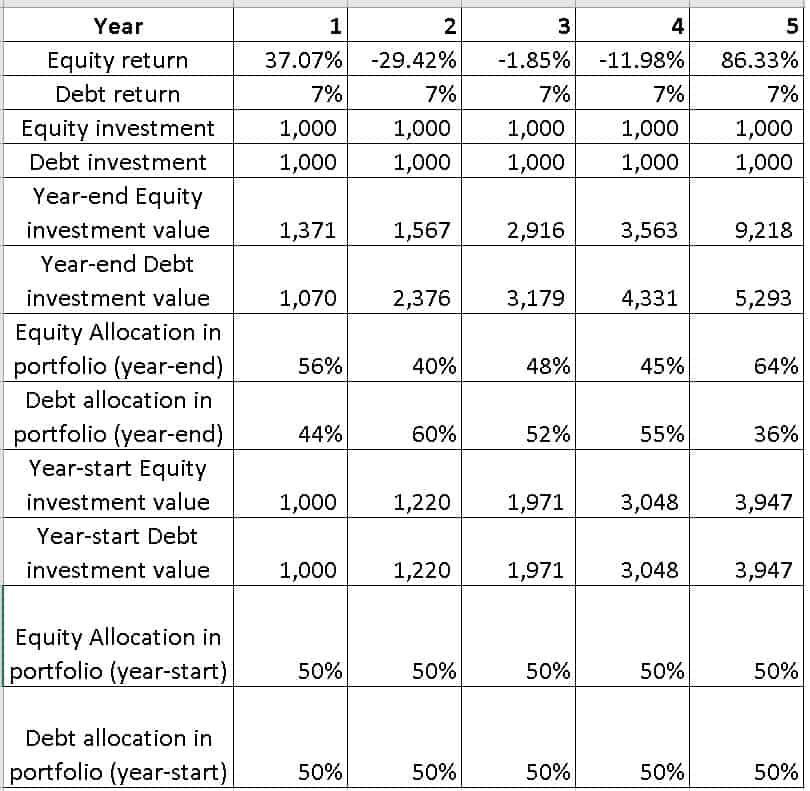
For this particular example set, the portfolio values after five years with no rebalancing are Rs. 7807 (equity) and Rs. 6153 (debt). With annual rebalancing, this becomes Rs. 9218 (equity) and Rs. 5293 (debt). The reason you ended up with more money in equity (and overall) is simple. We had about 24% more money in equity before that 86% return in year 5.
I do not want to use this singular example to praise regular rebalancing. Regular rebalancing sometimes results in a higher corpus, and sometimes not. We would know only in real-time. At the very least, rebalancing helps you sleep better. You booked some “profit” after a 37% return from equity and invested more when you saw a minus 29% return.
An alternative (certainly not superior) is one-way rebalancing. You book “profits” only when equity or debt returns are positive or super positive.
For example, in the picture below, we rebalance only if equity returns are positive at the start of year two, for example, as shown in red. We do not consider a rebalance at the end of year 5 because there is no sixth year in our example.
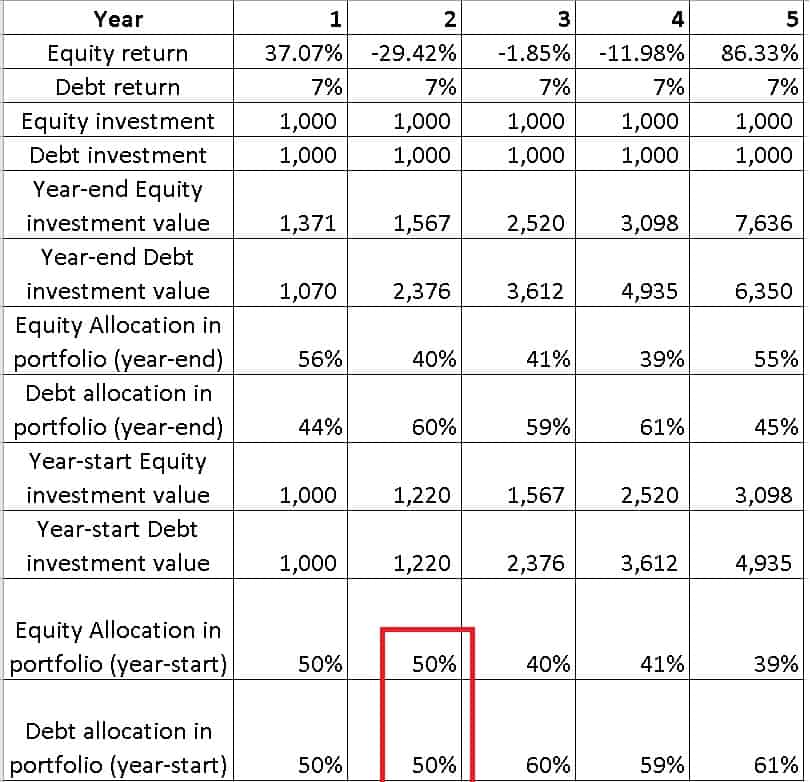
This results in 20% more corpus in debt. We do not know beforehand “which strategy is better?” Looking for an answer to this is a waste of time. However, we can combine two-way and one-way rebalancing for a particular goal.
Initially, we rebalance both ways. That is, book profit from equity and shift to debt or vice versa as per the year-end asset allocation. After a few years, you can focus on gradually building debt corpus by one-way rebalancing. If you have additional funds from elsewhere, you can invest more on equity dips as well, but it is better not to factor in future cash flows now.
If you are worried about taxes and exit loads, you can rebalance if your equity allocation is 5% above or below the desired level. This will not happen each year.
Related question: Can I book excess returns from equity funds as profit from time to time?
Finally, remember that the above illustrations do not attempt to reduce equity allocation to lower risk. This is an extremely important step to ensure we achieve our goal corpus no matter the market conditions – bull market, bear market or range-bound market. This has to be factored in from day one. Otherwise, the invested amount will be lower. The freefincal robo advisor tool automates this process. Different strategies to vary equity allocation before and after retirement and what works are covered in the lectures on goal-based portfolio management.