Last Updated on September 6, 2019 at 11:49 pm
This is a guest post by Krishna Kishore who writes a refreshing blog on stock investing at tyroinvestor.com. He readily agreed to write this post, explaining the features of a stock screener, upon my request.
~~~~~~~~~~~~
There are many stock screeners available online like the ones from Google Finance, Reuters, Equity master and paid services from Bloomberg as well. Out of them all, www.screener.in is one of the best and the one that I personally use and recommend because of its salient features.
But why to use it in the first place?
🔥Secure your future with our Robo-advisory tool trusted by over 3,500 investors and advisors. From effortless retirement planning to funding your children’s biggest dreams, turn your financial goals into reality. 🔥
Subscribe for money management solutions via email! (Link takes you to our email sign-up form) Join 32,000+ readers in our community.
👉 New Tool Alert! NaviPlan: A Privacy-Focused Multi-asset Tracker and Goal Planner 👈
Okay, to understand that let me give you an example.
You got a “tip” from a very good investor. He is very bullish about the stock. Now you wanted to know about the company. What will you do?
Following are the steps!!
1) Open Moneycontrol.com and type the company’s name.
2) Check the company’s current market price.
3) Click on 3 months, 6 months, 1 year, 2 years to know how the company is doing from past few quarters.
4) Quickly check EPS, PE, Dividend yield, Price to Book etc.
5) Get an idea of the company’s performance (without even knowing what are the products & services that the company offers).
But Krishna, What is wrong in doing so?
Nothing wrong in it but you will be “Biased”. Being in so called “Bull Market”, this can be dangerous to our portfolio. Every stock will make new heights these days. Hence, your mind takes the shortcut to process this least available information to say whether this company is doing great, good, bad or ugly. You start your analysis with a biased mode. We are not sure why that stock went up/down. Is it because of any sectorial momentum, Tailwind or Headwind? No idea, but we will start thinking that the stock price has went up, so something good happened/going to happen to the company (Shortcut processing of information).
Recently I watched a movie called “Drishyam”. The tagline of the movies goes something like this “Visuals can be deceiving”.
This particular tagline with a small change can be aptly suited for markets. “Stock Prices can be deceiving”!!!
But, also at the same time, we do not have enough time on earth to go through Annual reports of each and every company to understand the financial health of it. (Remember in olden days, Ben Graham, Peter Lynch, Buffett and many other legends actually did so)
This is where Stock Screeners comes into picture to serve the purpose.
Stock Screeners gives the fundamental view of the company (not in-depth information) which will be very useful and enough to get an initial idea of its health condition.
As already said I prefer using www.screener.in and now let’s try to understand the functionalities of it.
This is my stock screener page and I am taking example of one of India’s most consistent compounder, “Pidilite Industries”!!!
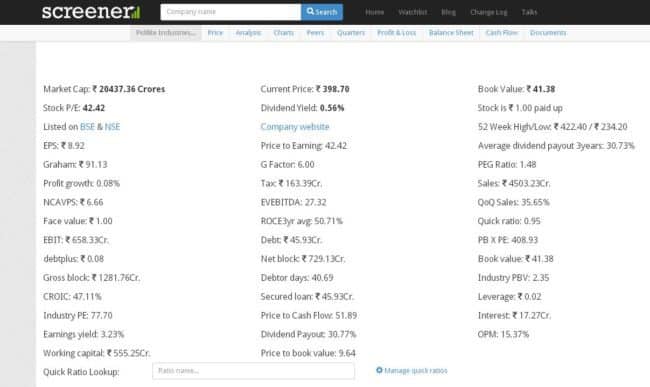
(Please do register to access all the functionalities and type which ratios you want to have in your page under “Manage Quick Ratios” section)
1) From this screen shot, I can get the following info. (In order to understand a stock more than just looking at the price, you need to know about the terms stated in the above screen shot)
a) Market Capitalization: Market capitalization is calculated by multiplying a company’s shares outstanding by the current market price of one share. This is used to tell us the size of the company, what are the future prospects of the company to grow further at a good rate.
I highly recommend you to please go through the videos of 2 min each for better understanding for these terms. Fun Learning!!!
http://www.investopedia.com/video/play/market-cap/?rp=i
b) Book Value per Share: This gives the per share value of a company by calculating total assets minus intangible assets and liabilities.
http://www.investopedia.com/video/play/book-value/
c) Price to Book Value: This is an important ratio to consider if the company is trading at expensive levels or not. This is mainly used for NBFC’s to compare the stock prices among its peers.
http://www.investopedia.com/video/play/price-to-book-ratio/
d) Price to Earnings ratio: This is one of the most important ratios to consider. Leaving the technical terms aside, this gives the “Confidence of the Investors on the Company”. High PE says, Investors are expecting the company to generate above average earnings for the longer period of times. Sometimes this confidence turns in “Over confidence” & if it happens welcome to the Bull Market.
Just to give you an example, during the time of Reliance Power IPO, the oversubscription of this went viral and people are ready to pay 5000 (Five thousand) PE for this company. This kind of ratios is highly unsustainable. If you ask me what PE is cheap and what PE is costly. These are mostly considered by Relative valuations and preferably from same sectors. (Read more about Reliance IPO here)
e) Dividend Yield: This is calculated by ratio between Annual Dividend per share to the current market price.
http://www.investopedia.com/video/play/understanding-dividend-yields/
f) Earnings per Share: The portion of a company’s profit allocated to each outstanding share of common stock. Very important metrics to look for.
http://www.investopedia.com/video/play/earnings-per-share/
Profitability Indicator Ratios: ROE & ROCE
g) Return On Equity: Another major ratio to look for. It tells how much profit a company generates with the money shareholders have invested. If explained properly, ROE alone can be a separate post.
http://www.investopedia.com/video/play/return-on-equity/
h) Return on Capital Employed: A financial ratio that measures a company’s profitability and the efficiency with which its capital is employed
ROCE = Earnings before Interest and Tax (EBIT) / Capital Employed
i) Piotroski score: This is an interesting number to know the fundamentals of a company. I have already written an article for the same: What is the Piotroski Score of Your Stock ?
j) Price to Free Cash Flow: A valuation metric that compares a company’s market price to its level of annual free cash flow. This is similar to the valuation measure of price-to-cash flow but uses the stricter measure of free cash flow, which reduces operating cash flow by capital expenditures.
http://www.investopedia.com/video/play/understanding-free-cash-flow/
There are much more ratios that this Screener provides, but as I told you, for the initial analysis of a company, these is good enough to start.
2) Later, it provides an amazing screen which states the Pros and Cons of the company.
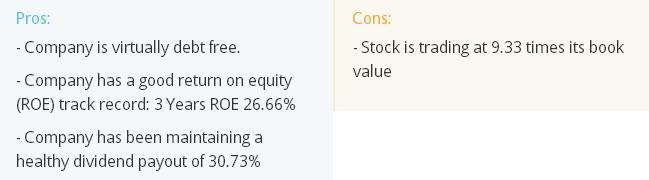
3) In this screen, it provides the information of Individual stock performance vis-a-vis Index along with the shareholding pattern.
Only one small issue is, here we will not know if any of the promoter holdings have been pledged or not. This is critical information in terms of analyzing a company. Promoter pledging is not a good sign while analyzing the current condition of the company.

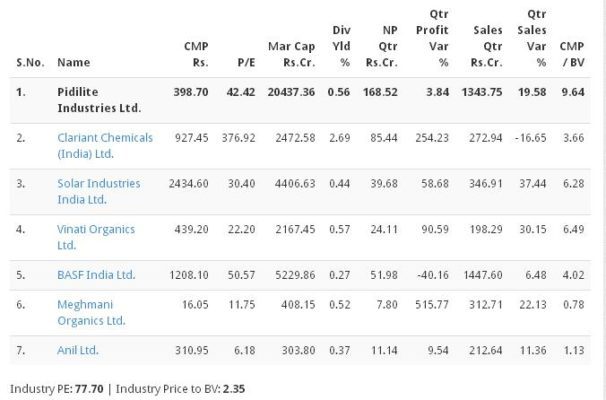
Peer Comparison:
4) Relative Valuation is very important for any company. This screen allows us to understand the financials of the company with respect to its peers.
Financials (Income statement: Standalone & Consolidate):
5) As already discussed above, this particular section gives us the first glance of the company’s financials on Quarterly & Annual basis for both Standalone and Consolidated.
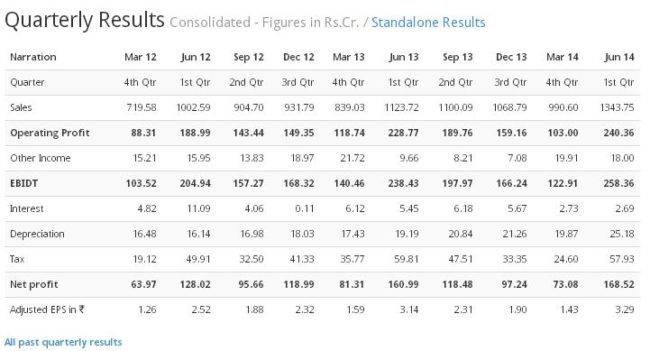
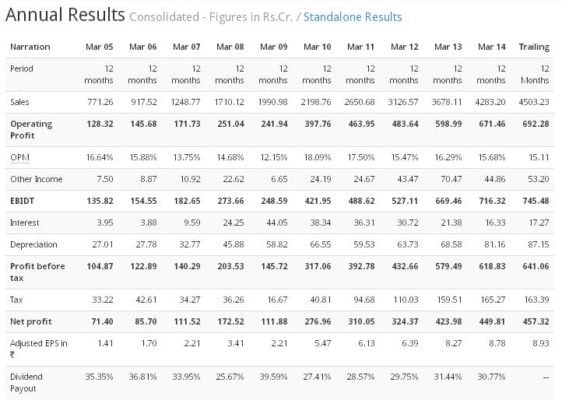
As you can see below that some of the terms below are in “BOLD” which states the importance of it. Let’s have a quick understanding of them:
Operating Profit: The profit earned from a firm’s normal core business operations. This value does not include any profit earned from the firm’s investments (such as earnings from firms in which the company has partial interest) and the effects of interest and taxes.
http://www.investopedia.com/video/play/operating-profit/
EBIDTA: EBITDA is essentially net income with interest, taxes, depreciation, and amortization added back to it, and can be used to analyze and compare profitability between companies and industries because it eliminates the effects of financing and accounting decisions.
http://www.investopedia.com/video/play/earnings-before-interest-taxes-depreciation-and-amortization-ebitda/
Profit Before Tax: As the name suggests, it is a profitability measure that looks at a company’s profits before the company has to pay corporate income tax.
Net Income: This is Very Very critical number to look for in the company’s Income statement. Net income is calculated by taking revenues and adjusting for the cost of doing business, depreciation, interest, taxes and other expenses. The measure is also used to calculate earnings per share.
http://www.investopedia.com/video/play/net-income/
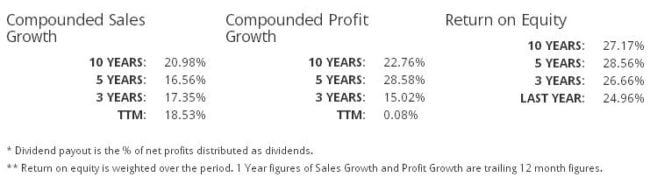
6) The other screen gives the compounded growth of Sales, Profits and ROE over 3,5,10 and TTM periods of time.
7) Financials (Balance sheet: Standalone & Consolidate):
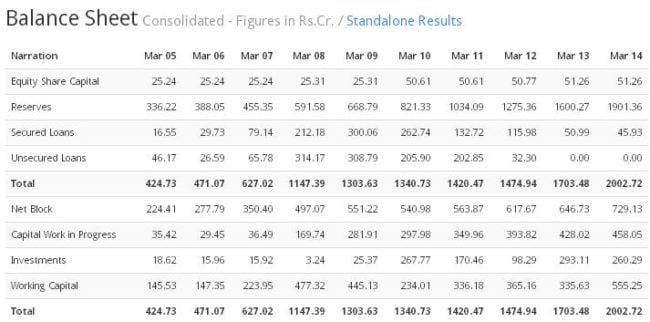
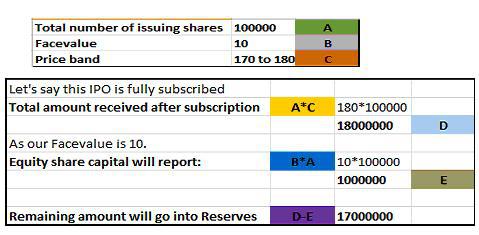
Let me take a moment and try to explain what is first 2 rows (Equity Share capital & Reserves) of any balance sheet tell us.
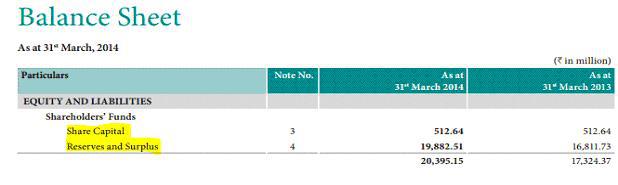
Example: Let’s say company ABC came up with an IPO and wanted to raise 10 crore rupees. It shares are prices at a band of 170-180 rupees with a Face value of 10 each. Total number of issuing shares is 1 Lac.
Working Capital: A measure of both a company’s efficiency and its short-term financial health.
Formula: Working capital = Current Assets – Current Liabilities
8) Cash Flow statement: Even though Cash flow statements are the critical ones to check where and how the money is flowing in & out. This gives info of Cash Flow from Operations (CFO), Cash Flow from Investments (CFI) & Cash flow from Financing (CFF)
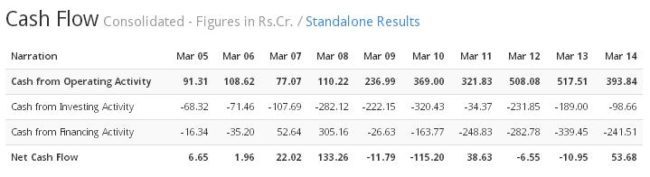
Cash Flow from Operations: The amount of cash generated by a company’s normal business operations. Operating cash flow is important because it indicates whether a company is able to generate sufficient positive cash flow to maintain and grow its operations, or whether it may require external financing.
http://www.investopedia.com/video/play/operating-cash-flow-ocf/
9) Recent Announcements, Annual reports & Credit Ratings:
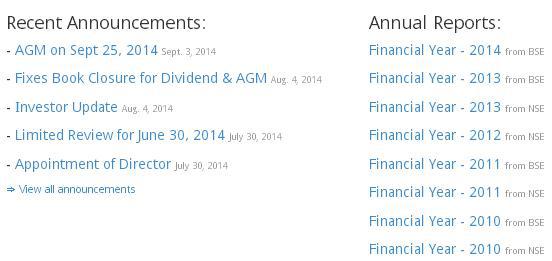
This section gives the information on recent activities like AGM, Corporate actions like Dividends, Splits. It also provides us with the latest information of Annual reports and credit ratings for the Debentures or Bonds issued by the company.
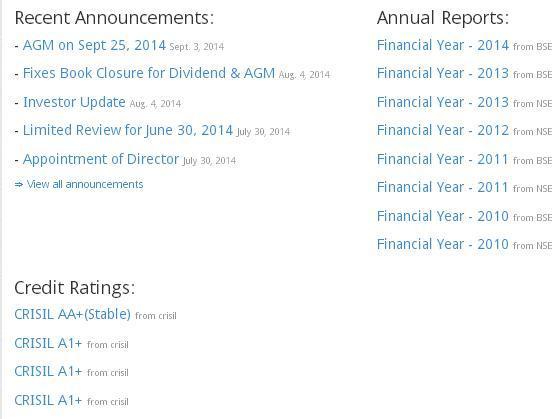
Also, another great feature of this is, this allows us to export all the above information into an Excel sheet. It takes all the data from www.bseindia.com.

You can also customize many things and create your own stock wish list.
Go & Explore the amazing stuff available at www.screener.in
Also, if you care to, you can try out the Freefincal Excel Stock Screener
Happy Learning & Investing 🙂
~~~~~~~~~~~~
Do join me in thanking Krishna for a comprehensive review of a stock screener.
We are on Google News
Use this button to add freefincal.com as a preferred personal finance source on Google News.

Explore 1,400+ videos on YouTube!

Subscribe to get posts via email!
Join 32,000+ readers and get free money management solutions delivered to your inbox! (Link takes you to our email sign-up form)Join our WhatsApp Channel

Explore our products
🔥Join our community of 9000+ users! 🔥- Use our Robo-advisory Tool to create a complete financial plan! More than 3,500 investors and advisors use this! Use the discount code robo25 for 20% off. Plan your retirement (early, normal, before, and after), plus non-recurring financial goals (such as child education) and recurring financial goals (such as holidays and appliance purchases). The tool helps anyone aged 18 to 80 plan for retirement, plus six non-recurring and four recurring financial goals, with a detailed cash flow summary.
- Our Flagship Course! Learn to manage your portfolio like a pro to achieve your goals regardless of market conditions! More than 3,500 investors and advisors are part of our exclusive community! Get clarity on how to plan for your goals and achieve the necessary corpus no matter the market conditions! Watch the first lecture for free! One-time payment! No recurring fees! Lifelong access to videos! Reduce fear, uncertainty and doubt while investing! Learn how to plan for your goals before and after retirement with confidence.
- Join the freefincal investor circle! An exclusive space for investors, advisors, fintech employees and students to access financial planning and insurance tools, mutual fund and stock analysis tools, coding strategies and Excel macros for data extraction. 750+ members are now part of our investor circle.
- Increase your income by getting people to pay for your skills! More than 900 salaried employees, entrepreneurs and financial advisors are part of our exclusive community! Learn how to get people to pay for your skills! Whether you are a professional or small business owner seeking more clients through online visibility, or a salaried individual looking for side or passive income, we will show you how to do it by showcasing your skills and building a community that trusts and pays you. (Watch the 1st lecture for free). One-time payment! No recurring fees! Lifelong access to videos!
- Portfolio Tracker! Track your mutual funds and stock investments with our Google Sheet!
- We also publish monthly screeners for
Our Podcast: Let's Get Rich With Pattu
On Spotify: Let's Get RICH With PATTU! Every single Indian CAN grow their wealth! On Audible: Listen to the Let's Get Rich with Pattu Podcast

Listen to the Let's Get Rich With Pattu podcast on YouTube.
Now watch Let's Get Rich With Pattu தமிழில் (in Tamil)!About The Author

Dr M Pattabiraman giving a lecture
- Dr M. Pattabiraman (PhD) is the founder, managing editor and primary author of freefincal. He is an associate professor at the Indian Institute of Technology, Madras.
- He has over 14 years of experience publishing news analysis, research and financial product development. He has over 28 years of teaching and research experience. He is also a public speaker and keynote presenter.
- He is a patron and co-founder of “Fee-only India,” an organisation promoting unbiased, commission-free, AUM-independent investment advice.
- Connect with him via @pattufreefincal on X LinkedIn YouTube
- Pattabiraman has co-authored three print books.

This book helps you ask the right questions and find the right answers. It also includes nine online calculators to create custom solutions.
(2) Gamechanger: Forget Startups, Join Corporate & Still Live the Rich Life You Want. 

Both the boy and girl versions of "Chinchu Gets a Superpower".
Most investor problems stem from a lack of poor decision-making. We made bad decisions and money mistakes when we started earning, and we spent years undoing them. Why should our children go through the same pain? What is this book about? As parents, what if we had to groom one ability in our children that matters not only for money management and investing but for every aspect of life? My answer: Sound decision-making. So, in this book, we meet Chinchu, who is about to turn 10. The story follows what he wants for his birthday and how his parents plan it, while also teaching him key ideas about decision-making and money management. What readers say! 
Feedback from a young reader after reading Chinchu Gets a Superpower!
Must-read book even for adults! This is something that every parent should teach their kids right from a young age. The importance of money management and decision-making based on their wants and needs. Very nicely written in simple terms. - Arun.
About freefincal & its content policy
Freefincal is a News Media organisation dedicated to providing original analysis, reports, reviews and insights on mutual funds, stocks, investing, retirement and personal finance developments. We do so without conflict of interest and bias. Follow us on Google News. Freefincal serves more than three million readers a year (5 million page views) with articles based only on factual information and detailed analysis by its authors. All statements made will be verified with credible and knowledgeable sources before publication. Freefincal does not publish paid articles, promotions, PR, satire or opinions without data. All opinions will be inferences backed by verifiable, reproducible evidence/data. Contact Information: To get in touch, please use our contact form. (Sponsored posts or paid collaborations will not be entertained.)Our publications
- Your Ultimate Guide to Travel. This is an in-depth exploration of vacation planning, including how to find affordable flights, budget accommodations, and practical travel tips. It also examines the benefits of travelling slowly, both financially and psychologically, with links to relevant web pages and guidance at every step. Get the PDF for Rs 300 (instant download)

- How to profit from content writing: Our ebook is for those interested in getting a side income via content writing. It is available at a 50% discount for Rs. 500 only!