We have added a Coast Fire calculation option to the freefincal robo advisor. Coast Fire is best explained with an example. Suppose you are 25 years old and wish to retire by age 55. You estimate the retirement corpus required to maintain your current lifestyle to be Rs. 5 Crores.
Suppose you wish to invest each month for the next 30 years with investments increasing at the rate of 5-10% each year. The retirement calculation tells you that the initial amount is Rs. 50,000 (this is only for example and not the output of an actual calculation).
You can manage to do this, but you have an issue with your job or even your industry. You work long hours and too hard. You recognise that if you keep this up, your health will erode as your wealth grows.
So you ask yourself, “What if I aggressively invest for the next 10 years and then stop investing for retirement (which is another 20 years away)?” For the last 20 years, the accumulated corpus will grow to your expected target corpus with no further investments.
If all goes to plan, you aggressively invest for the next 10 years and then switch to a more relaxed employment choice, which will allow you to spend more time with your family and take care of your health. This is the basic idea of coast fire. The 10-year mark in this example is the coast point.
🔥Secure your future with our Robo-advisory tool trusted by over 3,500 investors and advisors. From effortless retirement planning to funding your children’s biggest dreams, turn your financial goals into reality. 🔥
Subscribe for money management solutions via email! (Link takes you to our email sign-up form) Join 32,000+ readers in our community.
👉 New Tool Alert! NaviPlan: A Privacy-Focused Multi-asset Tracker and Goal Planner 👈
It is a form of financial independence. It is not a form of early retirement! The person still has to work for 20 years to cover expenses from age 35 to 55.
Now, I do not think of this as a smart idea or a practical one. The investment required for a coast fire, as opposed to a normal retirement, will be huge. Most people cannot pull this off.
Many things can go wrong with this plan. A retirement target corpus is not set in stone. As our lifestyle changes and as the economy develops, it is a moving target. Some people can make the mistake of living frugally to invest more to get to the coasting point. After they switch to a less strenuous job, their expenses can increase more than expected. You may find yourself in a situation where you are no longer coasting and need to invest more for retirement, but you can’t!
We do not recommend planning for a coast fire! However, many younger people are interested in it, and therefore it is provided as an option at least to illustrate how impractical it is!
Coasting is best achieved organically. For example, I reached the coast point by 2017-18. Since then, I have been investing at the same rate as before, if not more. The present version of the freefincal robo advisor will tell you if you have achieved the coasting point.
The updated version will tell you the amount necessary to invest to reach the coasting point in X years (an input). The settings will be visible (rows 143 to 147 in Step 3 Retirement Planning) only if the years left to retire are more than 10. The default setting for coast fire is no, and we recommend that it be left like that!
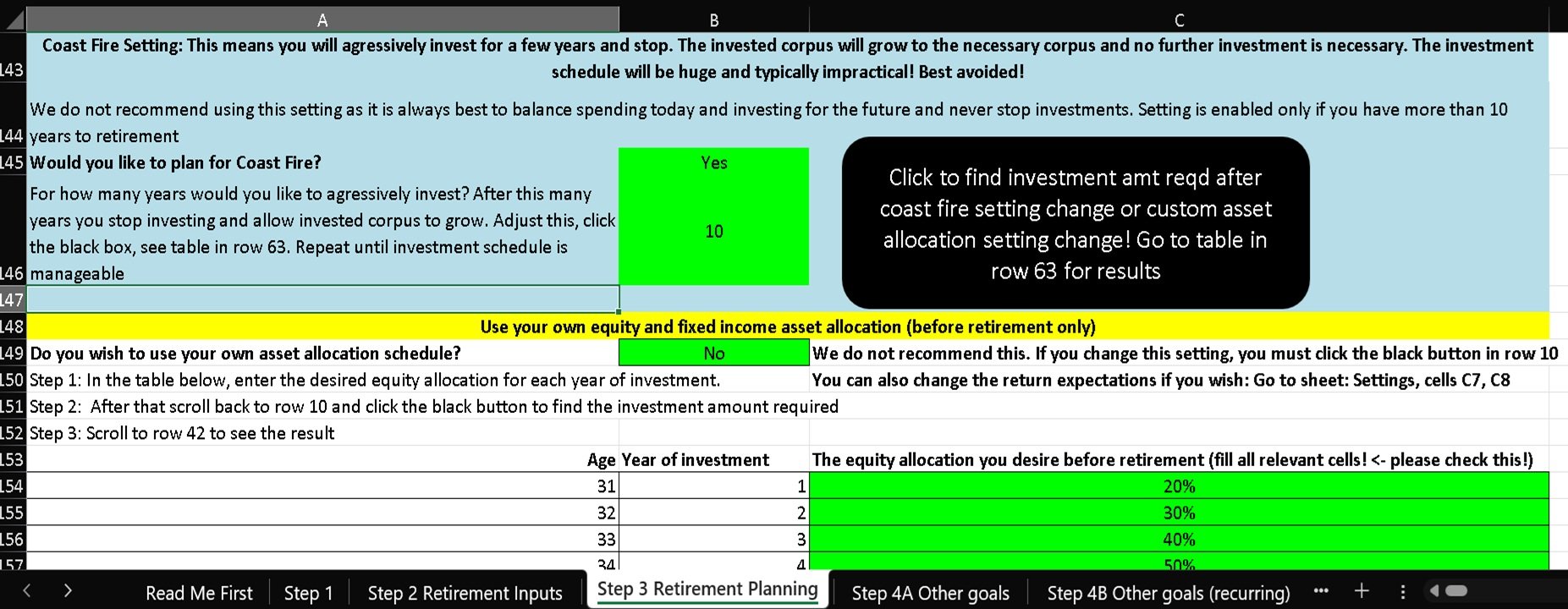
This is a zoomed-up view.
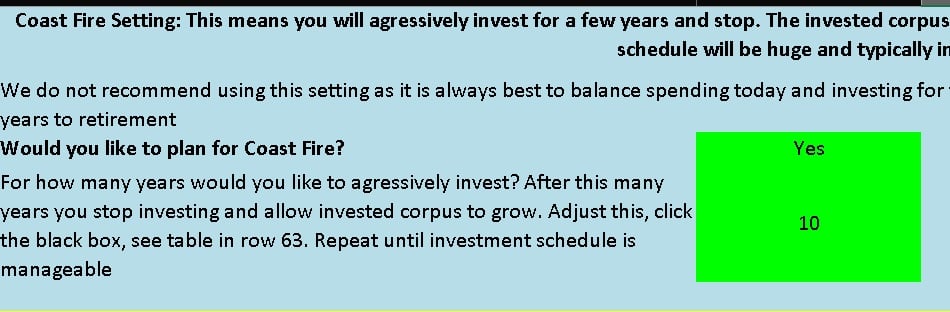
You will have to evaluate the macro button (to the right of the above setting) or script (in Google Sheets) to determine the new investment amount. Clear instructions are available on the sheet.
As a tool maker, I found the coast fire option intriguing and easily included it in the robo tool’s setup. As a user, though, I recommend that you do not use it. Therefore, if you are an existing user of the robo tool, this update will not be sent to you unless you request it (and please do not request it unless you actually need it).
A similar notion is also possible for other goals, like children’s education. This is available on request to existing users.
Key features of the robo-advisor tool
- An automated asset allocation schedule helps users effectively manage the sequence of returns risk, based on our extensive research, which is available in our goal-based portfolio management course.
- A unique bucket strategy for retirement planning that minimises the risk of outliving the corpus. Users can opt to use a decreasing equity exposure bucket strategy (glide-path) to reduce sequence of returns risk and churn (buckets can be sequentially converted to income)
- There is also a custom DIY bucket strategy module.
- Ability to handle an integrated/unified portfolio (one portfolio for all goals)
- Ability to handle three income streams after retirement
- Ability to handle financial goals after retirement (eg, kids’ education after you retire early)
- Ability to incorporate an income floor or laddered annuities to reduce further the risk of outliving the corpus and address the lack of health risk after retirement.
- All inputs are fully customisable.
- It can be used for commercial/professional use as well. Many advisors use this to create financial plans for their clients.
- Users will get all future updates.
More than 3000 investors and financial advisors are using the tool at the time of writing. The tool was featured in the Economic Times: Meet Pattabiraman, the man who helps many plan a better retirement through his calculators.
Video Guide
Click to play
Presentation: The tool is available in two formats
- As an Excel file with macros. It will work on Mac Excel and Windows Excel.
- Or on Google Sheets with scripts.
All inputs are fully customisable. It can be used for commercial purposes as well. Users will get all future updates as well. Get the sheet via this link: Robo Advisory Software Tool: Build a complete financial plan!
Retirement planning Illustrations made with the robo tool:
- Retirement plan review: Am I on track to retire by 50?
- I am 30 and wish to retire by 50. How should I plan my investments?
- Can I retire by age 55? Retirement Planning Case Study
- Case Study: Achieving Financial Freedom for Early Retirement
- How should I plan if I want to retire in 20 years?
- Is it possible to combine a bucket strategy with income laddering after retirement?