A reader asks, “I am 28 years old and wish to retire by 45. My monthly expenses are about Rs. 40,000. My current net worth is essentially zero as I just started to work. How much should I invest to retire by 45? I do not intend to get married. I can manage to invest about two-three times the monthly expenses.”
A robust health insurance policy is essential. If the reader does not have one, he should buy one immediately. See: Select the right health insurance policy with these free resources. This may increase the current monthly expenses assumed below, but we shall work with Rs. 40,000 as an illustration.
To find out the retirement corpus required and the asset allocation plan, we use the freefincal robo advisory tool with the following assumptions:
- Life expectancy: 90 years
- Increase in monthly investment each year: 10%
- Inflation before retirement: 7% and after retirement 6%
- Post-tax return expected from equity investments: 10% Don’t expect more! Equity returns are on the way down! See: Ten year Nifty SIP returns have reduced by almost 50%
- Post-tax return expected from current taxable fixed income: 5% Again, returns will go down in the future!
- Rate of return expected from current tax-free fixed income: 6% Same here – do not expect too much!
The retirement corpus increases to Rs. 5.11 Crores. The monthly investment required is Rs. 59,000 increasing each year at the rate of 10%. This includes the mandatory EPF or NPS contributions.
If we wish to guarantee some income with a pension ( = expenses in the first year of retirement), then the corpus increases to Rs. 6.56 crores and the investment Rs. 76,000 increasing each year at the rate of 10%. This includes the mandatory EPF or NPS contributions. See: How to beat inflation after retirement along with guaranteed pension. Another option is an Annuity ladder calculator to plan for retirement with multiple pension streams.
🔥Secure your future with our Robo-advisory tool trusted by over 3,500 investors and advisors. From effortless retirement planning to funding your children’s biggest dreams, turn your financial goals into reality. 🔥
Subscribe for money management solutions via email! (Link takes you to our email sign-up form) Join 32,000+ readers in our community.
👉 New Tool Alert! NaviPlan: A Privacy-Focused Multi-asset Tracker and Goal Planner 👈
Since the reader can invest 2-3 times his current monthly expenses, he can plan for a robust retirement plan with income flooring or even annuity laddering. We shall consider the simple situation without these add-ons, but the bucket strategy mentioned below remains the same. The income flooring or annuity laddering will have additional annuities (pension plans) as guaranteed income sources.
The recommended change in asset allocation is shown below.
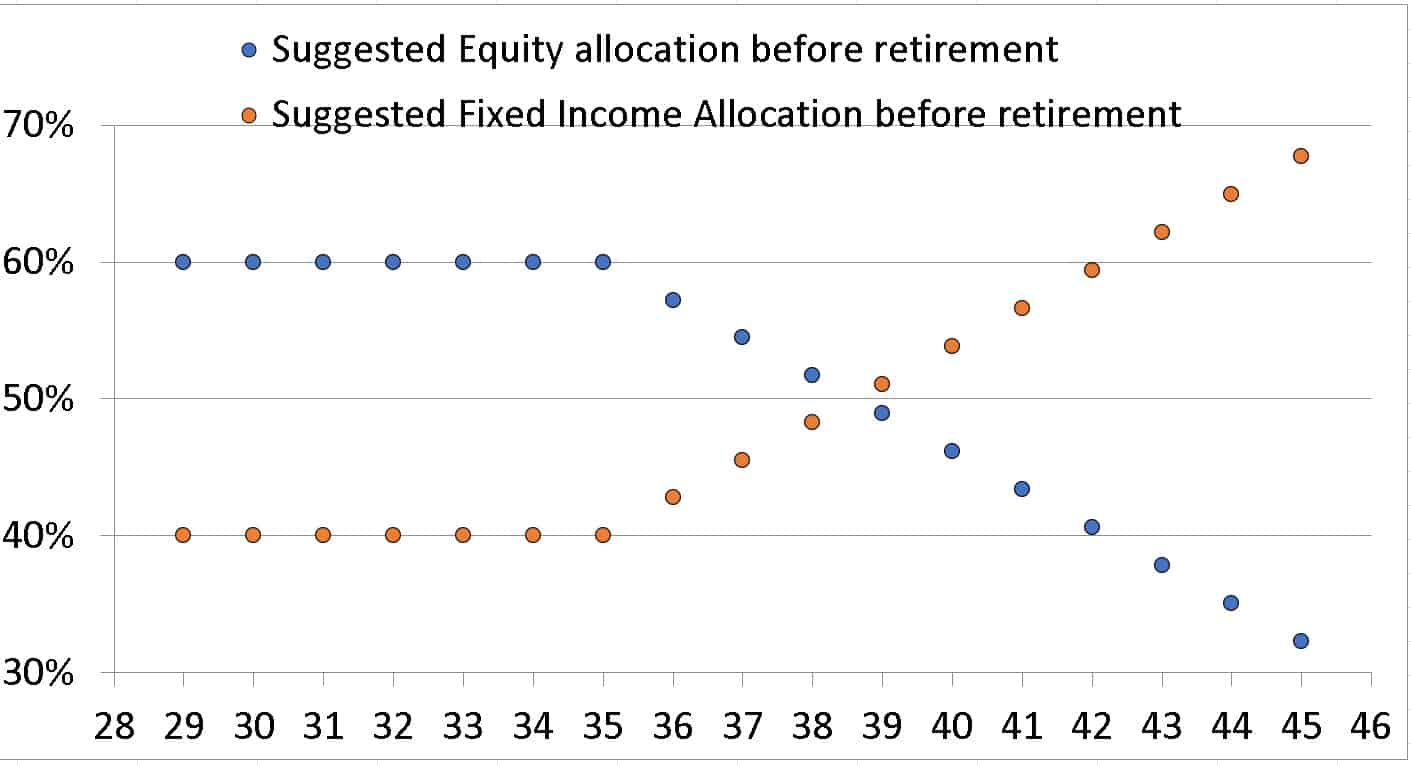
The equity allocation is gradually reduced from an initial 60% equity to about 32% at age 45. The investment amount required calculated above factors in this asset allocation change.
Out of the total corpus of Rs. 5.11 crores, 5% is kept aside for emergencies.
- An income bucket with 50% of the remaining corpus for guaranteed income for the first 15 years in retirement. During this time, investments will be made in the following three buckets. This bucket has no equity.
- A low-Risk bucket with 27% of the remaining corpus for income from year 16 to year 25 in retirement. The low-risk bucket will have an asset allocation of 30% equity and 70% debt during the investment period (years 1 to 15 of retirement).
- Corpus from a medium risk bucket with 14% of the remaining corpus will provide income from year 26 to 33 in retirement. This bucket shall have an asset allocation of 50% equity and 50% debt during the investment period (year 1 to year 25)
- Corpus from a high-risk bucket with 9% of the remaining corpus will provide income from years 34 to 40 in retirement. This bucket has 100% equity to start with. (year 1 to year 33).
- The buckets will be actively managed to reduce risk during this investment period via rebalancing and profit booking from one bucket to another. To understand how this works, try this: The Retirement Bucket Strategy Simulator.
- After 15 years, the low-risk bucket will be turned into 100% debt and provide income for about ten years. After that, the other buckets will also be progressively used.
Note: Only about 30-32% is set aside for equity. The rest is fixed income. Early retirement does not mean holding more equity. It is extremly risk to do so. A poor sequence of returns can wipe out the corpus. See:Want to be financially free? Do not count on frugality! Worry about sequence of returns risk!
Important: The retirement plan must be reviewed each year. The assumptions and inputs must be suitably varied to reflect reality.
In summary, the reader is on track to retire by age 50 as long as he can easily afford to stick to the investment schedule mentioned above. A few years later, he can modify the calculation by using income flooring or annuity laddering to fortify the retirement plan.