Last Updated on February 13, 2022 at 7:47 am
Suresh asks, “Can you please write an article on which type of debt mutual fund should be used for a long-term financial goal? Can we use liquid funds for these?”
For those who make the effort to understand how they work, debt mutual funds offer unique benefits. That said, most retail investors can stick to overnight funds, liquid funds and money market funds for most of their goals. These invest in short-term bonds with (typically) good credit quality.
The NAV of a debt fund fluctuates as per the demand and supply forces in the market. In normal situations, a debt fund holding long term bonds will fluctuate more than a debt fund holding short-term bonds.
Those who wish to learn more about debt mutual funds can use our free E-book: A Beginner’s Guide To Investing in Debt Mutual Funds and our monthly debt fund screeners can be used for selection learning and tracking.
🔥Secure your future with our Robo-advisory tool trusted by over 3,500 investors and advisors. From effortless retirement planning to funding your children’s biggest dreams, turn your financial goals into reality. 🔥
Subscribe for money management solutions via email! (Link takes you to our email sign-up form) Join 32,000+ readers in our community.
👉 New Tool Alert! NaviPlan: A Privacy-Focused Multi-asset Tracker and Goal Planner 👈
There is absolutely nothing wrong with using a liquid fund or a money market fund as the debt component of a long term portfolio with or without other debt products like EPF or PPF. In a long term portfolio with significant equity, debt mutual funds help with two-way rebalancing. That is from equity to the debt fund when there is a bull market and vice-versa during a bear market.
Investors who can appreciate and tolerate the risks associated with a gilt fund can also reap the benefits over the long term.
The 10-year rolling returns of 1Y treasury bill index vs long term gilt index vs Nifty 500 TRI vs portfolio with 50% equity and 50% of the T-bill index and gilt index are shown below. There are 5992 data points in each line.
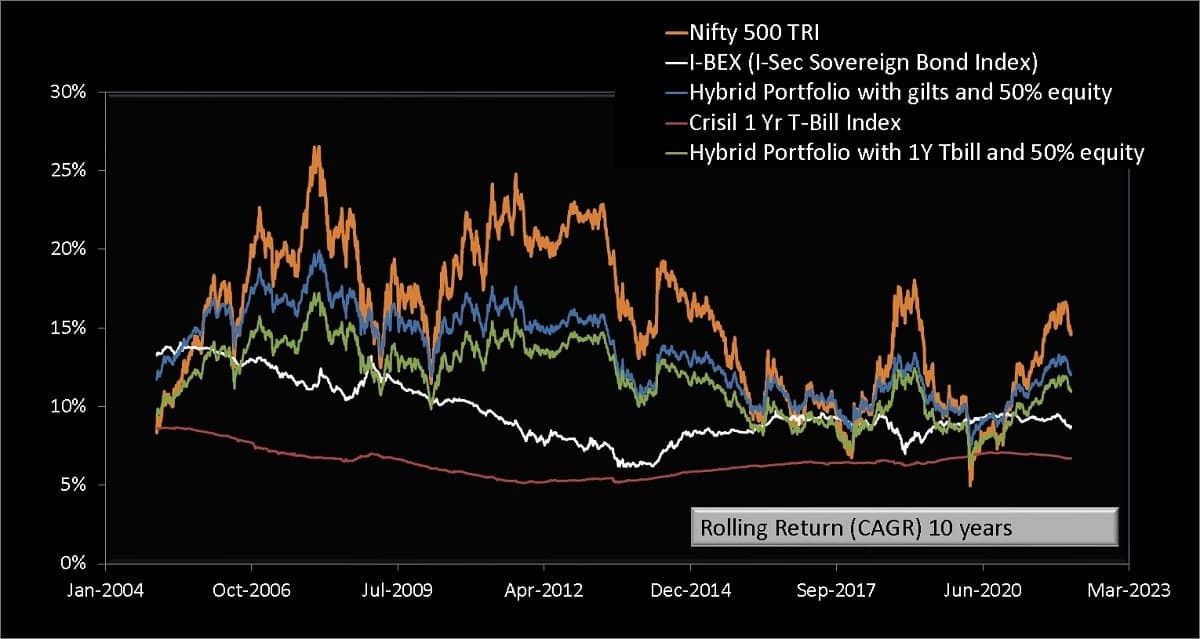
Notice that the 10Y gilt index return are comfortably about the 1Y Treasury bill index (this is used as a proxy for liquid funds and money market funds). So naturally, a 50% equity + 50% gilt portfolio will be more rewarding than a 50% equity and a 50% T-bill portfolio.
We have assumed a simplistic daily rebalance here. A standard annual rebalancing is not expected to be too different.
The results over 15 years are shown below. There are 4429 data points in each line. The general observations are also the same.
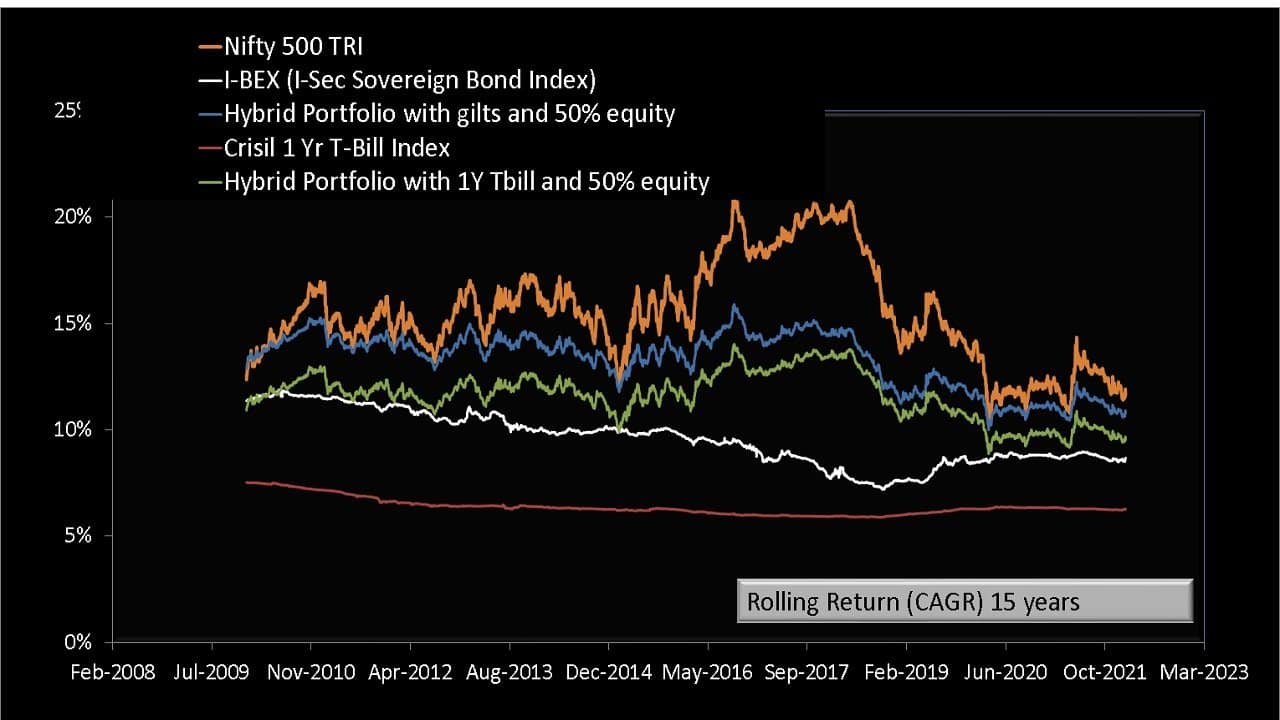
The role play by asset allocation in reducing the volatility (potential return spread) of equity can also be seen from the above graphs. Also see: PPF vs Gilt mutual funds: Which has done better over 15 years?
In summary, investors who can appreciate and tolerate gilt volatility are likely to be rewarded over the long term. There is however nothing wrong with using short-term debt funds like money market funds or even liquid funds in a long term portfolio.
Additional resources on gilt mutual funds
- How to choose a gilt mutual fund
- FAQ on gilt mutual funds: essentials investors should know
- Gilt funds vs Dynamic Bond Funds vs Corporate Bond Funds: Which is the better choice?
- If equity MF returns are negative will gilt MF returns be positive?