In this article, we discuss How to calculate LTCG with a Grandfathering clause for equity shares that underwent split and how to fill Schedule 112A.
About the author: Manmohan Sethumadhavan is a freelancer, investor, and personal finance enthusiast “in search of the absolute truth.” You can follow Manu on Twitter @ManuTsr.
- I purchased 1000 Nos. of AMRUTANJAN HEALTH CARE LIMITED on 01-01-2016 at Rs.488 per share for a total amount of Rs.4,88,000
- The share underwent a split from Face Value of Rs.2 to Rs.1 on 13-04-2018, and thus, I have 2000 Nos. of shares.
- I sold the entire shares on 11-03-2024 at Rs.665 per share, totalling Rs.13,30,000
Since the holding period is over one year, the gains here are classified as Long Term Capital Gains u/s 112A. Since the shares were purchased before 31-01-2018, the grandfathering clause is applicable, and the gains accrued before the said date can be ignored. The Fair Market Value (FMV) as of 31-08-2018 needs to be taken for this. The law says as follows:
“Explanation” to Section 55(2)(ac):
For this clause –
🔥Secure your future with our Robo-advisory tool trusted by over 3,500 investors and advisors. From effortless retirement planning to funding your children’s biggest dreams, turn your financial goals into reality. 🔥
Subscribe for money management solutions via email! (Link takes you to our email sign-up form) Join 32,000+ readers in our community.
👉 New Tool Alert! NaviPlan: A Privacy-Focused Multi-asset Tracker and Goal Planner 👈
(a) “fair market value” means –
(i) In a case where the capital asset is listed on any recognised stock exchange as on the 31st day of January 2018, the highest price of the capital asset quoted on such exchange on the said date
Now, this is pretty simple in most cases. The highest price on the said date can be taken and multiplied by the number of shares. The highest price per share on 31-01-2018 for this share is Rs.605. But in this case, there is an issue. The stock has been split from FV Rs.1 to FV Rs.2; thus, my 1000 Nos. of shares have become 2000 Nos. on 13-04-2018, i.e., after the date for FMV. The number of shares on 31-01-2018 – the date for FMV, is only 1000.
| As on date | No. of shares held |
| 01-01-2016 | 1000 |
| 31-01-2018 | 1000 |
| 13-04-2018 | 2000 |
| 11-03-2024 | 2000 |
Many stock brokers have also been seen issuing Capital Gains Statements in this way. This ends up with an FMV of Rs.12,10,000 and long-term capital gains of Rs.1,20,000, which is wrong.
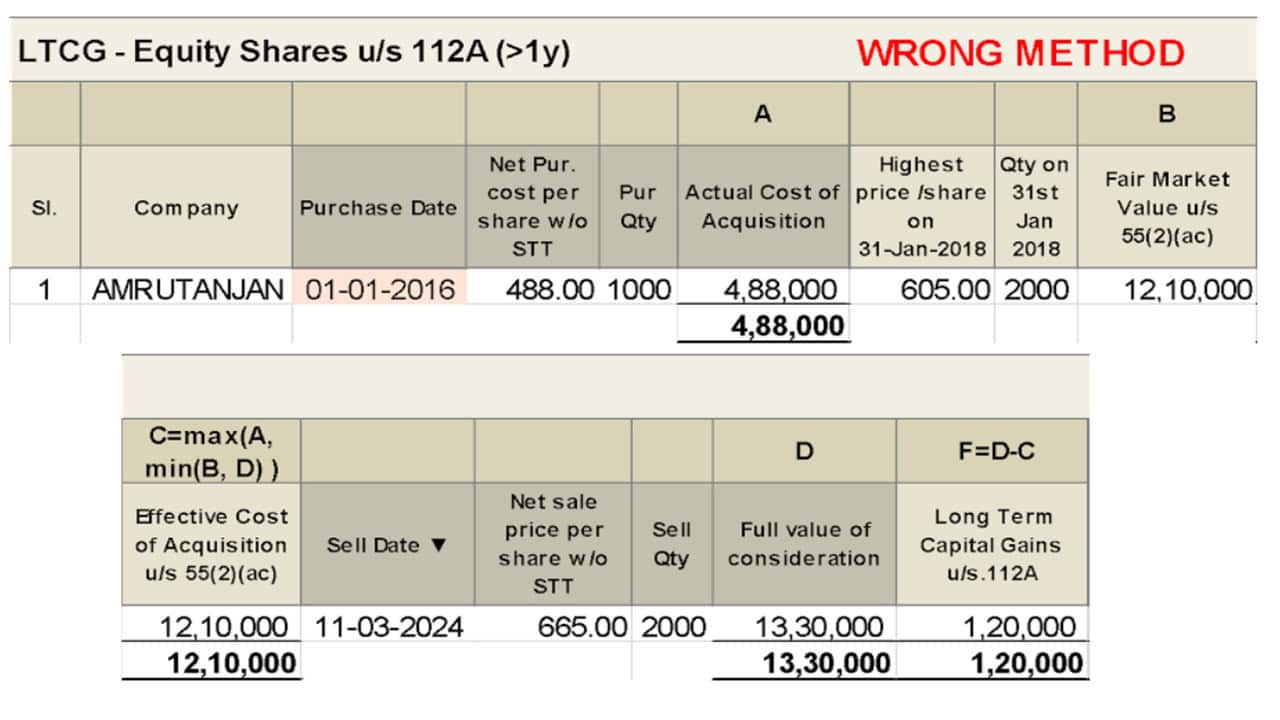
Adding more apparent justification to this view, in Schedule-112A of ITR-2 and ITR-3, there is only one column to enter the number of shares/units sold, and there is no way to enter the number of shares/units on the date of purchase, on the date of calculation of FMV, and on the date of sale, separately. The Fair Market Value is to be entered as “per share/unit basis”, and the total FMV is calculated automatically by multiplying this by the number of shares (which, of course, is the number of shares sold) for which you have no control.
But this is both incorrect and illogical. Even with a simple reading of the above section 55(2)(ac), it can be understood that the FMV shall be “the highest price of the capital asset” on the said date. When shares are bought in lots, sold in lots, and capital gains with grandfathering are calculated separately, the FMV shall also be calculated for each lot. Thus, the highest value for the entire 2000 shares sold, irrespective of its status, whether it has undergone any split, merge or amalgamation, as of 31-01-2018, is to be taken as the FMV for that particular lot of sale.
Let us further analyse the law.
Section 55
(2) For the purposes of sections 48 and 49, “cost of acquisition”, –
(b) in relation to any other capital asset, –
(v) where the capital asset, being a share or a stock of a company, became the property of the assessee on –
(d) the sub-division of any of the shares of the company into shares of smaller amount, means the cost of acquisition of the asset calculated with reference to the cost of acquisition of the shares or stock from which such asset is derived.
It is clear from the above section that in case of splits, the FMV has to be taken in a pro-rata way and thus the cost of acquisition has to be arrived with reference to the acquisition of the original asset. Hence in this case it shall be arrived
- by multiplying the price per share Rs.605 by 1000, the number of shares held on 31-01-2018, or
- by multiplying the pro-rata price per share i.e., Rs.302.50 (605/2) by 2000 – the number of shares sold which equals to Rs.6,05,000 and thus a capital gain of Rs.7,25,000.
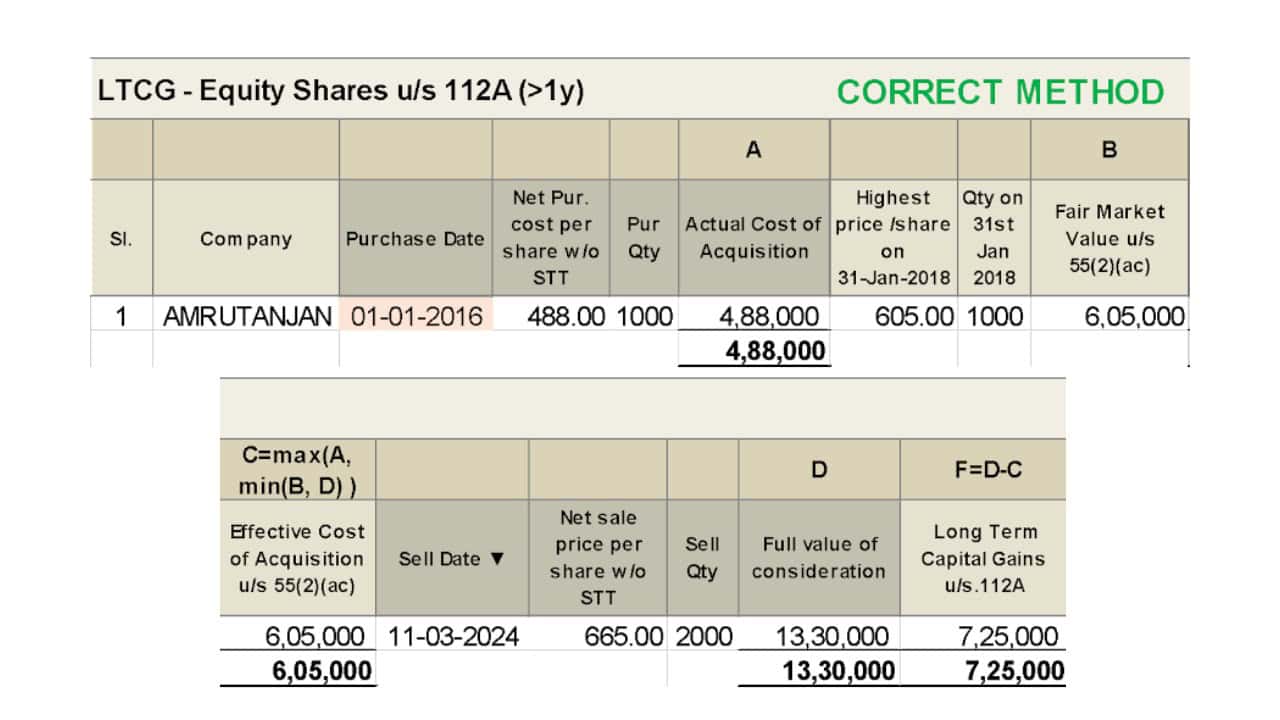
This would be further complicated in case of multiple splits and mergers like HDFC-HDFC Bank. This is also applicable to ETFs and Mutual Funds units.
Here is how this data should be filled in ITR Schedule-112A.

