The amendment to the finance bill 2023 modifying the tax status of debt funds seems to have rendered many investors in turmoil. They seem desperate to invest in debt funds before 1st April – we recommend that you don’t: Should I invest a lump sum in debt mutual funds before 1st April 2023?
They seem desperate to find alternatives for debt funds regardless of liquidity and risk. We have already discussed – Can I invest in equity savings funds instead of debt funds from 1st April 2023?
Arbitrage funds are among the saner alternatives, but they are not suitable for long term investments unless you are okay with a liquid fund-like return (pre-tax). Also see: New debt fund tax rule: How to change my investment strategy?
EPF (VPF) is not liquid and is taxable beyond Rs. 2.5 lakhs. NPS Tier 2 – no one knows how those are taxable! And that would be like investing in a black box and 100s of securities in the name of diversification. No, thank you.
How about balanced advantage funds, then? Our recommendation again is a vehement no. (1) These funds can freely change their equity allocation. Even if we assume from 1st April, many of the funds ensure the equity allocation does not drop below 36%, it can still increase to as much as a diversified equity fund.
🔥Secure your future with our Robo-advisory tool trusted by over 3,500 investors and advisors. From effortless retirement planning to funding your children’s biggest dreams, turn your financial goals into reality. 🔥
Subscribe for money management solutions via email! (Link takes you to our email sign-up form) Join 32,000+ readers in our community.
👉 New Tool Alert! NaviPlan: A Privacy-Focused Multi-asset Tracker and Goal Planner 👈
And we have no idea what strategy these funds follow (sure, some rules may be known, but not all of them). This means the fund manager risk in these funds is higher than in diversified equity funds as they could get the asset allocation wrong.
Leaving all that aside, how does it make sense to increase portfolio risk – switching from debt funds to hybrid funds – only to pay lower taxes?!
Performance of Dynamic Asset Allocation Funds and Balanced Advantage Funds
The absolute 32-day return between Feb 20th 2020, and Mar 23rd 2020, is listed below. This can be a proxy for a drawdown (fall from a maximum). It should be obvious that numbers are much higher than debt funds.
| Scheme Name | Abs Return |
| Principal Balanced Advantage Fund | -12.7 |
| Shriram Balanced Advantage Fund | -14.6 |
| BOI AXA Equity Debt Rebalancer Fund | -15.9 |
| Edelweiss Balanced Advantage Fund | -16.1 |
| Axis Dynamic Equity Fund | -17.0 |
| L&T Balanced Advantage Fund- | -18.5 |
| DSP Dynamic Asset Allocation Fund | -19.3 |
| Tata Balanced Adv Fund- | -19.4 |
| BNP Paribas Dynamic Equity Fund | -19.5 |
| SBI Dynamic Asset Allocation Fund | -20.2 |
| Baroda Dynamic Equity Fund | -20.7 |
| Nippon India Balanced Advantage Fund- | -21.8 |
| Motilal Oswal Dynamic Fund | -21.9 |
| Franklin India Dynamic Asset Allocation FOFs | -22.9 |
| Union Balanced Advantage Fund- | -23.5 |
| Aditya Birla SL Balanced Advantage Fund- | -25.5 |
| IDFC Dynamic Equity Fund | -26.0 |
| Kotak Balanced Advantage Fund- | -26.1 |
| Invesco India Dynamic Equity Fund | -26.6 |
| ICICI Pru Balanced Advantage Fund- | -26.7 |
| HDFC Balanced Advantage Fund-(Adjusted) | -31.7 |
| ITI Balanced Advantage Fund- | -33.2 |
Please don’t say the markets recovered – that is hindsight bias! And by the way, another few months of the current scene time will eliminate much of that recovery anyway.
These are the five-year standard deviation of balanced advantage or dynamic asset allocation funds, along with a few long-duration debt and gilt funds. The standard deviation is a measure of return volatility. Or how much monthly returns over a five-year period have deviated from the average monthly return. The higher the value, the higher the NAV volatility.
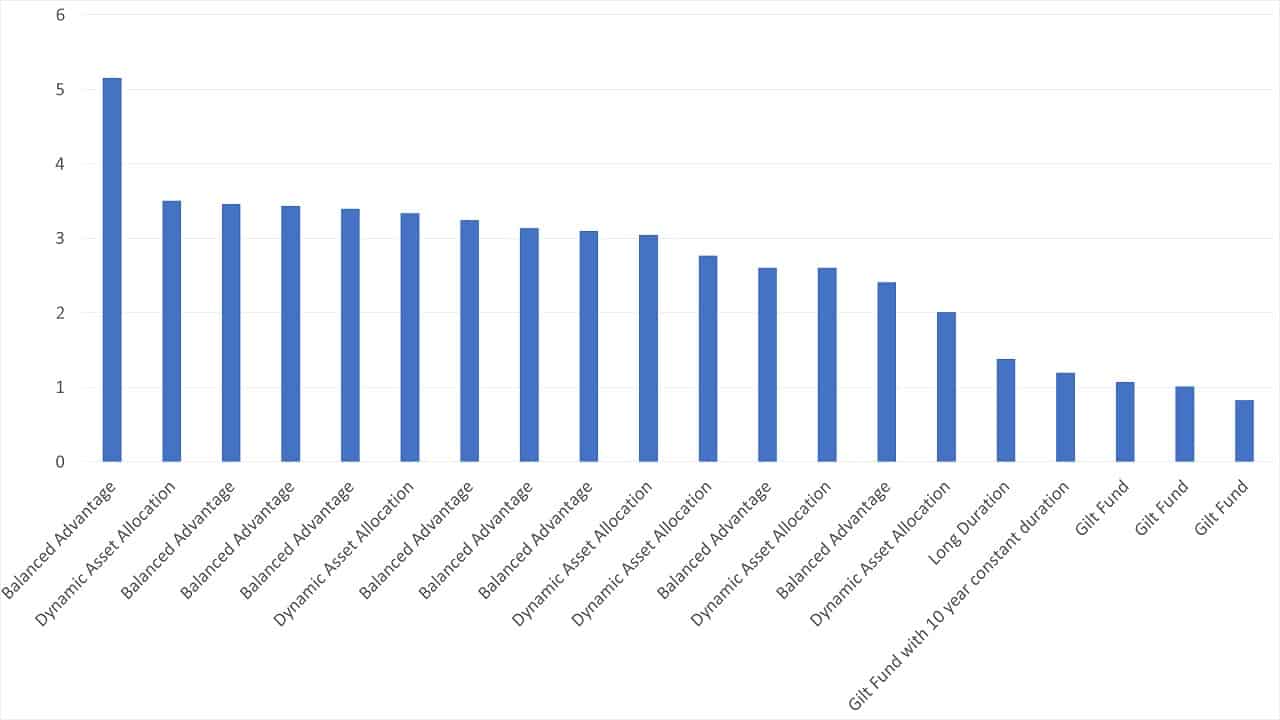
The lone range up top is HDFC Balanced Advantage, which is mostly a pure equity fund. Notice the sudden fall in volatility to the right of the graph, pointing us to the debt funds. Balanced advantage or dynamic asset allocation funds are much more volatile and have a much higher drawdown (fall from a peak) than debt funds.
Investors should not opt for these instead of debt funds to save tax! We recommend investors relax and get used to paying higher taxes and focus on managing their portfolios as per their financial goals.