Motilal Oswal Nifty Bank Index Fund will be India’s first bank index fund*. The scheme will track the Nifty Bank index. This has 12 of the most liquid and large Indian Banking stocks weighted as per free-float market capitalization. Should an investor consider this bank index fund? If so, when and how? Can this be a large cap fund replacement? Let us find out. * As of Aug 2019, there are nine banking ETFs and two of then are private bank ETFs
Let us first consider the role of a bank in an economy. Even at a simple, basic level, it should be clear that banks are essential to help businesses expand, survive during periods of loss by offering regulated credit. They also make dreams come true by offering credit to individual investors and SMEs. They also borrow from the same entities they lend to! In addition, they now sell insurance, mutual funds, structured products etc.
The point is, they drive both industry and consumerism at the same time and have also found other ways to generate profit by selling products of subsidiaries or affiliates. So if we view banks as a sector (a banking fund active or passive is a sectoral fund) then it should be clear that the growth of the economy is intricately linked to the growth of the banking sector.
🔥Secure your future with our Robo-advisory tool trusted by over 3,500 investors and advisors. From effortless retirement planning to funding your children’s biggest dreams, turn your financial goals into reality. 🔥
Also being a service industry connected to all other sectors equally, it should be less prone to sector-specific risks (eg. auto-sector slow down) and has the potential to be more rewarding. This is well illustrated in the presentation file of Motilal Oswal Nifty Bank Index Fund. The banking sector is typically among the less volatile sectors in the country.
So it makes intuitive sense to invest in banks and perhaps even the banking sector as a whole, but how practical is this for the average retail investor? Of course, one could argue that picking individual banking stocks is hardly rocket science as this can be done simply by tracking the Nifty Bank Index or the Nifty Private Bank Index which has only 10 stocks! Pick the least volatile stocks from these are you are done (provided you know what you are doing and accept risks).
Let us, however, consider the options for those who prefer a slightly broader basket of banking stocks.
Nifty Bank vs Nifty Private Bank vs Nifty 50 vs Nifty Next 50
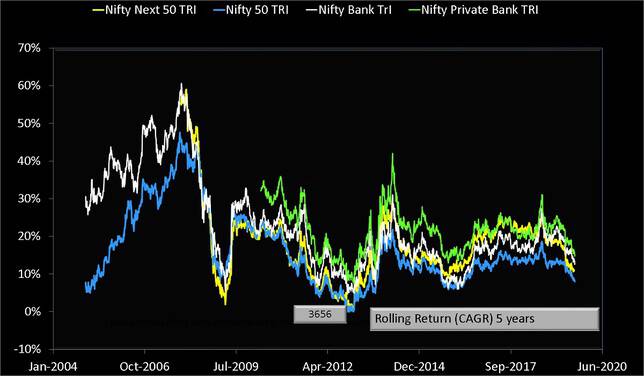
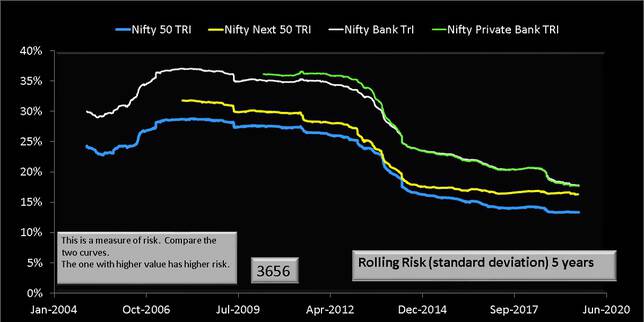
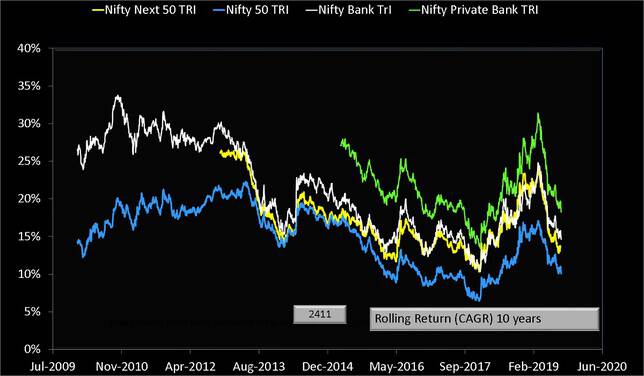
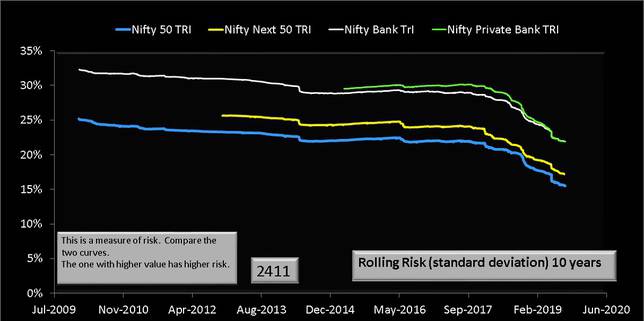
Let us compare the above indices. We look at every possible five year and ten year return periods and also compare the standard deviation or the volatility for these durations.
Five years
Rolling Returns
Rolling Risk
Notice that the banking indices doe not provide an investor with higher return regularly enough for the guaranteed higher risk that they offer. Therefore unless you can act on privileged information about the sector or are studying it closely or are trading in it, avoid Motilal Oswal Nifty Bank Index Fund or other banking ETFs for such durations.
Ten years
Rolling Returns
Rolling Risk
Over ten years, the banking indices have fared better than five in terms of reward. However, most investors simply cannot handle the associated excess risk. Therefore are better off avoiding Motilal Oswal Nifty Bank Index Fund.
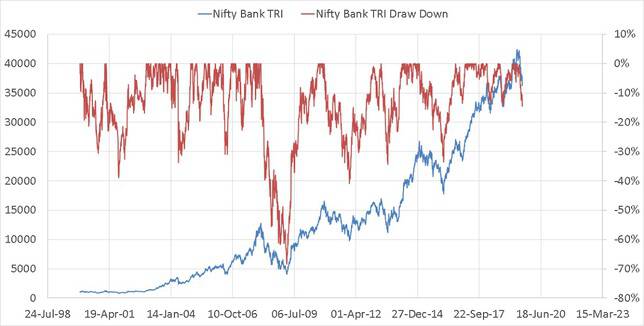
To understand what I mean, please refer to the index drawn down graph below. Drawdown is the percentage fall of the index from its most recent peak. The drawdown for Nifty Bank is shown below on the right axis.
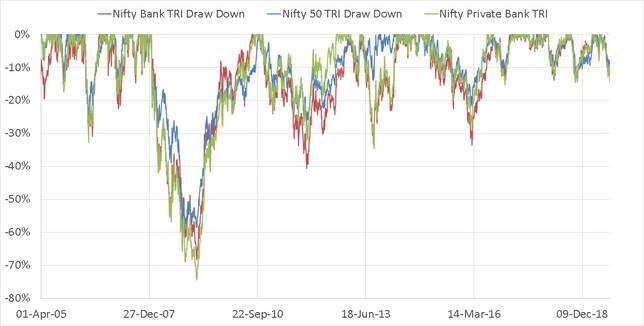
If we compare drawdowns, we notice the same pattern see in the rolling risk: Nifty 50 falls lesser than Nifty Bank.
How about the Nifty Private Bank Index?
Sometimes the Nifty Private Bank index has been riskier than the Nifty Bank index and sometimes not. For the reasons mentioned above, both banking indices cannot be used as large cap replacements. There is too much concentration risk. Between Nifty Bank and Nifty Private Bank, clearly, the latter has done well or just as well as the Nifty Bank Index at a slightly higher risk. However, if a few private banks get caught into a scam, there would be no one to bail them out (at least other than HDFC and ICICI) and it could cause a (bigger) domino effect in the private bank index.
Thus one should be careful about this. In any case, both Private Bank ETFs are new and there is no hurry to invest in these now.
Can we invest in the Motilal Oswal Nifty Bank Index Fund?
Although the Nifty Bank has done better than the Nifty 50 index with reasonable consistency, one will have to wait for a long time (at least ten years?). Is this justifiable considering the guaranteed higher risk than Nifty 50, I would say no. In any case, most diversified funds contain significant exposure to banks and that is good enough.
Do share this article with your friends using the buttons below.
Create a complete financial plan with our Robo-advisor!
Trusted by 3500+ investors and advisors! Use code robo25 for a 20% discount!