Last Updated on December 29, 2021 at 6:25 pm
Many investors make the mistake of believing what seems logical will actually work in the stock market! Take the case of buying on market dips. Many believe if they invest a lump sum when the market has fallen, they would make more returns and consider this a form of market timing (it is not!).
This article busts this myth by backtesting a systematic investment and a systematic + dip investment. We also compare a systematic investment with a systematic + momentum investment and show that it is no different from dip-buying!
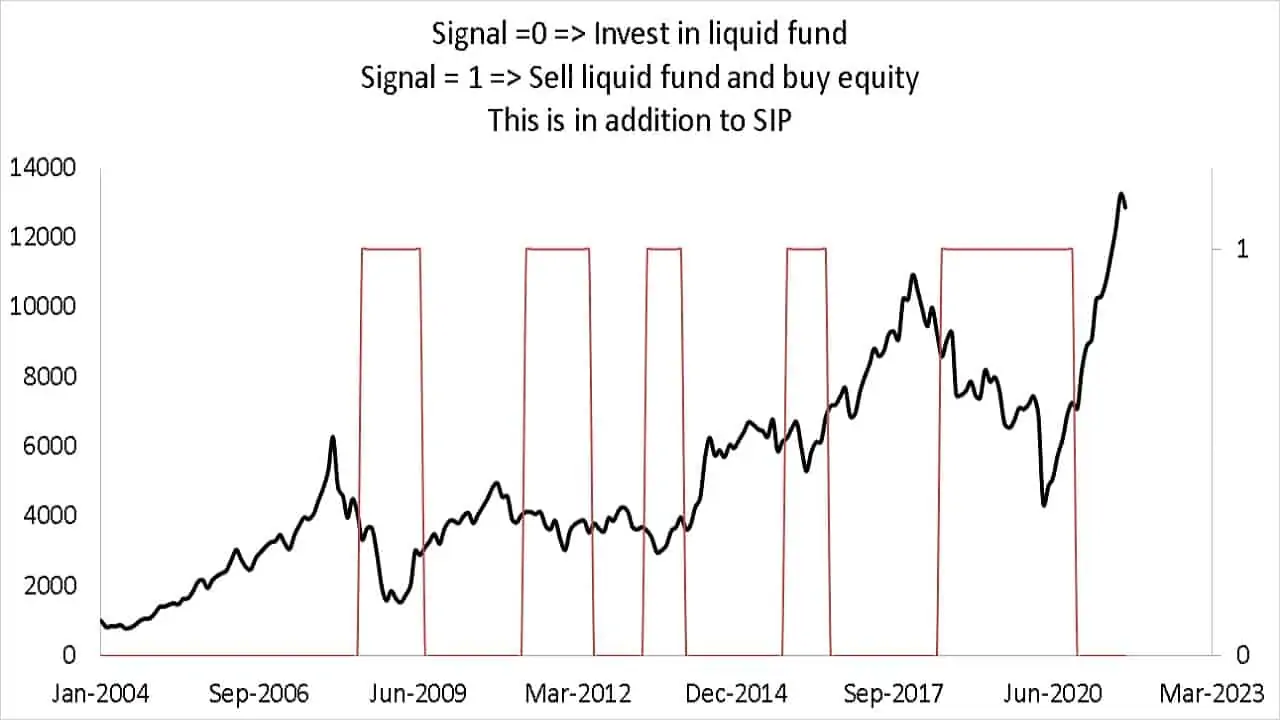
Systematic vs systematic + dip investment: Suppose we invest Rs. 2000 a month via SIP in equity. Let us call this systematic. In contrast, suppose we invest Rs. 1000 a month via SIP in equity. The other Rs. 1000 is used for buying on DIPs. The dip signal is defined using six months and 12 months moving averages.
- If the signal = 0, the market is moving up, and the other Rs. 1000 is invested in a liquid fund.
- If the signal =1, the market is falling, and the liquid fund is redeemed and invested in equity.
- Let us call this strategy systematic + dip investing.
This is an example with Nifty Smallcap 100 – TRI.
🔥Secure your future with our Robo-advisory tool trusted by over 3,500 investors and advisors. From effortless retirement planning to funding your children’s biggest dreams, turn your financial goals into reality. 🔥
Subscribe for money management solutions via email! (Link takes you to our email sign-up form) Join 32,000+ readers in our community.
👉 New Tool Alert! NaviPlan: A Privacy-Focused Multi-asset Tracker and Goal Planner 👈
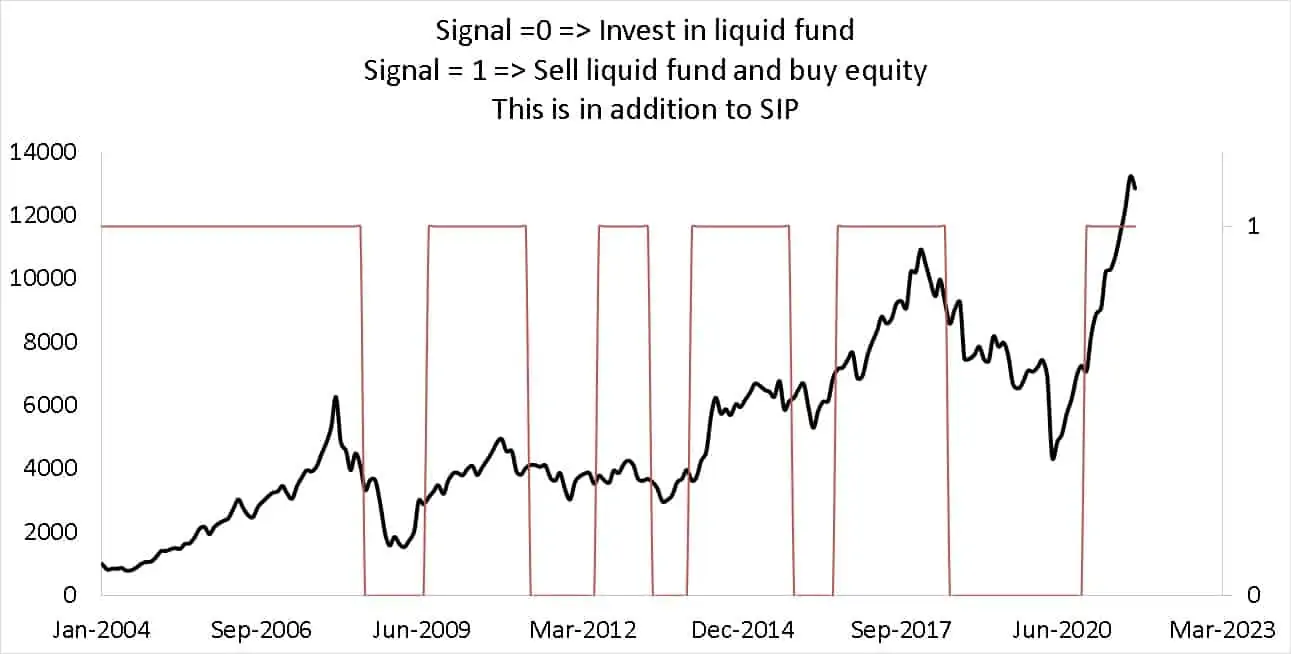
Systematic vs systematic + momentum investment: Suppose we invest Rs. 2000 a month via SIP in equity. Let us call this systematic. In contrast, suppose we invest Rs. 1000 a month via SIP in equity. The other Rs. 1000 is used for buying when the market is moving up (momentum). The momentum signal is defined using six months and 12 months moving averages and is the opposite of the dip signal mentioned above.
- If the signal = 0, the market is moving down, and the other Rs. 1000 is invested in a liquid fund.
- If the signal =1, the market is moving up, and the liquid fund is redeemed and invested in equity.
- Let us call this strategy systematic + momentum investing.
This is an example again with Nifty Smallcap 100 – TRI.
We will backtest these strategies over 15 years using Sensex TRI data + a liquid fund and over 30 years using S&P 500 TRI data + 1Y US Treasury bill index. The results for the small cap index was recently shared in the Facebook group Asan Ideas for Wealth.
Results for Sensex TRI + liquid fund
Dip buying
We test the dip-buying strategy over 122 15-year periods for the Sensex + liquid fund (HDFC liquid fund was used as a proxy). The top panel shows Sensex TRI and the signal. The bottom panel shows the XIRR comparison. Each XIRR data point is a 15-year return.

Notice there is no difference between the two strategies. If anything, the DIP buying has produced a lower return recently. Please note, no taxes are accounted for in this backtest. So this only makes the DIP result even worse when we factor in tax.
Momentum buying
These are results for systematic investing vs systematic + momentum buying.

Again, there is barely any difference before tax!
Results S&P 500 TRI + 1Y US treasury bill
Some investors believe buying on dips will make a difference over the long term. So we consider 30 years here. There are 262 30-year return data points in the lower panels.
Dip buying

The difference between the two strategies is so tiny that we cannot tell them apart!
Momentum buying

Again the same result – no difference!
What do these results mean? The above results clearly show that waiting to buy on market dips is a useless strategy. It is a loss-making strategy if we factor in taxes! The same is also true for momentum-buying.
We want to point out that trying to buy stocks or mutual fund units at a particular time is not market timing! Market timing refers to buying tactically and selling tactically.
In this case, the outcome will depend a lot on what method is used. Some market timing strategies:
- can result in lower risk* (main aim) and lower returns (side-effect)
- and some can result in higher returns* (some times) and higher risk (the price to pay)
* Please note, lower risk or higher returns is not a guarantee. Backtests do not factor in future market movements and sequence of returns, human emotions, taxation and exit loads. All these would impact the outcome of market timing, aka tactical asset allocation.
No single strategy would work for all markets and at all times, including systematic investing! See: How the fate of your mutual fund SIPs is decided by timing luck!
How we invest is only one side of the coin. How we manage the risk at the portfolio level and ensure enough money for our future needs (regardless of returns!) defines investing success.