Building wealth is not a static event; it’s an evolution. As your income grows and your experience deepens, the “one-size-fits-all” advice of your early 20s starts to feel restrictive.
To help you navigate this journey, we’ve developed the Wealth Evolution Framework. By identifying which quadrant you currently inhabit, you can move away from guesswork and toward a strategy that matches your real-world capacity for risk, reward and long term wealth building.
About the author: Jay Sheth, SEBI Registered Investment Adviser and a member of Fee-only India, a group of fixed-fee-only advisors. He can be contacted via his website shwealth.in.
The Wealth Evolution Framework
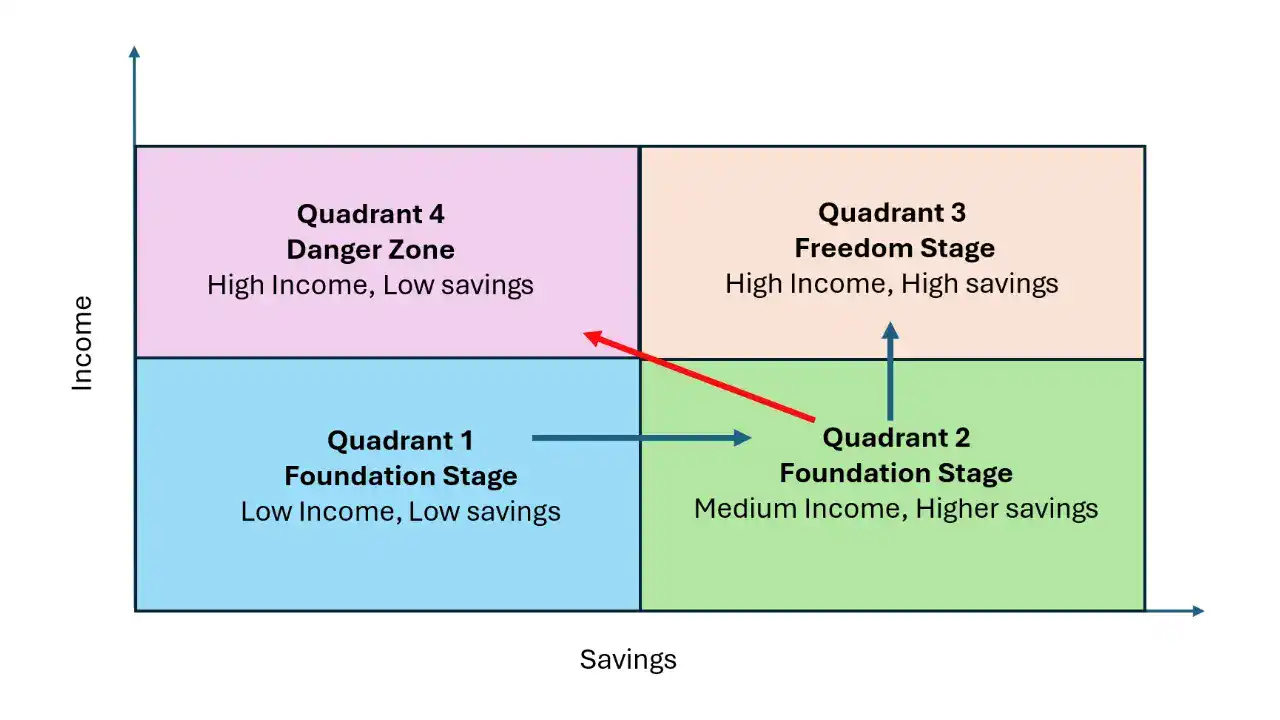
Quadrant 1: The Foundation Phase (Low Income, Low Savings)
🔥Secure your future with our Robo-advisory tool trusted by over 3,500 investors and advisors. From effortless retirement planning to funding your children’s biggest dreams, turn your financial goals into reality. 🔥
Subscribe for money management solutions via email! (Link takes you to our email sign-up form) Join 32,000+ readers in our community.
👉 New Tool Alert! NaviPlan: A Privacy-Focused Multi-asset Tracker and Goal Planner 👈
Typically: Early-career professionals or those starting their financial journey.
Salaries are going to be the lowest when you enter the workforce. At this stage, your expenses are going to be high. Most people employed outside their hometown would have to tackle with expenses of rent, living expenses, education loan repayment, lifestyle expenses of just starting to earn and freedom to spend, etc. In this stage, your greatest asset is time, but your greatest hurdle is liquidity. Your savings are a small percentage of your salary, or even if the savings ratio is high the absolute saving amount may be less. This phase could last from 2-5 years.
- Investment Strategy: Defensive and Foundational.
- Asset Allocation:
- High Debt/Cash (Emergency Corpus): With your first paycheck, do not think of investing in the markets to start making great returns. Your priority is not “beating the market”; it’s building a 3-6-month safety net.
- Fixed Income: If you have built an emergency fund, do not just start taking risks with equity or other volatile instruments. Your expenses may not have fully stabilised, and you may have a lot of other near-term commitments or goals (marriage, four-wheeler, family commitment) which may require money parked in non-volatile assets. The idea is to create a strong base which would give you the confidence and buffer to invest in volatile and high-return assets.
- Minimal Equity (The Education SIP): Even if it’s just ₹1,000, start an equity SIP. The goal here isn’t a massive corpus—it’s to experience market volatility and understand your own temperament.
Exceptions: If you have strong family backing and assets, you can park a higher proportion of your savings in equity.
Quadrant 2: The Accumulation Phase (Medium Income, Higher Savings)
The initial years are over, where expenses kept adding up. Now you are more aware of your outgoings. A few years of increments/promotion/job switch may have put you in a higher earning bracket and enabled you to save more. This is where the “heavy lifting” of wealth creation happens. You have covered your basics, and your surplus is growing. A person may end up spending the highest part in this quadrant. This is the time to shift from saving to aggressive compounding.
- The Strategy: Growth and Diversification.
- The Asset Allocation:
- Aggressive Equity: This should be your largest bucket. Use index funds, largecap funds, and flexicap funds to create your core portfolio for long term goals (more than 5 years). You can allocate a small ratio (5-10%) to a satellite portfolio consisting of midcap or smallcap funds.
- Precious Metals: Start allocating 5–10% to gold as a hedge against equity downturns.
- Debt: Maintain asset allocation according to your risk appetite by investing in debt. Stick to PPF, GILT, Hybrid debt, and Mutual Funds. For any short-term goals ensure money is parked in debt
Quadrant 3: The Freedom Phase (High Income, High Savings)
You have made significant savings and investments by now. You may not have achieved financial independence as yet, but with your solid foundation and high income and savings, financial independence may seem to be on the horizon.
- The Strategy: Sophisticated and Experimental.
- The Asset Allocation:
- Core Portfolio: Keep investing in index funds and large caps to ensure reaching your retirement corpus.
- Satellite Portfolio: Allocation to the satellite portfolio can be increased based on your experience of investing small sums in midcap / smallcap
- Direct Equity: You can dabble into direct equity to experience multibagger returns. However; choose quality companies rather than chasing random tips.
- International Exposure: Diversify geographically by investing in US or Global Tech funds or S&P 500 to hedge against domestic currency depreciation. International exposure can be started while being in Quadrant 2 if it aligns with goals (international trips, foreign education)
- Real Estate: High-ticket real estate or REITs can provide a steady secondary income stream.
Quadrant 4: The Danger Zone (High Income, High Expenses)
Typically, high earners suffer from “Lifestyle Creep” or “The Golden Handcuffs.”
This is the most deceptive quadrant. On paper, you look “rich,” but in reality, you may be one paycheck away from a crisis. Lack of discipline in the earlier quadrants leads a person to this Quadrant. High EMIs for luxury cars and massive home loans often mean your net worth could be lower than someone in Quadrant 2.
- The Strategy: Survival and Realignment.
- The Asset Allocation:
- Aggressive De-leveraging: Your “investment” should be paying down high-interest debt first.
- Traditional Re-balancing: Stop experimenting with crypto or high-risk stocks. Stick to traditional, boring, and predictable instruments (Index Funds, FDs) while you fix your cash flow.
- The Expense Audit: Wealth is what you keep, not what you spend. Transitioning to Quadrant 3 requires a sustained period of controlled spending until your savings rate hits at least 30-40%. Do a check on the number of working years you have left, and what savings rate you would require to achieve your retirement corpus and other goals.
Final Thoughts
Wealth is a journey through these quadrants. The key is to never stay in Quadrant 4 and to move through Quadrants 1 and 2 as quickly as your career allows.
Disclaimer:
1) Registration granted by SEBI, membership of BASL and certification from NISM in no way guarantee performance of the intermediary or provide any assurance of returns to investors.
2) Nothing in the article is a recommendation to invest in any particular asset class. Please reach out to your advisor before making any investment decisions
3) Investment in securities is subject to market risks. Read all the related documents carefully before investing.

Join 32,000+ readers and get free money management solutions delivered to your inbox! Subscribe to get posts via email! (Link takes you to our email sign-up form)

Use our Robo-advisory Tool to create a complete financial plan! More than 3,000 investors and advisors use this! Use the discount code robo25 for 20% off. Plan your retirement (early, normal, before, and after), plus non-recurring financial goals (such as child education) and recurring financial goals (such as holidays and appliance purchases). The tool helps anyone aged 18 to 80 plan for retirement, plus six non-recurring and four recurring financial goals, with a detailed cash flow summary.
🔥Join our community of 9000+ users! 🔥Avail massive discounts on our courses + freefincal investor circle!
Track your mutual funds and stock investments with our Google Sheet!
We also publish monthly equity mutual funds, debt and hybrid mutual funds, index funds, ETF screeners, as well as momentum and low-volatility stock screeners.
You can follow our articles on Google News

We have over 1,000 videos on YouTube!

Podcast: Let's Get RICH With PATTU! Every single Indian CAN grow their wealth!
You can watch podcast episodes on the OfSpin Media Friends YouTube Channel

- Do you have a comment about the above article? Reach out to us on Twitter: @freefincal or @pattufreefincal
- Have a question? Subscribe to our newsletter using the form below.
- Hit 'reply' to any email from us! We do not offer personalised investment advice. We can write a detailed article without mentioning your name if you have a generic question.
About The Author
Dr M. Pattabiraman (PhD) is the founder, managing editor and primary author of freefincal. He is an associate professor at the Indian Institute of Technology, Madras. He has over 14 years of experience publishing news analysis, research and financial product development.
Connect with him via Twitter(X) LinkedIn YouTube
Our flagship course! Learn to manage your portfolio like a pro to achieve your goals regardless of market conditions! More than 3,500 investors and advisors are part of our exclusive community! Get clarity on how to plan for your goals and achieve the necessary corpus no matter the market conditions! Watch the first lecture for free! One-time payment! No recurring fees! Lifelong access to videos! Reduce fear, uncertainty and doubt while investing! Learn how to plan for your goals before and after retirement with confidence.
Increase your income by getting people to pay for your skills! More than 900 salaried employees, entrepreneurs and financial advisors are part of our exclusive community! Learn how to get people to pay for your skills! Whether you are a professional or small business owner seeking more clients through online visibility, or a salaried individual looking for side or passive income, we will show you how to do it by showcasing your skills and building a community that trusts and pays you. (Watch the 1st lecture for free). One-time payment! No recurring fees! Lifelong access to videos!
Our book for kids: “Chinchu Gets a Superpower!” is now available!


Must-read book even for adults! This is something that every parent should teach their kids right from their young age. The importance of money management and decision making based on their wants and needs. Very nicely written in simple terms. - Arun.
Buy the book: Chinchu gets a superpower for your child!
How to profit from content writing: Our new ebook is for those interested in getting a side income via content writing. It is available at a 50% discount for Rs. 500 only!
We publish monthly mutual fund screeners and momentum, low-volatility stock screeners.
About freefincal & its content policy
Freefincal is a News Media organisation dedicated to providing original analysis, reports, reviews and insights on mutual funds, stocks, investing, retirement and personal finance developments. We do so without conflict of interest and bias. Follow us on Google News. Freefincal serves more than three million readers a year (5 million page views) with articles based only on factual information and detailed analysis by its authors. All statements made will be verified with credible and knowledgeable sources before publication. Freefincal does not publish paid articles, promotions, PR, satire or opinions without data. All opinions will be inferences backed by verifiable, reproducible evidence/data. Contact Information: To get in touch, please use our contact form. (Sponsored posts or paid collaborations will not be entertained.)Connect with us on social media
Our publications
You Can Be Rich Too with Goal-Based Investing

Gamechanger: Forget Startups, Join Corporate & Still Live the Rich Life You Want

Your Ultimate Guide to Travel