Last Updated on April 14, 2026 at 11:48 am
Investors captivated by Axis mutual funds stellar 2019 performance wonder if Axis Growth Opportunities Fund can be an alternative to Parag Parikh Long Term Equity Fund. Both funds can allocate a portion of their funds to international stocks. We compare their investment syles and portfolio allocation to understand how they differ.
The international exposure in these funds will make a difference to an investors portfolio only if they take on significant exposure. Most investor portfolios are cluttered with tens of funds and even if they buy either of these, they can manage only 5-10% exposure. This means their portfolios will have only about 5-10% of the international exposure in these funds. Therefore it is important to consider these funds only if your portfolio needs it!
It should be kept in mind that Axis Growth Opportunities Fund (AGOF) is less than 14 months old (launched in Oct 2018) while Parag Parikh Long Term Equity Fund (PPLTEF) is three months shy of its seventh birthday (launched May 2013).
🔥Secure your future with our Robo-advisory tool trusted by over 3,500 investors and advisors. From effortless retirement planning to funding your children’s biggest dreams, turn your financial goals into reality. 🔥
Subscribe for money management solutions via email! (Link takes you to our email sign-up form) Join 32,000+ readers in our community.
👉 New Tool Alert! NaviPlan: A Privacy-Focused Multi-asset Tracker and Goal Planner 👈
Thanks to Axis Bank distribution networks, AGOF already has 40% of PPLTEFs AUM (2585 Crores as on Dec 31st 2019). In this short period, it makes no sense to look at AGOF’s performance in terms of risk or reward (the featured image above shows the NAV movement since the launch of the Axis fund).
PPLTEF is a fairly established multicap fund with excellent risk-adjusted performance since inception. See Parag Parikh Long Term Equity Fund Review. Readers familiar with my yearly audits will know that this forms the core of my retirement portfolio. Its current AUM levels are still low and since it does not have an associated bank the risk of a sudden influx of funds is fairly low.
So choosing PPFLTEF over AGOF on the basis of past performance is a no-brainer. The biggest risk associated with PPFLTEF is the risk of active management. What if Rajeev Thakkar is no longer the fund manager? Will this not affect performance?
No one can say for sure but older investors may recall Rajeev Thakkar faced the prospect of jail for being involved in the accident that killed Parag Parikh and was later cleared. This worried many investors then. So it is a real risk. He could quit anytime to start on his own etc. The scheme has two other FMs for the international equity and bond segment but do they get as much attention?
As mentioned above, the biggest risks associated with AGOF is the lack of history and chances of huge influx over a short period of time via Axis Bank. With a 1% extra expense ratio in the regular plan, it is a definite possibility.
Also, how long would the recent performance of Axis funds last, is another problem. A top performer can only move down while an average performer has a lot more breathing space. It would better to give AGOF some more time to perform especially when the market falls (and the aum problem is temporarily out of the equation).
Aside from March 2016, PPLETF has also not been seriously tested during a market fall, although it has performed admirably after budget 2018 when the mid and small cap segments started falling.
Both funds have a common risk: if international markets collapse these funds can take a bigger hit than others with only Indian equity. Investors who want to “diversify their portfolio with international (read US) stocks” have to look beyond returns in the last couple of years and consider the risks of doing so.
With these remarks out of the way, let us consider some differences between these two funds. The importance of giving the AGOF fund more time can be clearly seen the graph below which shows the international equity exposure over time.
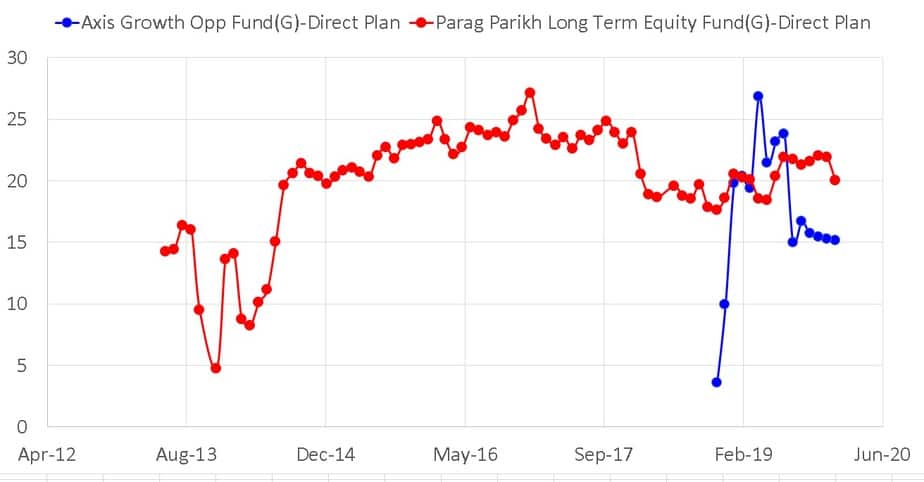
One cannot say whether AGOF will hold more or less or as many international stocks as PPLTEF. The market cap history of both the funds is shown below.
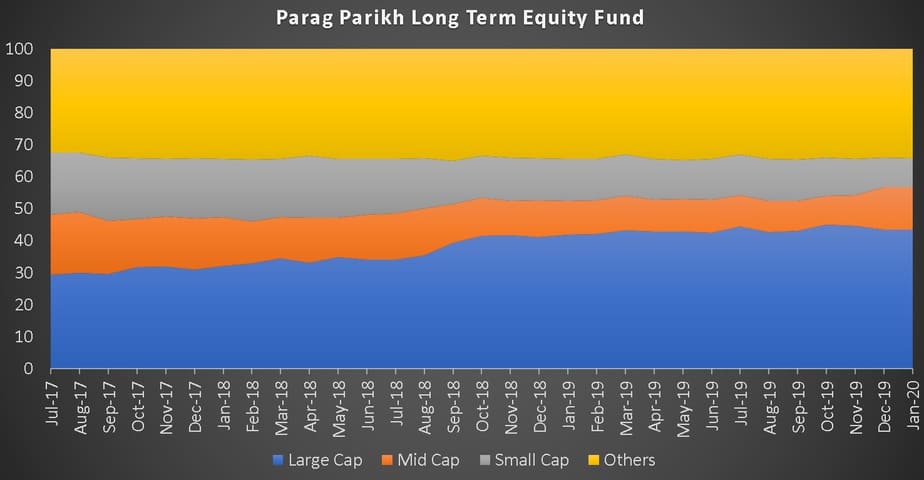
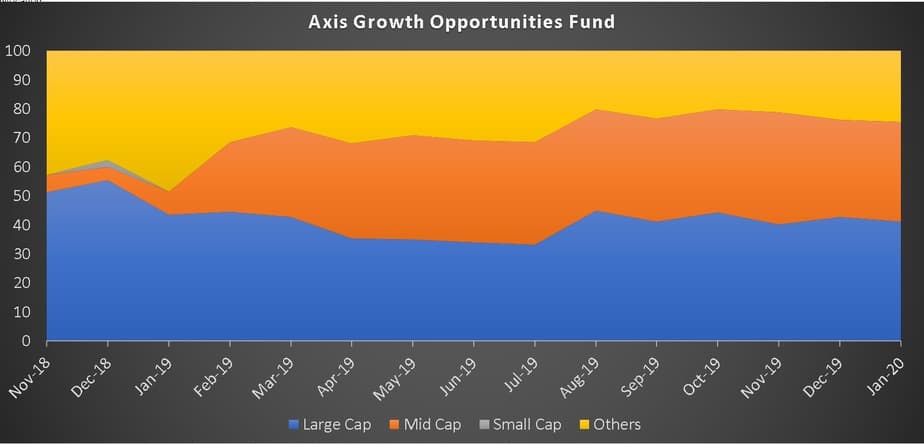
The significant midcap exposure in AGOF and the significant cash + derivatives (others) exposure in PPLTEF is striking. AGOF will tend to stay away from small cap stocks (although it has the freedom to invest), while PPLTEF has no such restrictions.
According to its scheme presentation, AGOF can invest up to 35% in international stocks (predominantly large caps), 30-35% in Indian large caps, 35-40% in Indian midcaps.
PPLTEF can also invest up to 35% in international stocks with no other restrictions related to market cap. AGOF is expected to be growth-oriented in its stock-selection style (a combination of bottom-up and top-down) as opposed to PPLTEFs focus on value investing (bottom-up stock selection with an emphasis on the long term).
Summary: Those are the key differences between these two funds. Investors opting for Axis Growth Opportunities Fund should bear in mind its lack of history and possibility of bank channel-driven AUM influx. Those who choose Parag Parikh Long Term Equity Fund based on past performance should keep in mind fund manager risk. Both funds can come under stress if international markets fall.
References:
- AGOF Scheme information document
- PPLTEF Scheme Information document