DSP Global Innovation Fund of Fund is an open-ended fund of fund scheme investing in an “Innovation theme” via global mutual funds and ETFs. The AMC claims this will provide the investor with exposure to “companies with innovation theme having potential for higher revenue and earnings growth”.
The structure of this fund of fund is a mess reminiscent of HDFC Developed World Indexes Fund of Fund. According to the scheme presentation, the DSP Global Innovation Fund of Fund will invest in
- iShares Semiconductor ETF 15% (index composed of U.S.-listed equities in the semiconductor sector)
- Morgan Stanley US Insight Fund 15% (invests in established and emerging companies in the United States benchmarked to Russell 3000 Growth Index)
- BGF World Tech Fund 20% (US-heavy tech fund benchmarked to MSCI All Country World Information Technology- Net Return in USD)
- Nikko AM ARK Disruptive Innovation Fund 15% (Another US heavy fund with no benchmark – how convenient!)
- Bluebox Global Technology Fund 20% (Another US-heavy tech fund, again no benchmark )
- iShares NASDAQ 100 UCITS ETF 15%
So this mix does not result in much geographic diversification (but then again most investors don’t care about that. They just want returns). The fund has about 71% of large cap and 20% of mid cap stocks.
Naturally, the AMC has the flexibility to change weights or funds at will (which is why the scheme weights are only mentioned in the presentation and not the scheme document). In fact, the scheme document does not (as far as we could tell) define what an innovation theme is.
Our first instinct is to ask, “why these funds/ETFs?” and “why those weights?”. Any attempt to try and backtest the weights is futile because the Morgan Stanley
US Insight Fund was launched only in Sep 2020 and the Nikko AM ARK Disruptive
Innovation fund only June 2020.
🔥Secure your future with our Robo-advisory tool trusted by over 3,500 investors and advisors. From effortless retirement planning to funding your children’s biggest dreams, turn your financial goals into reality. 🔥
Subscribe for money management solutions via email! (Link takes you to our email sign-up form) Join 32,000+ readers in our community.
👉 New Tool Alert! NaviPlan: A Privacy-Focused Multi-asset Tracker and Goal Planner 👈
This “minor” hitch did not prevent the AMC from backtesting this “strategy” from 29 Jan 2002 (when only two of the six funds were present!). They justify this with an elaborate fine print in the scheme presentation.
Data since inception returns (29 Jan 2002). * Basket is made by assigning 15% weight each to ishares Semiconductor ETF, Nikko AM ARK Disruptive Innovation fund, Morgan Stanley US Insight fund, ishares NASDAQ 100 UCITs ETF & 20% weight each to BGF World Tech Fund, Bluebox Global technology Fund. ARK Innovation ETF considered due to longer history which is US based
strategy equivalent to Nikko AM ARK Disruptive Innovation Fund. Morgan Stanley Insight fund considered due to longer history. 30% allocation is done to Morgan Stanley Insight Fund prior to 2015 as data for ARK Innovation ETF is not available while 40% allocation is done to BGF World Technology fund prior to 2019 as data for Bluebox Global Technology fund was not available. Rebalancing on Annual basis. Data as on 31 Dec 2021. Past performance may or not sustain in future and should not be used as a basis for comparison with other investments. 2021.Above
mentioned figures pertain to performance of the model and do not in any manner indicate the returns/performance of the any scheme of DSP Mutual Fund. Past performance may or may not sustain in future and should not be used as a basis for comparison with other investments..
Let us for a moment accept the above assumptions as reasonable. If so, how good is this strategy? This is a screenshot from the scheme presentation.
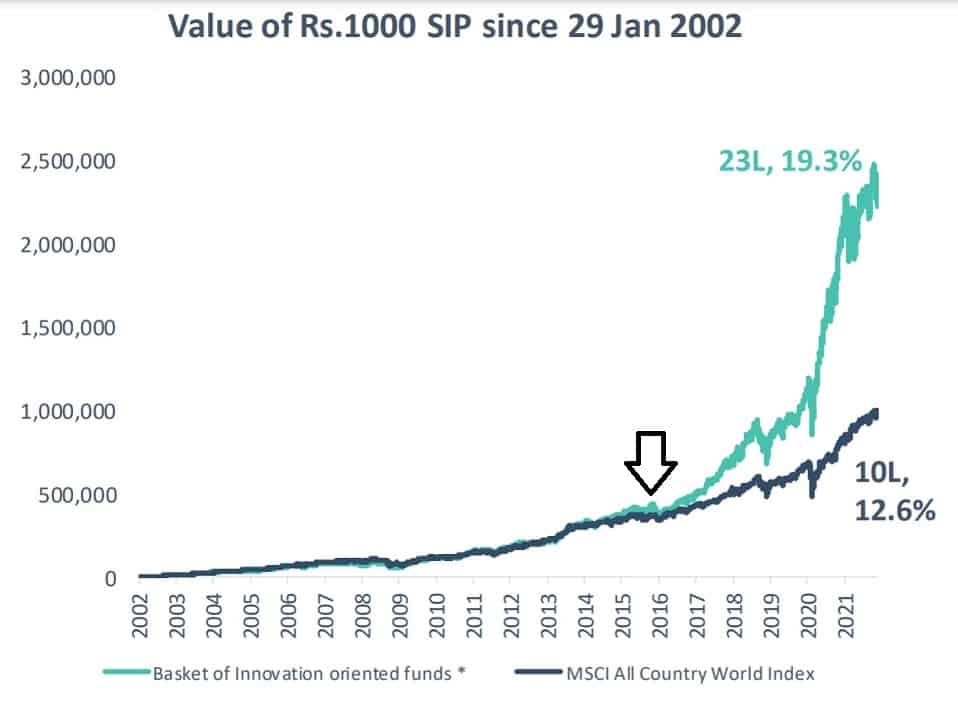
The fund house claims “SIP is an ideal way to invest in Innovative companies”. However, from 2002 to 2016 – 14 years, the great SIP in an imaginary basket of innovative funds would not have outperformed a SIP in MSCI All Country World Index!
It is only in the last few years, particularly after the March 2020 crash the “strategy” has outperformed. It would be immature and imprudent to assume that the recent past performance will continue into the future.
The evidence that it will not is already here:
- BGF World Tech Fund underperformed its benchmark by 19.35%
- Morgan Stanley US Insight Fund underperformed its benchmark by 32.36% (yes that is the margin of underperformance!)
What is more important is the weights of the six funds can be happily adjusted to produce any return that we want today. There is no justification for choosing 15% of X ETF and 20% of Y fund. Read more: Data Mining in Index Construction: Why Investors need to be cautious.
This claim, “SIP in Innovation oriented funds can provide investors better investment experience as well as opportunity to earn relatively higher returns” is unsubstantiated by their data!
So is this: “Innovation oriented funds have witnessed periodic high drawdowns; investors need to hold the fund for long–term through SIP with an aim for better investment experience”
Buying units on the same day of the month (aka SIP) will neither enhance returns nor reduce risk as established several times before: Myth Busted: SIPs do not reduce risk or enhance returns! And Will a lump sum investment beat a SIP over 15 years?
The reason that a SIP will not fare better than a lump sum can be understood intuitively (if you don’t wish to read the proof linked above). After running a SIP for Rs. X a month for 10 years, the amount in the market will be (120X+gain/loss). This is now a lump sum investment in the market. The next months SIP instalment of Rs. X will not do much to influence returns. To reiterate, in the above backtest, a 14Y SIP underperformed a SIP in an index fund!
In summary, the investment strategy proposed by the DSP Global Innovation Fund of Fund is US-heavy and high risk (being thematic in nature). The AMC’s own backtest against an index fund is unimpressive considering the extra fee to be paid to the three active funds in the basket over and above fees charged by DSP. Those who want to invest in “innovation” are better off with a Nasdaq 100 index fund (after appreciating its risks). Those who want “geographic diversification” are better off with an S&P 500 index fund (not to worry, SEBI should soon increase overseas investment limits!)