Last Updated on April 22, 2022 at 7:27 am
In this report, we look at how dynamic bond funds have altered their portfolio over the last few months in anticipation of an interest rate hike.
Bond market sentiment is monitored via the bond yield which is inversely proportional to bond price. If yield fall, it implies existing bonds have become more valuable (higher price). This means interest rates are falling or is expected to fall. That is newer bonds will offer lower interest so existing bonds are in demand.
If the yield increases, the price of existing bonds falls as the market expects higher rates from newer bonds. This is how the 10Y gilt yield has behaved in the last 10 years.
Notice the steep increase in yields over the last few months. This means the markets are expecting an interest rate hike.
🔥Secure your future with our Robo-advisory tool trusted by over 3,500 investors and advisors. From effortless retirement planning to funding your children’s biggest dreams, turn your financial goals into reality. 🔥
Subscribe for money management solutions via email! (Link takes you to our email sign-up form) Join 32,000+ readers in our community.
👉 New Tool Alert! NaviPlan: A Privacy-Focused Multi-asset Tracker and Goal Planner 👈
The investment strategy of dynamic bond funds: Typically, when the interest rates are expected to fall, the dynamic bond fund manager will increase exposure to long-term bonds. When the interest rates are expected to increase, the fund manager will move to short-term bonds. So let us find out what they have done over the past few months.
Note: The following data is only meant for educational purposes and should not be construed as investment advice. Dynamic bond fund managers speculate on bond supply and demand and they could get it wrong.
To appreciate this decision risk, the average (weighted)portfolio maturity in years for dynamic bond funds is tabulated below.
| Date | Average Portfolio Maturity in years (March 2022 |
| Nippon India Dynamic Bond(G) | 8.1900 |
| Axis Dynamic Bond Fund-Reg(G) | 7.9600 |
| HDFC Dynamic Debt Fund(G) | 6.5100 |
| Kotak Dynamic Bond Fund-Reg(G) | 6.2300 |
| ICICI Pru All Seasons Bond Fund(G) | 5.8800 |
| Mirae Asset Dynamic Bond Fund-Reg(G) | 4.7200 |
| Baroda BNP Paribas Dynamic Bond Fund(G) | 4.7100 |
| Mahindra Manulife Dynamic Bond Yojana-Reg(G) | 4.7000 |
| IIFL Dynamic Bond Fund-Reg(G) | 4.4100 |
| Union Dynamic Bond(G) | 4.1500 |
| IDFC Dynamic Bond Fund-Reg(G) | 4.1300 |
| Aditya Birla SL Dynamic Bond Fund-Reg(G) | 2.9700 |
| DSP Strategic Bond Fund-Reg(G) | 2.6900 |
| UTI Dynamic Bond Fund-Reg(G) | 2.5700 |
| Quantum Dynamic Bond Fund(G)-Direct Plan | 2.1800 |
| Canara Rob Dynamic Bond Fund-Reg(G) | 2.0600 |
| IDBI Dynamic Bond(G) | 2.0500 |
| PGIM India Dynamic Bond Fund(G) | 1.3500 |
| SBI Dynamic Bond Fund-Reg(G) | 1.1900 |
| JM Dynamic Bond Fund-Reg(G) | 1.0800 |
| L&T Flexi Bond Fund-Reg(G) | 1.0200 |
| Tata Dynamic Bond Fund-Reg(G) | 0.4600 |
| ITI Dynamic Bond Fund-Reg(G) | 0.1470 |
Notice the spread in average maturity. Funds like Nippon India Dynamic Bond, Axis Dynamic Bond Fund, and HDFC Dynamic Debt Fund are predominantly invested in long term bonds while the rest of the category holds lower tenure bonds. Funds from Tata and ITI have money market instruments in their portfolios!
So this means only some funds will do well if the rate hike is announced and we have no idea which. It is for this reason, that we recommend not using dynamic bond funds.
The category average (unweighted) of Dynamic Bond Fund Portfolio Maturities in Years with recent drop corresponding to yield hike shown in the oval.
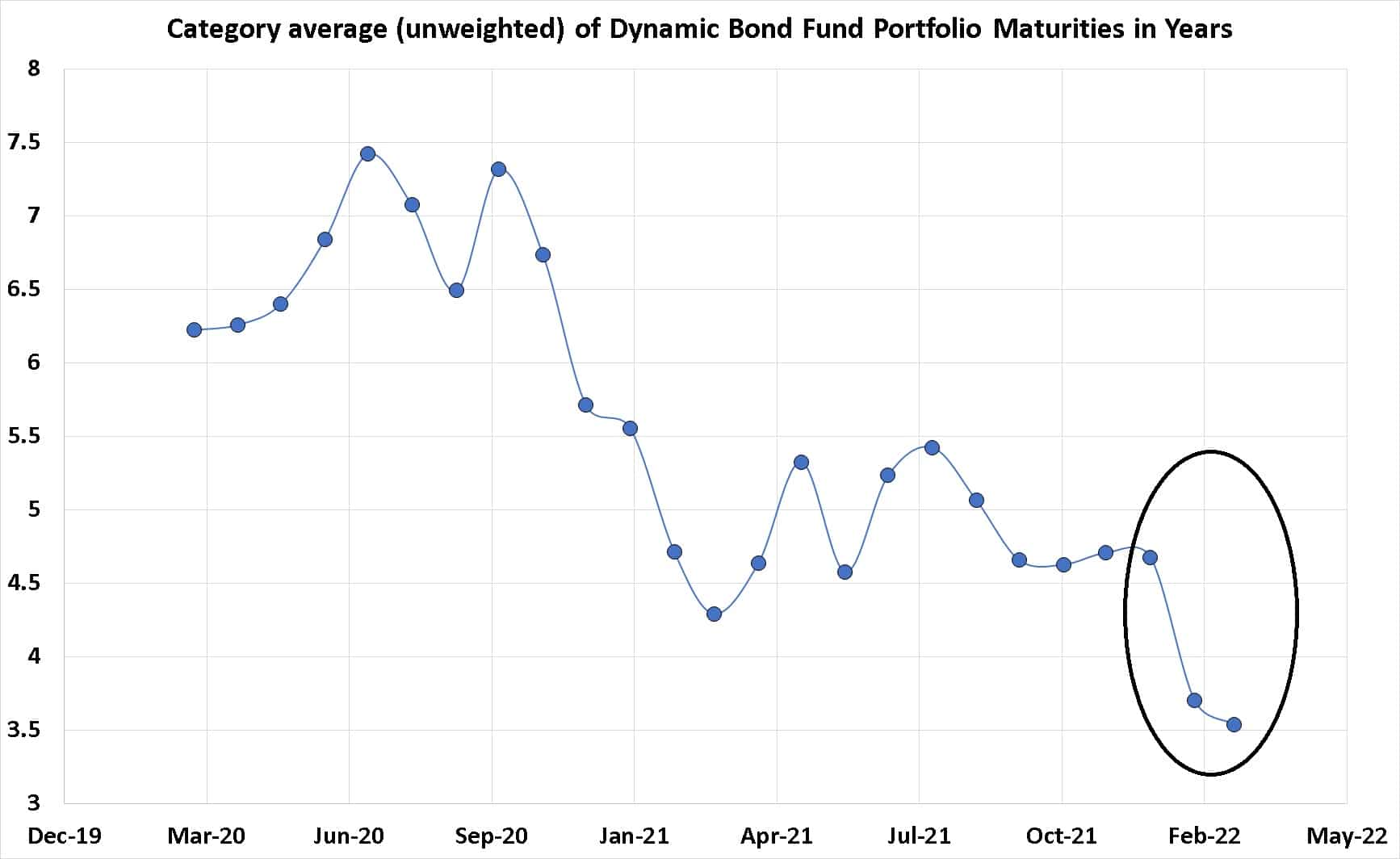
Next, we consider the percentage change in average portfolio maturity from Dec 2021 to March 2022.
| Fund | Change |
| ITI Dynamic Bond Fund-Reg(G) | -96% |
| IDBI Dynamic Bond(G) | -73% |
| L&T Flexi Bond Fund-Reg(G) | -68% |
| Tata Dynamic Bond Fund-Reg(G) | -65% |
| Quantum Dynamic Bond Fund(G)-Direct Plan | -59% |
| PGIM India Dynamic Bond Fund(G) | -56% |
| UTI Dynamic Bond Fund-Reg(G) | -53% |
| Union Dynamic Bond(G) | -42% |
| Aditya Birla SL Dynamic Bond Fund-Reg(G) | -33% |
| Baroda BNP Paribas Dynamic Bond Fund(G) | -26% |
| ICICI Pru All Seasons Bond Fund(G) | -17% |
| IDFC Dynamic Bond Fund-Reg(G) | -13% |
| DSP Strategic Bond Fund-Reg(G) | -9% |
| Mirae Asset Dynamic Bond Fund-Reg(G) | -9% |
| Mahindra Manulife Dynamic Bond Yojana-Reg(G) | -8% |
| HDFC Dynamic Debt Fund(G) | -7% |
| IIFL Dynamic Bond Fund-Reg(G) | -5% |
| Nippon India Dynamic Bond(G) | -5% |
| JM Dynamic Bond Fund-Reg(G) | -4% |
| Axis Dynamic Bond Fund-Reg(G) | -3% |
| Canara Rob Dynamic Bond Fund-Reg(G) | -2% |
| SBI Dynamic Bond Fund-Reg(G) | 3% |
| Kotak Dynamic Bond Fund-Reg(G) | 8% |
Most funds have reduced decreased exposure to longer-term bonds since Dec 2021. Some have drastically changed portfolio character while funds from SBI and Kotak have marginally increased exposure to long-term bonds.
Funds with drastic changes in bond tenure typically have low AUM. For example:
| Fund | March 2022 AUM (Crores) |
| ITI Dynamic Bond Fund-Reg(G) | 24.5040 |
| IDBI Dynamic Bond(G) | 19.1296 |
| L&T Flexi Bond Fund-Reg(G) | 57.8501 |
| Tata Dynamic Bond Fund-Reg(G) | 168.6028 |
| Quantum Dynamic Bond Fund(G)-Direct Plan | 85.6402 |
| PGIM India Dynamic Bond Fund(G) | 125.2633 |
| UTI Dynamic Bond Fund-Reg(G) | 354.8948 |
Whereas some of the large funds have not change their portfolio much.
| Fund (Change in Avg maturity from Dec 21 to March 22) | March 2022 AUM (Crores) |
| ICICI Pru All Seasons Bond Fund(G) (-17%) | 6062.2324 |
| IDFC Dynamic Bond Fund-Reg(G) (-13%) | 2677.4547 |
| Nippon India Dynamic Bond(G) (-5%) | 4507.0992 |
| Axis Dynamic Bond Fund-Reg(G) (-3%) | 2467.2599 |
| SBI Dynamic Bond Fund-Reg(G) (+3%) | 2389.1505 |
| Kotak Dynamic Bond Fund-Reg(G) (+8%) | 2274.5155 |
Although it cannot be said conclusively, the lower AUM funds seem to have higher “flexibility”.
In summary, most dynamic bond funds have started shifting to shorter-term bonds over the last few months. They are likely to continue in this vein in the near future as a rate hike is expected in the next quarter. Investors holding debt mutual funds suitable for their long term goals after understanding the underlying risks need not react to this development.