This is a performance review of ICICI Prudential Equity & Debt Fund (previously called ICICI Balanced) and a comparison with ICICI Prudential Balanced Advantage Fund. Let us find out how these funds have fared against equity benchmarks and discuss when to choose which fund. Let us start with the basics.
What is the difference between a balanced fund and a balanced advantaged fund?
I have discussed this difference in detail before: Balanced Advantage vs Aggressive Hybrid Funds: When to use what. The essential idea is that a balanced fund or aggressive hybrid fund as they are called now hold a minimum of 65% direct equity and up to 80%. The rest in bonds. In a balanced advantage fund, the direct equity allocation can swing from 40% to 80% depending on market conditions. To maintain equity fund status, the fund manager will use derivatives (arbitrage) to ensure min 65% effective equity.
Therefore, the balanced advantage fund or dynamic asset allocation fund will use market timing models while the balanced fund or aggressive hybrid fund typically will not.
As previously discussed ICICI Prudential Balanced Advantage Fund: packs performance with low volatility and is a fantastic first fund for new equity investors who are scared of market volatility. In this post, let us see why ICICI Prudential Equity & Debt Fund is also a good choice for any investor who does not mind a bit more risk and a decent chance of higher returns.
🔥Secure your future with our Robo-advisory tool trusted by over 3,500 investors and advisors. From effortless retirement planning to funding your children’s biggest dreams, turn your financial goals into reality. 🔥
ICICI Prudential Equity & Debt Fund: About the fund
Launched in Nov 1999, the fund has grown in popularity and size to about 26.7 thousand crores Co-managed by ICICI’s go-to man Sankaran Naren since Dec 2015. You can expect this fund to follow the general philosophy adopted by Value Discovery, Balanced Advantage and Dynamic Fund (multi-asset).
That is a mix of growth and value style investing with a dash of PB based market timing. Since there is not much scope in the asset allocation for variations, the timing element is not expected to play a significant role. The debt part of the portfolio can also be expected to take duration calls depending on interest rate movements.
There can be no doubt that Naren is one of the (if not, the) best fund managers in the country. However he now “manages” about 40 funds (many of them closed-ended)!! Over the years, one could see that whenever a fund was in trouble or when the AMC decided to push a type of fund, Naren would be added as a fund manager. The result was almost always positive.
This, however, could also be the biggest drawback. Too much dependence on Naren. On the basis of regular dividends, the AUM in both ICICI Prudential Equity & Debt Fund and balanced advantage has rapidly swelled in the recent past. So how long the performance will last, how long will the Naren magic last are concerns that both investors and potential investors have to consider.
Rolling returns and risk (3,4,5 years)
In what follows let us look at rolling returns and rolling risk over 3,4,5 years. This is a pretty short period though. The comparison will include balanced advantage, NIfty 100 and Nifty 100 Equal Weight. The fund itself is benchmarked to Crisil Aggressive Hybrid with 65% of NIfty, but that is too easy a benchmark to beat.
Also, in this age of index investing, it makes perfect sense for active investors to choose hybrid funds with guaranteed lower risk (compared to equity indices) and comparable or even better returns. Of during huge bulls runs, hybrid funds may not shine as much but that is not as important as the performance during bear markets.
Three years
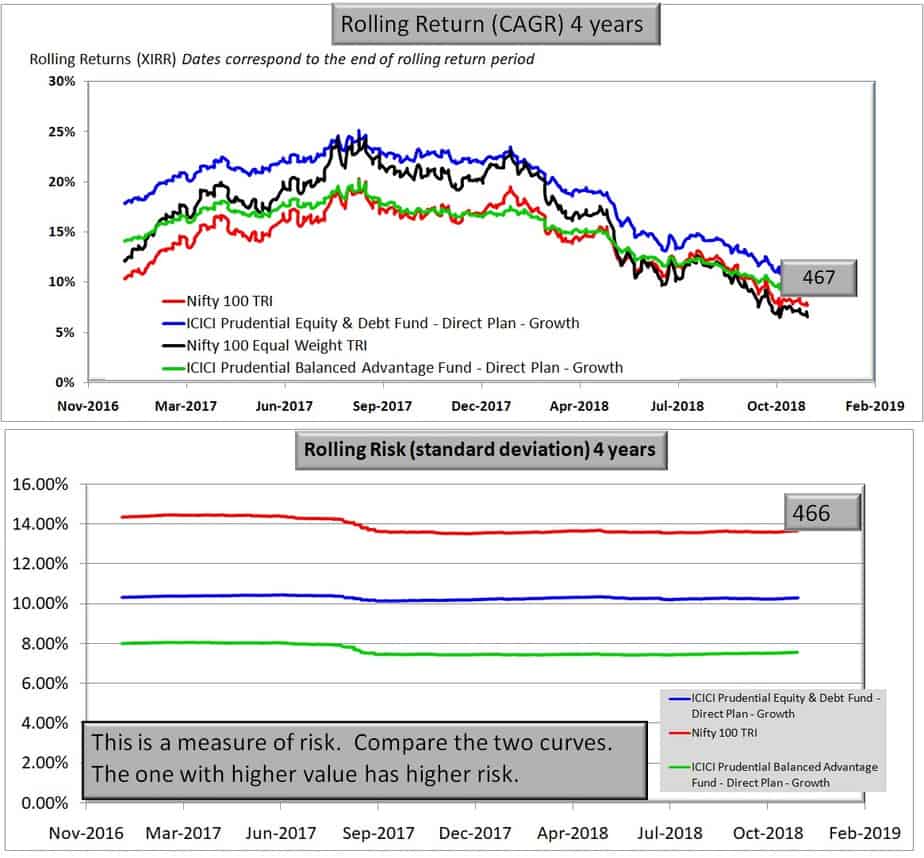
Four years
Five years
That is pretty awesome! Compared to Nfity 100, ICICI Prudential Equity & Debt Fund has delivered higher returns at lower and balanced advantage has delivered comparable returns at even lower risk!
Of course, it is important to keep in mind that this is over a short time frame and the return outperformance may not last. The point is that it need not! You should still get decent returns are lower risk.
Compared to the Equity and Debt fund, Balanced advantage is lower-risk, lower-return option but it is expected and not a problem.
Performance Fingerprint (5 years)
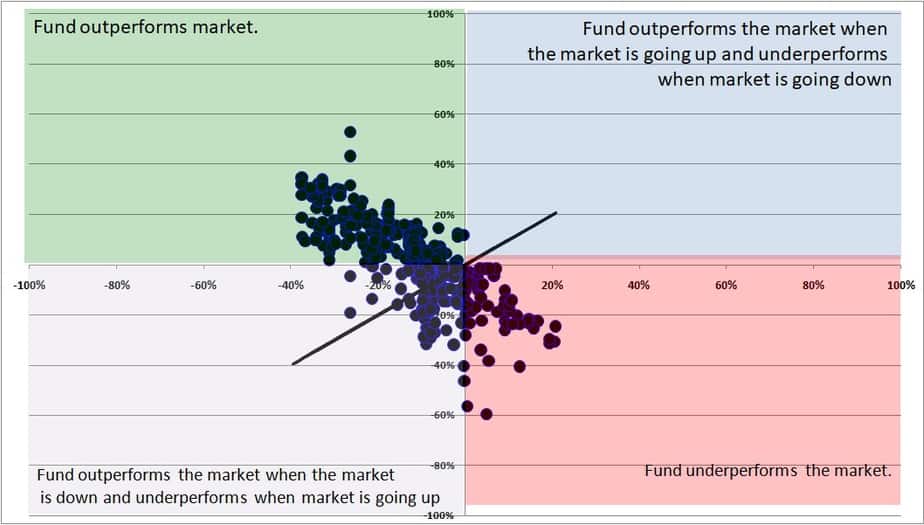
This is the performance fingerprint of ICICI Equity and Debt fund vs Nifty 100 TRI. Monthly returns are compared and binned into four categories as shown below.
That is pretty awesome for a hybrid fund compared with a pure equity index. Of course, this is due to the small debt allocation and periodic rebalancing cushion the fund during bad market movements. So people who think higher equity means higher returns are wrong.
This is the reason why I keep saying, if you are worried about index funds, then shift your portfolio to active hybrid funds. You will get guaranteed lower risk, decent returns that often might beat equity index returns and the expense ratio is justified. You can learn more about this here:
Summary
So in conclusion, ICICI Prudential Equity & Debt Fund is a compelling pick provided the investor is wary of sudden jumps in AUM and dependence on Naren for outperformance. It is important to keep in mind that we have only considered a small slice of history and outperformance of pure equity indices may not always be possible. So invest with an understanding of risk and reward.
Video Version of the review
Check out the latest video and other fund reviews from the freefincal youtube channel
Do share this article with your friends using the buttons below.
Create a complete financial plan with our Robo-advisor!
Trusted by 3500+ investors and advisors! Use code robo25 for a 20% discount!