Last Updated on December 29, 2021 at 12:59 pm
The importance of the banking sector in providing stability and growth to an economy is something that even a non-expert can intuitively understand. Among their many roles, the one most relevant for an investor is funding both trade, enterprise, businesses and consumerism. We recently discussed MNC Funds as an alternative to large cap fund. So I wanted to find out how well banking indices have fared against Nifty 50 and ended up realising that it is time for private bank ETFs.
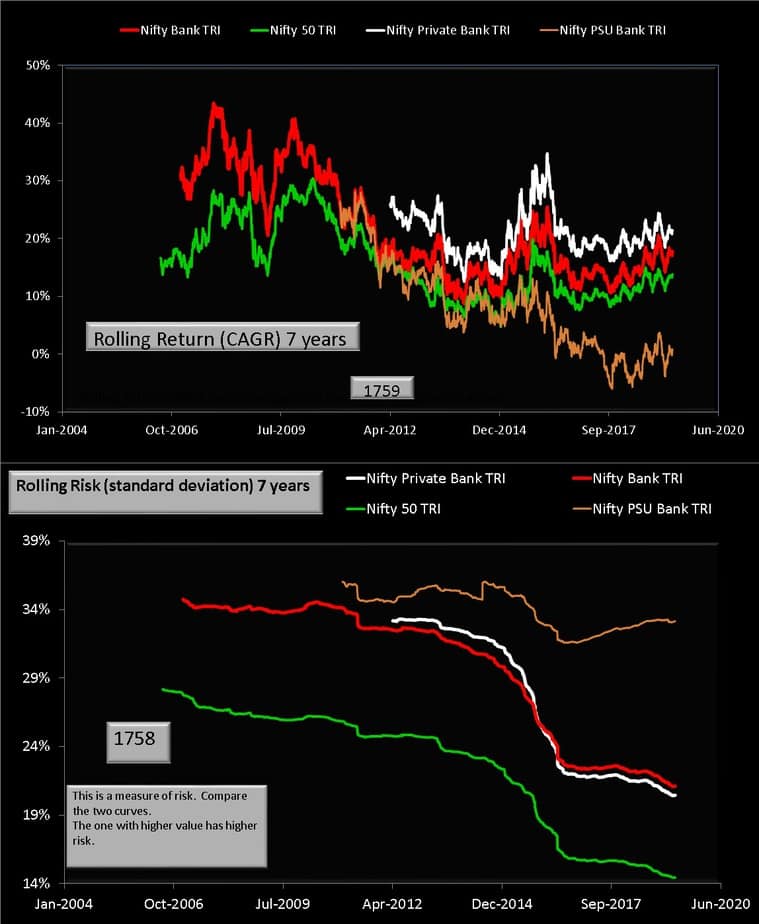
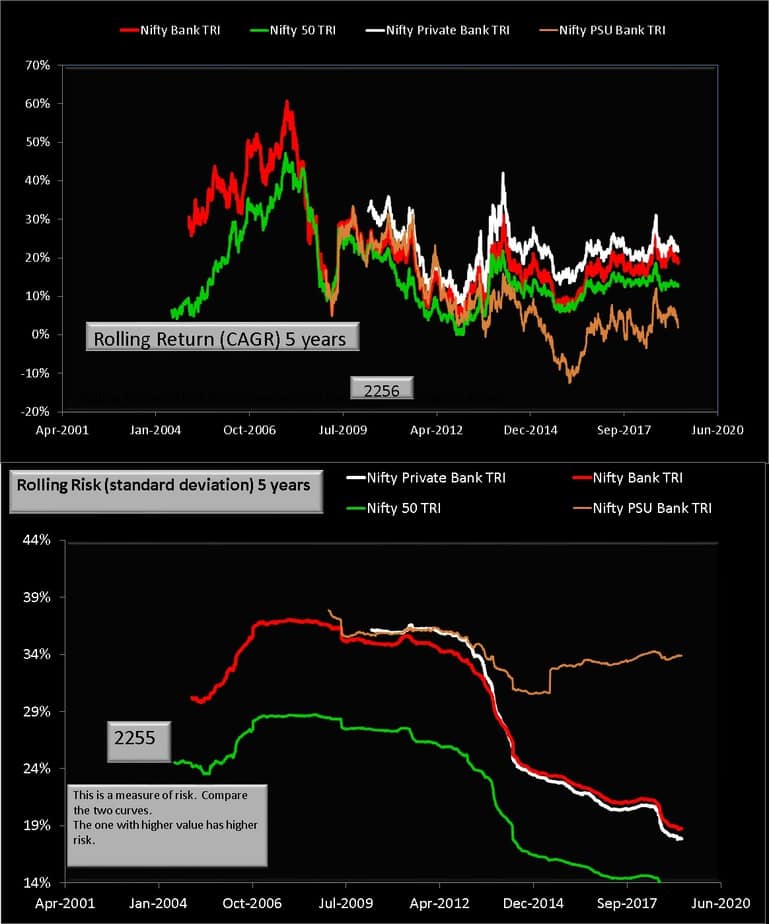
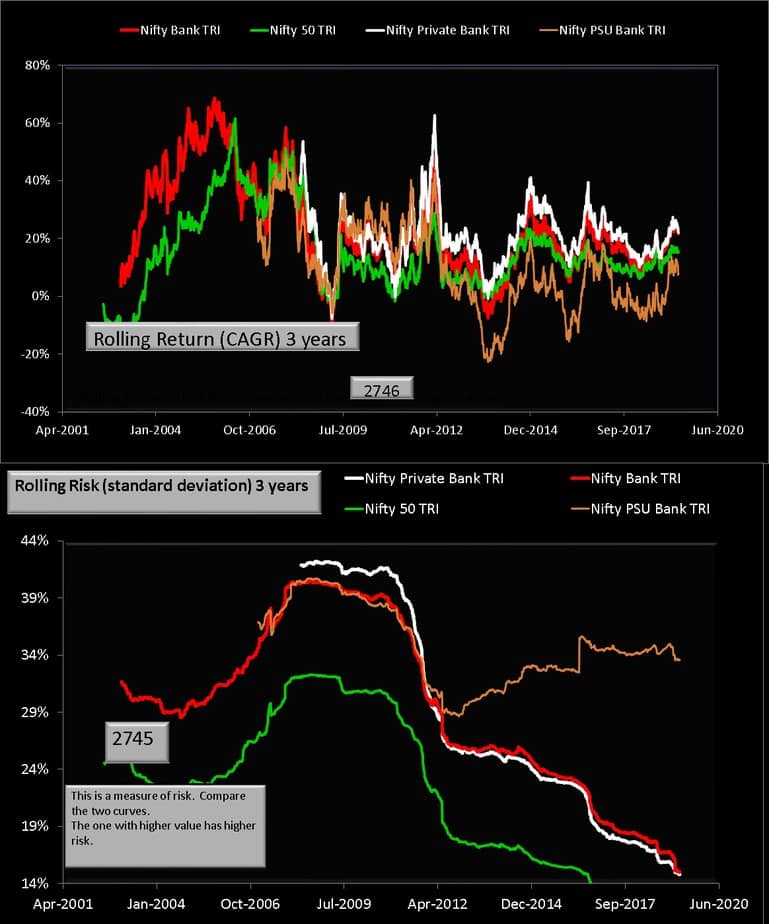
Even before we consider any results, two aspects of banks should be reasonably clear. (1) Compared to Nifty, the banking index would be a guaranteed high-risk with a potential high reward option. (2) More importantly, we still have PSU banks or banks where the government holds the major stake. And we know that PSU banks have been suffering due to rising non-performing assets. With this background let us dive straight into the rolling returns and rolling risk for four indices: Nifty, Nifty Bank, Nifty PSU Bank, Nifty Private Bank.
Update: We have two of them now: one from ICICI and one from TATA. Thanks to the @TheWokeIndian2 on Twitter
Nifty vs Nifty PSU Bank vs Nifty Private Bank: 7 years
🔥Secure your future with our Robo-advisory tool trusted by over 3,500 investors and advisors. From effortless retirement planning to funding your children’s biggest dreams, turn your financial goals into reality. 🔥
Subscribe for money management solutions via email! (Link takes you to our email sign-up form) Join 32,000+ readers in our community.
👉 New Tool Alert! NaviPlan: A Privacy-Focused Multi-asset Tracker and Goal Planner 👈
Nifty vs Nifty PSU Bank vs Nifty Private Bank: 5 years
Nifty vs Nifty PSU Bank vs Nifty Private Bank: 3 years
Impression
Notice how Nifty Private Bank has consistently outperformed both NIfty 50 and Nifty Bank. Also, notice how the risk associated with PSU banks has significantly shot up recently. Although Nifty Private Bank Index is more volatile than Nifty, it has provided superior returns more often than not. This data underlines the needs for a Private Bank ETF or Index funds.
List of Banking Mutual Funds
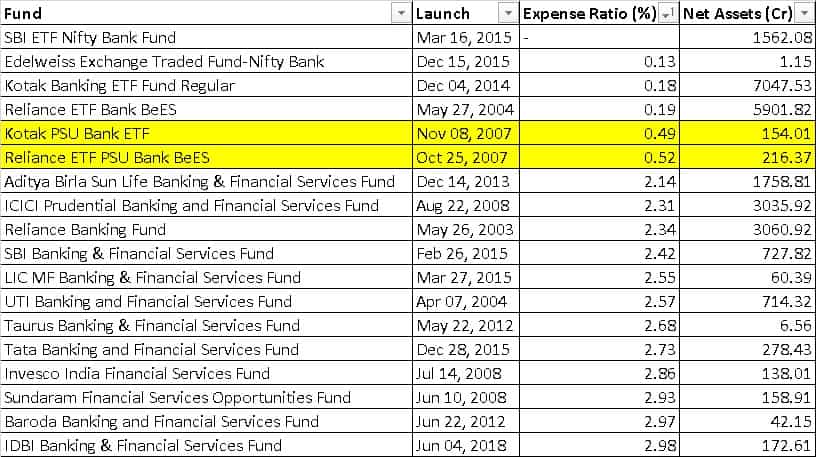
Notice that there are two PSU ETFs, but not private bank index based index fund or ETF. Notice also that the expense ratios are pretty steep! This includes direct plans as well (see below). Source: Value Research (as on April 2019)
| Fund (DIRECT Plans) | Expense Ratio (%) |
| IDBI Banking & Financial Services Fund | 0.75 |
| Invesco India Financial Services Fund | 0.98 |
| Tata Banking and Financial Services Fund | 0.99 |
| ICICI Prudential Banking and Financial Services Fund | 1.16 |
| Aditya Birla Sun Life Banking & Financial Services Fund | 1.29 |
| Reliance Banking Fund | 1.38 |
| UTI Banking and Financial Services Fund | 1.53 |
| LIC MF Banking & Financial Services Fund | 1.58 |
| SBI Banking & Financial Services Fund | 1.6 |
| Taurus Banking & Financial Services Fund | 2.08 |
| Sundaram Financial Services Opportunities Fund | 2.19 |
| Baroda Banking and Financial Services Fund | 2.35 |
Can the Nifty Bank be used instead of Nifty Private Bank Index?
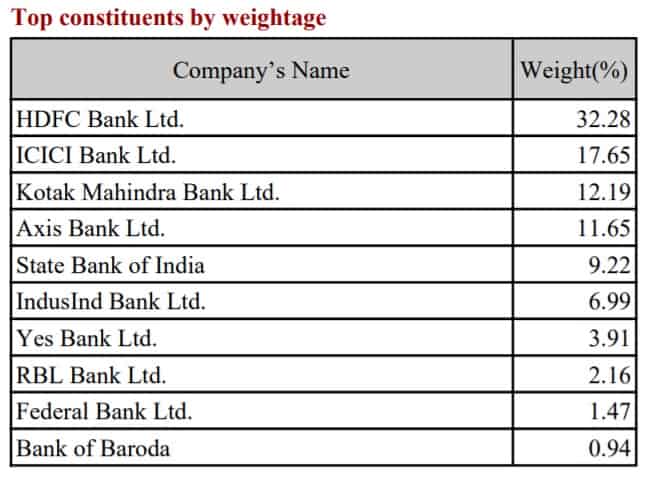
The Nifty Bank is only a bit less rewarding than the Nifty Private Bank Index because is dominated by Private Banks. See the current top 10/12 stocks.
Who can invest in Nifty Bank or Nifty Private Bank Indices?
Now, that is a troublesome question! Clearly, it is not for everyone. Clearly, it is not a replacement for large caps as the risk is much higher. It can work for someone with a higher risk digestive capacity (not just appetite), but the exposure has to be significant to make a difference. Want to dig deeper into this? Then check out Kotak Banking ETF Fund with an impressive 7000+ crore AUM. Find out its trading volumes, price NAV differential etc. It would be nice if someone comes up with a smart beta private bank index/ETF or stock basket and back-test it.
Warning: I have written this article as a curious analyst and not as an interested investor. I would suggest that you also read it in the same vein.