Last Updated on September 15, 2025 at 11:44 am
This is a performance review of SBI Bluechip Fund. Started in Feb 2006, it has grown to become one of the biggest large cap funds with 22746.36 Cr as on 30 Sep 2019, much of it in recent years. Does it make sense to invest in this fund anymore or shift to a Nifty 50 index fund? Let us find out.
From May 2018, the fund’s investment mandate became tighter. Earlier it had no specific restriction on market cap, although it was primarily a large cap fund. It could invest in bonds up to 30%. Now, 80% of its portfolio from the top 100 stocks by market cap.
According to AMFI, 69% of the AUM comes from the regular plan, growth option, 5% from regular plan dividend option, 24% from direct plan growth option and 2% from direct plan dividend option. For an AMC associated with a bank, the 26% direct contribution is impressive.
The scheme follows a blend of growth and value style of investing with a combination of a top-down and bottom-up approach to stock-picking strategies. In a top-down strategy, the fund manager will consider the stock only after evaluating the sector and the economy. In a bottom-up approach, the stock will be considered first.
🔥Secure your future with our Robo-advisory tool trusted by over 3,500 investors and advisors. From effortless retirement planning to funding your children’s biggest dreams, turn your financial goals into reality. 🔥
Subscribe for money management solutions via email! (Link takes you to our email sign-up form) Join 32,000+ readers in our community.
👉 New Tool Alert! NaviPlan: A Privacy-Focused Multi-asset Tracker and Goal Planner 👈
In Dec 2018, I had reported that Only Five Large Cap funds have comfortably beat Nifty 100! SBI Bluechip Fund was one of them. So the fund has a good track record in spite of the swell in AUM. The questions are, (1) was it because investing outside the index? (2) Will it be possible to maintain this in future? Let us dig deeper.
SBI Bluechip Fund: Basic Scheme Details
| Type | Open-ended scheme | |
| Asset | Equity | |
| Category | Market Cap Fund | |
| Sub Category | Large Cap Fund | |
| Inception Date | 14-02-2006 | |
| Fund Manager | Sohini Andani | |
| Objective | To provide investors with opportunities for long-term growth in capital through active management of investments in a diversified basket of large cap equity stocks (as specified by SEBI/AMFI from time to time). | |
| Minimum Investment | 5000 | |
| Incremental Investment | 1000 | |
| Exit Load | For exit within 1 year from the date of allotment 1% allotment – 1 % allotment – 1 %; For exit after 1 year from the date of allotment – Nil | |
| AUM (30-Sep-2019) | 22742.5027 (Cr.) | |
| Expense Ratio | 1.07 Direct 1.89 Regular | |
| Benchmark | S&P BSE 100 – TRI (Benchmark) | |
| Additional Benchmark | S&P BSE SENSEX – TRI (Benchmark) | |
| Investment Pattern | Minimum | Maximum |
| Debt instruments (including securitized debt) | 0 | 20 |
| Equity and equity-related instruments of large cap comp (including Derivatives) | 80 | 100 |
| MMI | 0 | 20 |
| Other equities and equity-related instruments | 0 | 20 |
| Units issued by REIT/InVIT | 0 | 10 |
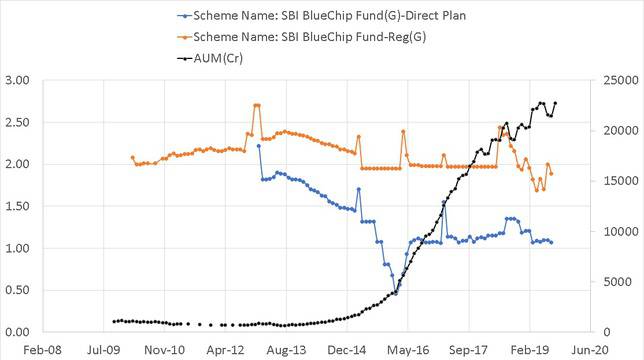
Expense Ratio and AUM History
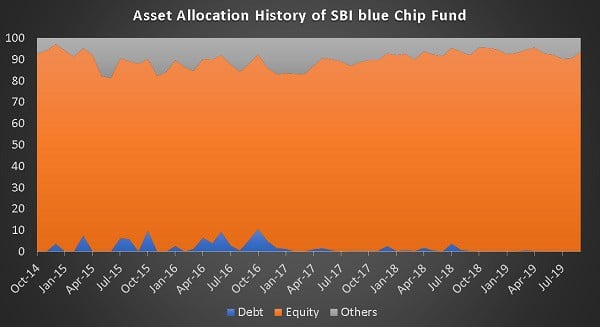
Asset Allocation History
The fund has maintained close to 90% exposure in stocks for much of its history (although it had the mandate to operate as a balanced fund with up to 30% bond exposure before May 2018)
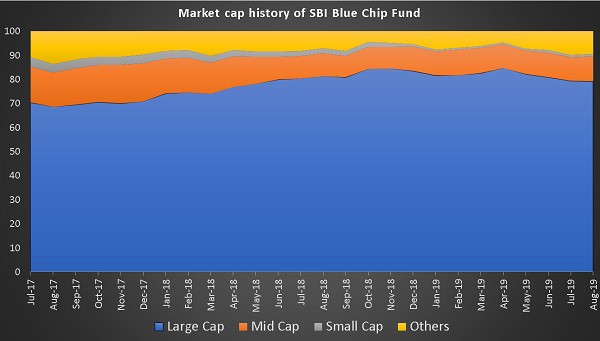
Market Cap History
Notice the gradual decrease in small cap exposure and mid cap exposure. This the main reason many believe that going forward large cap funds may not be able to beat the index.
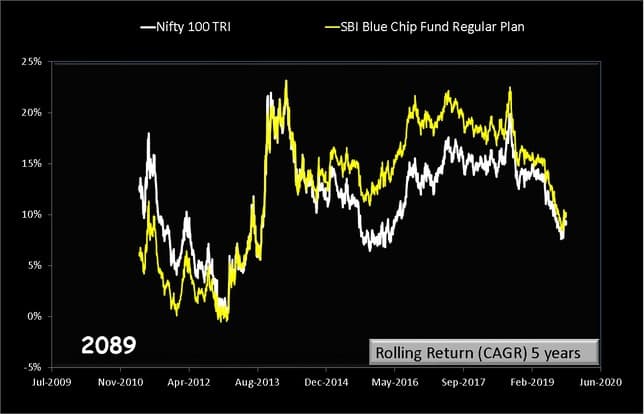
SBI Blue Chip Fund vs Nifty 100 TRI
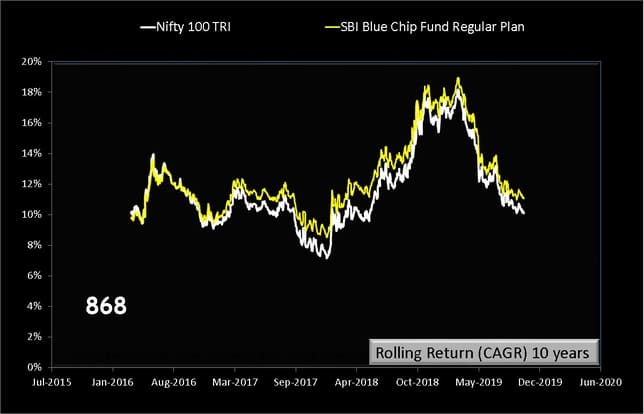
Let us check how the fund has fared against Nifty 100 (equivalent to BSE 100) over every possible 3, 5, 7 and 10 year periods. The number of returns considered is indicated in the plots.


Can this outperform Nifty 100?
Its volatility has always been lower than that of Nifty 100, but the return performance is not consistent enough. Naturally, we cannot predict if it will outperform Nifty 100 in the future with or without this data. However, a good track record allows us to take that chance.
I am afraid this (or most other active large cap funds) do not have such a record. Even when these funds were not restricted by the SEBI, they had trouble beating Nifty 100 (or Nifty). This is the reason I do not recommend active large cap in my handpicked List of Mutual Funds October 2019 (PlumbLine).
SBI Blue Chip Fund vs Peers
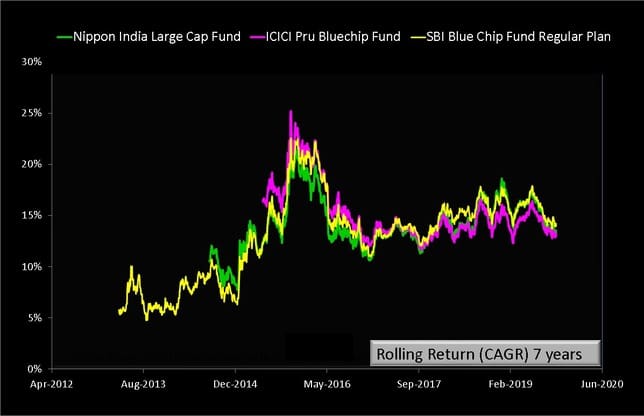
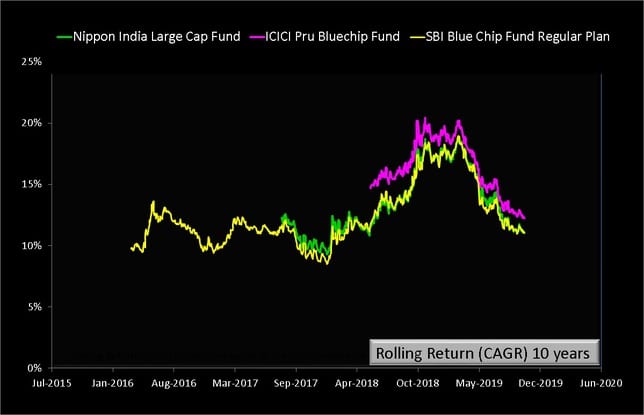
Shown below is the rolling returns comparison of SBI Bluechip with ICICI Bluechip and Nippon India Large Cap (Reliance Large Cap, previously Reliance Top 200).
Summary: Should you invest?
No. New investors should give this fund a miss and stick Nifty 50 and Nifty Next 50. For example see: Combine Nifty & Nifty Next 50 funds to create large, mid cap index portfolios. Old investors should also consider a gradual shift to either index fund or aggressive hybrid or multi-asset or balanced advantage funds