Last Updated on October 1, 2023 at 5:43 pm
A review of SBI Small Cap Fund previously called SBI Small & Midcap fund. The small cap mutual fund space is an adrenalin filled rough ride not suited for many. Spectacular returns in a short time is often followed by extended periods of meagre returns. This segment is most sensitive to AUM increases as the stock universe is rather limited. Funds have found it necessary to completely or partially stop inflow. SBI Small Cap Fund with only an AUM of about 1450 crores is no exception.
Regular readers maybe aware that I have been against investing in small cap funds and my Handpicked Mutual Funds January 2019 (PlumbLine) has none.Therefore please interpret the following as an analysis and not investment advice. I think any good mid cap fund will have all the small cap stocks that one ever needs in a portfolio. Before you assume investing in mid caps or small stocks is a better bet over the long term, check out these results: Large Cap vs Mid Cap vs Small Cap Funds: Which is better for long term investing?
If you do wish to consider SBI Small Cap for investment, do so only if you do not have a small cap fund in your portfolio. Kindly note I shall take no responsibility for your investment gains or losses if you choose to invest in this fund or any other fund that I have reviewed. I shall repeat the warning that the small cap mutual fund space is fraught with danger and if you do invest, make sure you book profits periodically using technical indicators like moving averages.
🔥Secure your future with our Robo-advisory tool trusted by over 3,500 investors and advisors. From effortless retirement planning to funding your children’s biggest dreams, turn your financial goals into reality. 🔥
Subscribe for money management solutions via email! (Link takes you to our email sign-up form) Join 32,000+ readers in our community.
👉 New Tool Alert! NaviPlan: A Privacy-Focused Multi-asset Tracker and Goal Planner 👈
Why SBI Small Cap Fund?
If I put myself in the shoes of an investor looking to add a small cap fund for the first time and look at the list of small cap funds, the following are the funds with an AUM of 1000 Cr and above (AUM on the right-most column and date of inception is in the middle)
| Reliance Small Cap Fund | Sep 16, 2010 | 7461.29 |
| Franklin India Smaller Companies Fund | Jan 13, 2006 | 6982.74 |
| HDFC Small Cap Fund – Regular Plan | Apr 03, 2008 | 6013.22 |
| L&T Emerging Businesses Fund | May 12, 2014 | 5630.77 |
| DSP Small Cap Fund – Regular Plan | Jun 14, 2007 | 4910.35 |
| Aditya Birla Sun Life Small Cap Fund | May 31, 2007 | 2231.89 |
| SBI Small Cap Fund | Sep 09, 2009 | 1438 |
| Sundaram Small Cap Fund – Regular Plan | Feb 15, 2005 | 1088.3 |
| Kotak Small Cap Fund – Regular Plan | Feb 24, 2005 | 1067.41 |
All the funds at the bottom in bold were small and mid cap funds and have recently become small cap funds due to the SEBI regulations. Out of these, by sheer instinct I would avoid the Sundaram fund and consider the rest. Just think of this post as looking at SBI small cap in depth. The ABSL fund is compared with SBI small cap below and is also worthy of a closer look.
I think new small cap investors should avoid large aum small cap funds as they may have trouble performing in this space. They should also keep an eye out for changes in AUM. Also as mentioned above, they should not hesitate to book profit to large caps or to debt
SBI Small Cap Fund: Old vs New Investment Strategy
SBI Mutual Fund announced that from May 15th 2018 onwards its Small and Mid cap fund would become a small cap fund. Earlier it defined small cap as the bottom 100/500 in terms of market cap and could invest between 50 -70% in small caps. It also had a capacity constraint clause of 750 crores. As a result, the scheme closed for subscription in October 2015 and re-opened via SIP route only since May 2018. The scheme can now invest 65-100% in small caps defined as bottom 250 stocks in terms of market cap. The benchmark for the fund remains S&P BSE Small Cap Index
The restriction to inflow via SIP is reasonably justified in this space at all times. It would however be better if there is a restriction on the max investment per month per Pan Card as this would also include SIPs.
Fund manager R. Srinivasan has been at the helm since Nov 2013. His first serious challenge was the correction in the small cap space from Jan 2018. The last 1Y trailing return of the fund is -20.7% This is 1% less than the category average but a good 7% more than NIFTY Small cap 250 TRI
SBI Small Cap Fund vs Peers: rolling returns and risk
AMFI only provides NAV data for this fund from Nov 2013 and I could not download earlier NAV from the AMC site. So we will have to restrict the analysis to three year rolling returns and risk. We shall consider two comparison sets below. Note I have not checked the change in investment strategy in these peers. They could have been more of a mid cap fund than a small cap fund in the past. Please excercise due diligence.
Comparison set one
SBI Small Cap vs
- Nifty Small Cap 250 TRI
- Franklin Smaller Companies
- DSP Small Cap (micro cap)
- L&T Emerging Business
- HDFC Small cap
- Reliance small cap
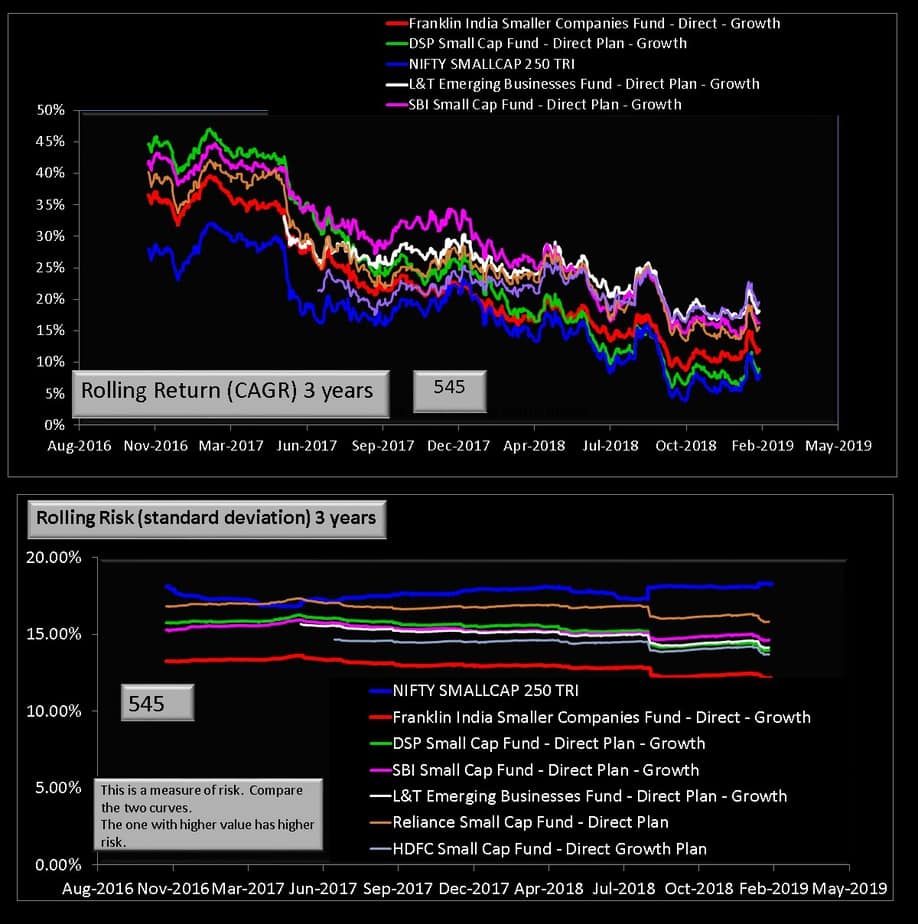
This covers a period an investment period from Nov 2013 to Jan 2016 and hence returns are plotted three years later. Notice that the SBI Small Cap Fund has done quite well in terms of return but is more volatile than many of its peers.
Comparison set two
SBI Small Cap vs
- ABSL Small Cap Fund
- Sundaram Small Cap Fund
- Kotak Small Cap Fund
- Nifty Small cap 50 TRI
- Nifty Midsmallcap 400 TRI
This NSE chart helps in understanding index classification. Also watch my talk on index investing: Can we get higher returns with lower risk?

Again SBI Small Cap fund has done quite well in comparison to peers and benchmarks.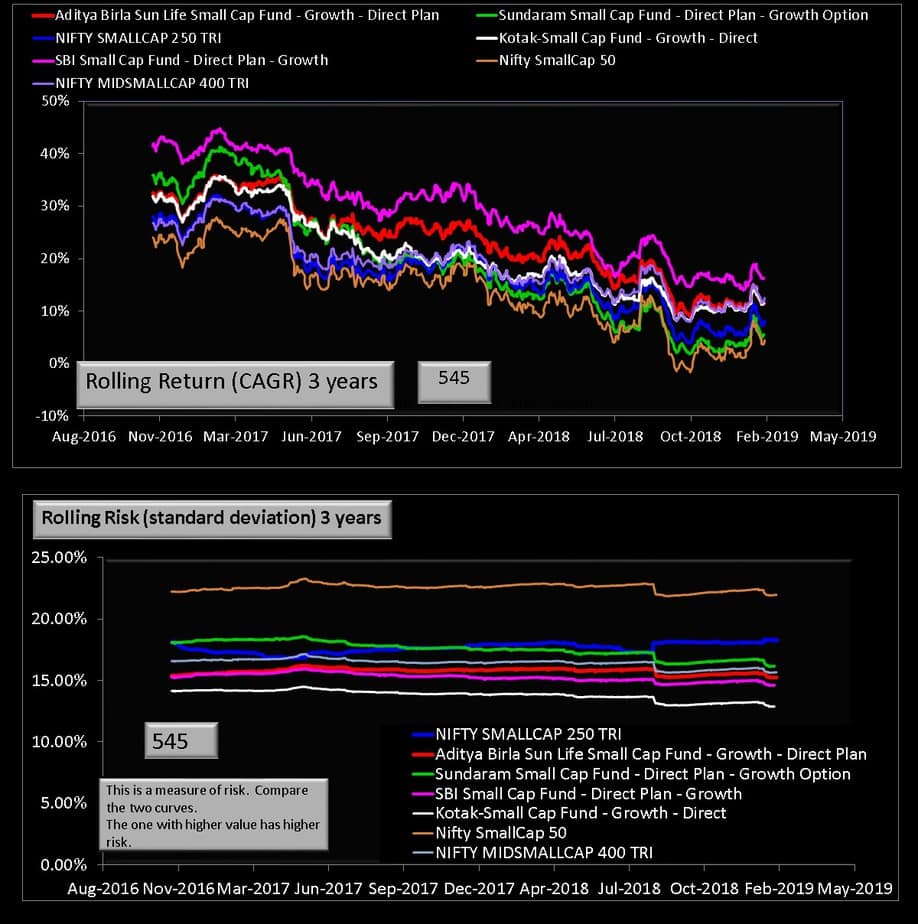
It is a bit more volatile but investors in this space are not for low volatility!
Summary
I reiterate my stance that one does not need a small cap fund. If you so desire please keep the following in mind
- Choose a fund with low AUM
- Watch out for AUM surges
- Use technical indicators like moving averages to periodically move in and move out of small cap funds from say a large cap holding or debt.
SBI Small cap fund in the limited period of observation has performed well and can be considered by a first time investor in a small cap fund. Existing investors in other small cap funds need not shift but must have a solid strategy in place else all the returns obtained will vanish in an instant.