Last Updated on December 29, 2021 at 5:33 pm
The real risk associated with equity markets is not a huge fall. That often results in a strong upward movement sooner than later. The real risk lies in lost time when the market heads nowhere. Over 10 years, 15 or 25 years, one could make huge absolute gains but poor annualised returns if we hit upon an extended sideways market.
A sideways market is one in which the index neither moves up or down too much. Naturally one can talk about a bull run or bear run or sideways market only by looking at the rear-view mirror, but that is how it is with our returns too.
After the Harshad Mehta scam broke, the Sensex went nowhere for 10-years. That was our very own lost decade as the govt was bankrupt (hence EPF, PPF gave 12%) and the economy just starting to open up.
🔥Secure your future with our Robo-advisory tool trusted by over 3,500 investors and advisors. From effortless retirement planning to funding your children’s biggest dreams, turn your financial goals into reality. 🔥
Subscribe for money management solutions via email! (Link takes you to our email sign-up form) Join 32,000+ readers in our community.
👉 New Tool Alert! NaviPlan: A Privacy-Focused Multi-asset Tracker and Goal Planner 👈
Consider this bizarre example: A man buys one unit of Sensex (let us assume index investing was possible then) just days before the Harshad Mehta scam broke on 30th March 1992 with the index at 4091.43 (arrows below). Over the next 25 years, he kept his unshakable faith in Equity and held on to his investment, no matter what. Finally, on 24th March 2017 with the index at 29421.40 (619% increase), he checks the annualized return he has got. What would be the result of this calculation? This is before dividends. Add 1.5% to 2% to the return due to dividends.
That is 8% return before dividends! Is the sufficient reward for “patience” and “discipline”? Naturally, when I offer this example, investors and especially sales guys complain, “this is cherry-picking. Average returns are much better”.
“Never forget the six-foot-tall man who drowned crossing the stream that was five feet deep on average. It’s not sufficient … to survive on average. We have to survive on the bad days.” — Howard Marks.
Our financial plan has to be prepared for the worst-case scenario. Let us consider two more examples. The Sensex closed on 4084 on Feb 22, 1994, and was 20464 on Feb 17, 2014. Again, if you look at only that information, it seems awesome – a 400% increase but the annualised return is only 8% (excl dividends but that does not mean much, see below).
The reason for the poor returns despite huge absolute gains is “time” or “bad timing” or “timing luck”. While the annualised return calculation assumed a smooth increase as the brown dots below, in the real world, our investment growth can be delayed by a poor sequence of returns.
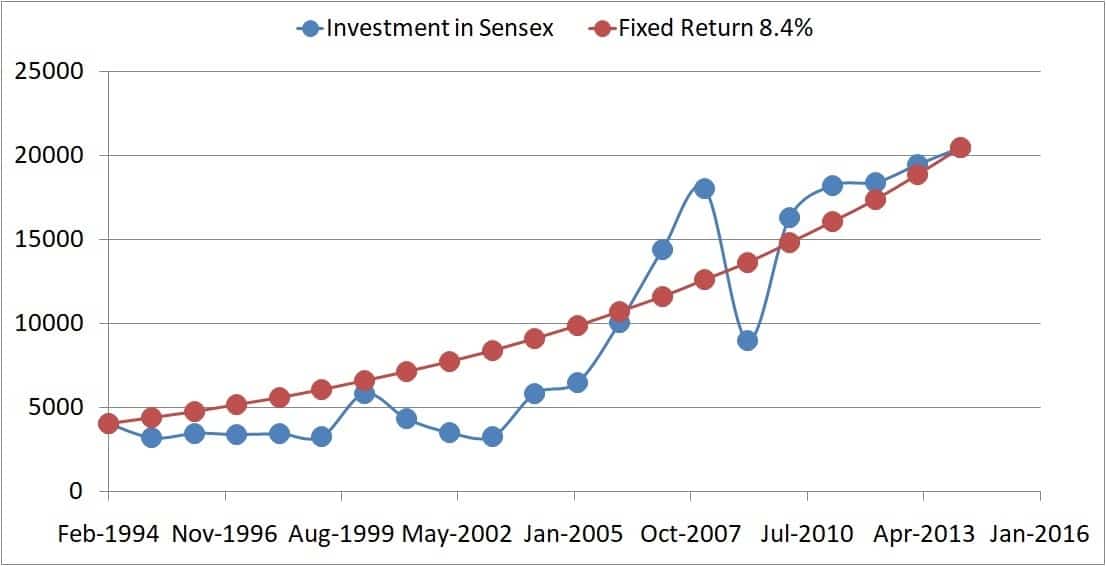
Observe how sideways market of the 90s affected growth significantly, much more than than the 2008 crash. A more recent example including dividends would help.
This also has been cherry-picked: after the 2008 recovery and before the 2020 crash. The Nifty TRI moved from 6168 on 18th Sep 2009 to 15412 on 15th Sep 2019, 150% gain but only 9.6% annualised return. The dates are marked in red dots below.
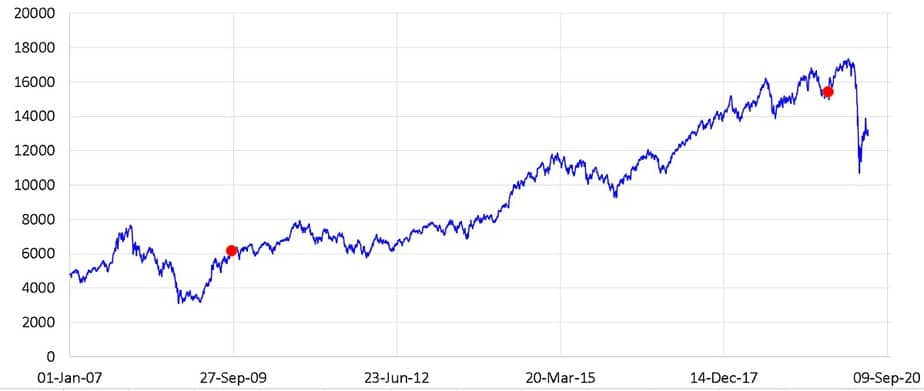
It is about 4+ years for the market to move up out of the total 10-years and some month were lost in fall and recovery after that, leading to poor returns (this time including dividends).
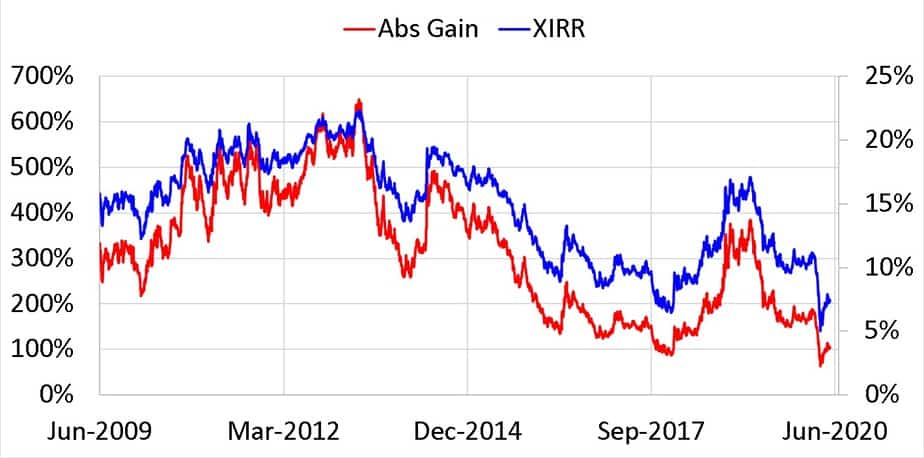
This is the full 10-year rolling returns graph with annualized and absolute returns. Absolute returns do not factor time and so even after the 2020 crash when XIRRs was 5-6%, the gain was 75-80%!!
How should investors tackle a sideways market?
A sideways market is an opportunity, but not your friend!
- When a sideways market occurs at the start of an investment journey it is a great time to invest in equity. However, if it lasts too long, then returns will suffer.
- While a return estimate is necessary to determine “how much to invest”, it is better to base that estimate with severe examples as above or at the very least be conservative.
- Since returns are not in our control, the only way to get close to the corpus required for a future expense is to (a) invest enough systematically (b) vary asset allocation or reduce equity exposure systematically.
- The lectures on goal-based portfolio management answer this specific question; how to manage a portfolio so that we can handle any sequence of return: bull, bear market or sideways market.