Last Updated on December 29, 2021 at 5:33 pm
One of the biggest mistakes investors make is to neve visualise their portfolio as “big” in future. They assume their portfolio value will always be comparable to what they invest each month. This results in many misconceptions like, “I can rebalance my portfolio just by changing the amount I invest”, and “I can time the market just by changing when to invest in equity and when not to”. In this article, let us try to bust this second myth.
Let us start with some definitions. “Beating the market” can mean, (1) more returns, (2) lower risk or (3) a combination of the two. Most people assume “market timing” will always result in (1). Truth, as we have repeatedly shown, (1) is a coin-toss (50-50 chance) and (2) is more likely. In this article, let us focus on (1) = more returns alone.
Nifty is “low” is defined as its current price lower than its 180-day exponential moving average (180 EMA). NIfty is “high” would mean the opposite. You can use our Index Valuation Tool to find out if the stock market (any index) is expensive or cheap in multiple ways.
🔥Secure your future with our Robo-advisory tool trusted by over 3,500 investors and advisors. From effortless retirement planning to funding your children’s biggest dreams, turn your financial goals into reality. 🔥
Subscribe for money management solutions via email! (Link takes you to our email sign-up form) Join 32,000+ readers in our community.
👉 New Tool Alert! NaviPlan: A Privacy-Focused Multi-asset Tracker and Goal Planner 👈
We shall consider a simple daily investment of Rs. 100. Daily SIP refers to a daily investment of Rs. 100 in NIfty TRI index (expense ratio is not included).
Nifty is low investment refers to a daily investment in Nifty TRI only when the price is lower than 180-day EMA. When the price is higher, the investment of Rs. 100 will be made into an imaginary debt fund offering a constant annual return of 8% (tax is not included anywhere).
Nifty is high investment refers to a daily investment in Nifty TRI only when the price is higher than 180-day EMA. When the price is lower, the investment of Rs. 100 will be made into an imaginary debt fund offering a constant annual return of 8% (tax is not included anywhere). This may seem like a silly thing to do. After all, it is commonsense to “buy low” into equity, it is not? You will be surprised how often commonsense does not hold up in a backtest.
When I asked members of FB group Asan Ideas for Wealth, “which would do better: daily SIP or Nifty is low between June 1999 and May 2020?” 145 members said Nifty is low and 81 members said daily SIP.
That is what a market crash can do to you! Make you believe tracing the NIfty every day from June 1999 would give you a return less than 8%! Cannot blame them though: 15-year Nifty SIP returns crash to 8% (51% reduction since 2014)
This is how the daily SIP in Nifty TRI would compare with a buy when NIfty is low SIP from June 1999.
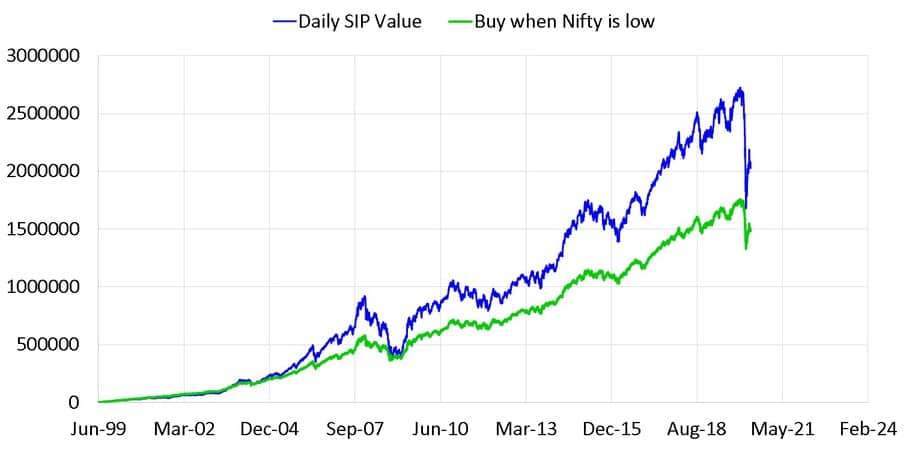
Before you start jumping with joy with “this is why one should not time the market” chants, relax and recognise that this is one data point!. Also, let us add the other kind of SIP – buy only when Nifty is high – into the mix.
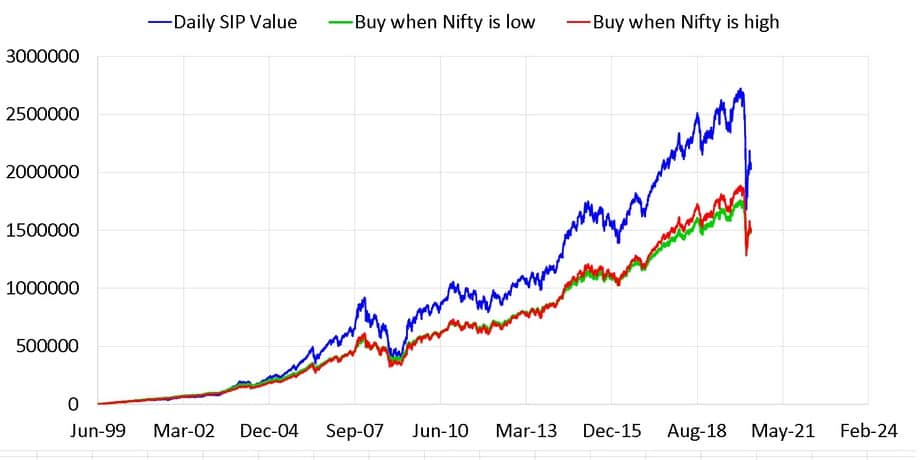
Amusingly the difference between buy only when NIfty is low vs buy only when Nifty is high is not that much! This is a close-up of recent movement.

Those who appreciate how momentum investing works will not be surprised about why buying-high also works. See the full backtest here: Nifty Momentum Timing: Can it produce higher returns?
Has the simple (or is it simplistic?) buy when low strategy ever beat the daily SIP? If we do a backtest over ten-years, we can compare results for 2706 different 10Y periods (the X-axis below).
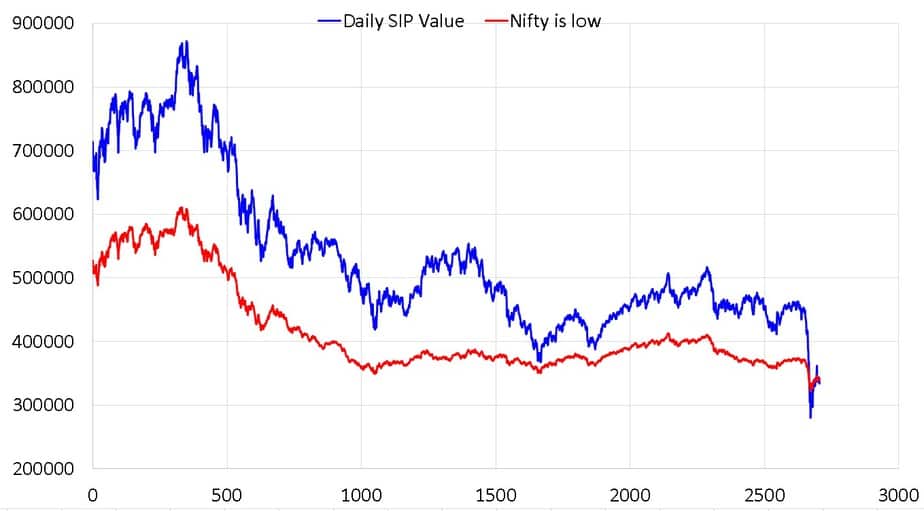
Buying low has won only when at the end of the 10-year period the market has crashed or is significantly off its highs.
The real question to be asking is, why did this strategy not work? As mentioned in the introduction, low net worth investors assume they can slip between the raindrops without touching the investment amount. Even those with a reasonably higher corpus fear taxation and believe the market can be timed by timing when the investment is made.
This is both silly and wrong. Any market timing strategy has to include reducing equity exposure when valuations are high and re-entering when favourable regardless of tax and exit load. Of course, this still means higher returns is a coin-toss!
Full report: Want to time the market? Then do it right! Buying on dips is not timing!
So what if we added tactical asset allocation to the above strategy? We should and we have already check it before: Market Timing With Ten-Month Moving Average.
Yes, I know what you thinking: “PE will work better (= more returns)”; “Double moving average will work better”; “MOVI will work better”, “Bollinger band will work better”. Yeah, yeah. Mere thinking will not cut it. Got to check if it works. Explore our tactical asset allocation archives. Next time something appears like commonsense and intuitive, either do nothing or test it rigorously and be disappointed (with yet another aspect of life).