Last Updated on December 29, 2021 at 5:14 pm
Bank Fixed Deposits (FDs) are a safe and secure way of earning a fixed return on your capital. Especially for senior citizens, they provide higher returns without a big tax blow because of the higher tax exemption slabs for those over sixty. When it comes to taxation of FDs, many investors are in a quandary as to whether the tax on interest earned is to be paid on maturity or every year. Both ways are perfectly legal, and it is up to the investor to choose which one suits him best. Let’s look at the two ways of paying tax on your interest income from FDs.
About the author: Anjesh Bharatiya is a 30+ taxman by profession and a Chemical Engineer by education. He has been an investor in the stock market since age 15! He likes to write about personal finance, stock markets, government policies, taxation, philosophy and football.
Accrual basis (Paying tax every year)
In this method, you pay tax on your interest income as it accrues to you, i.e. every year. You can find the interest earned every year pretty easily from your Form 26AS, which reflects the interest credit & the tax deducted at source (TDS). After Budget 2019, TDS is deducted by your bank at the rate of 10% if your interest income from FDs in a year exceeds Rs. 40,000/-. This rate increases to 20% if you have not submitted your PAN details to your Bank. You can also ask your financial institution for an interest certificate at the end of every financial year.
Cash basis (Paying tax on maturity)
In this method, tax is paid on interest income at the time it’s actually received by you, i.e. at the time of maturity. This method is also very easy to follow since maturity value is clearly mentioned on your FD certificate irrespective of whether the FD was made at the Bank branch or through online channels.
🔥Secure your future with our Robo-advisory tool trusted by over 3,500 investors and advisors. From effortless retirement planning to funding your children’s biggest dreams, turn your financial goals into reality. 🔥
Subscribe for money management solutions via email! (Link takes you to our email sign-up form) Join 32,000+ readers in our community.
👉 New Tool Alert! NaviPlan: A Privacy-Focused Multi-asset Tracker and Goal Planner 👈
What does the law say?
Section 145(1) of the Income Tax Act provides that income chargeable under the head “Income from other sources” can be computed by either cash or mercantile (accrual) system of accounting regularly employed by the individual who is paying taxes. Thus, there is no legal hurdle stopping you from following any of the methods. The Gujarat High Court in CIT v. Advance Construction Co. (P.) Ltd. [2005] 143 Taxman 61/275 ITR 30 (Guj.) held that “Section 145 is couched in mandatory terms and the department is bound to accept the assessee’s choice of method regularly employed, except for the situation wherein the Assessing Officer is permitted to intervene in case it is found that the income, profits and gains cannot be arrived at by the method employed by the assessee. The position of law is further well settled that a regular method adopted by an assessee cannot be rejected merely because it gives benefit to an assessee in certain years.”
The Supreme Court also held in CIT v. McMillan & Co. [1958] 33 ITR 182 (SC) that the choice of the method of accounting lies with the assessee, but the assessee must show that he has followed the method regularly for his own purposes.
Thus, an investor can follow any method of accounting as long as he remains consistent with it.
Pros and cons of the accrual method
The pay-as-you-earn concept inherent in the accrual method makes sure that your tax liability is spread out over the tenure of your FD investment. Anyhow, if you earn interest income higher than Rs 40,000/- in a year, your bank will deduct TDS on it, and thus, you need not deposit the tax by yourself unless your total income falls in the higher tax slabs. However, if you don’t declare the interest income visible in Form 26AS in your return for the year, it may show a mismatch between your Form 26AS (tax credit statement) and the return filed by you. It may also attract a notice under section 143(1)(a) of Income Tax which we will discuss later in this article.
The only downside to the accrual method is that your Bank may end up deducting TDS on your interest income even if your overall income is below Rs 2.5 lakh (basic tax exemption limit). You have to submit Form 15G (Form 15H for senior citizens) to avoid tax deduction in such situations.
Pros and cons of the cash method
The cash method is straightforward to follow, as already described above. And as described in this article, the power of compounding works superbly with deferred taxation (especially in debt mutual funds).
If your Bank is not deducting TDS on the interest (in case you have submitted Form 15G/15H), you may follow the cash method without any issues. However, if you are following the cash method, but your bank has deducted TDS on your interest income, you should not claim the TDS credit in your return. This TDS can be carried forward and claimed at the time of the maturity of your FD. The cash method may, however, make you susceptible to an income tax notice under section 143(1)(a). This notice is issued seeking a response to the errors/ incorrect claims/ inconsistencies in your return which attract adjustments. This is the type of proposed adjustment you may find in such a notice if you follow the cash method of accounting your interest income.
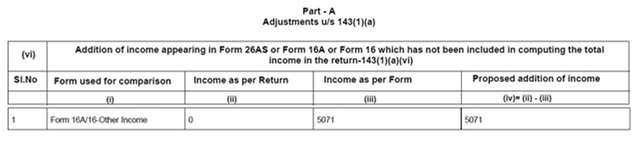
You may respond to the notice and post your disagreement with the proposed adjustment within 30 days of the receipt of this notice. But dealing with such situations can be a nightmare if your explanation is not accepted by the Department (remember that your e-filed returns are processed electronically by the IT Department without any manual intervention, and a robot is unlikely to properly understand your explanation). So, the cash method is not advisable to be followed for your FD investments.
Summary
Legally speaking, both the accrual and the cash method of paying tax on your interest income are acceptable. However, the accrual method offers better tax compliance and lower chances of receiving a notice from the Income Tax Department. It also feels easier on the pocket as you pay tax spread over the tenure of your FD even though you compromise on the compounding effect. Thus, it is the smarter way of paying taxes on your interest income.