Last Updated on February 13, 2026 at 3:00 pm
Imagine you have persistent chest pain. You have two options:
Option A: You visit a cardiologist. You pay a consultation fee of ₹1,500. He runs tests, asks uncomfortable questions about your diet and exercise, and gives you a boring, difficult lifestyle plan to follow for the next 20 years.
Option B: Your friendly neighbourhood Uncle ji, who isn’t a doctor but knows a lot about health, offers you a shiny, expensive magic pill for free. He says, just take this, beta, everything will be fine. No need for tests or exercise. Guaranteed health!
In healthcare, we almost always choose Option A. We understand that expertise costs money and that health requires hard work. Yet, in personal finance, we overwhelmingly choose Option B.
Join 32,000+ readers and get free money management solutions delivered to your inbox! Subscribe to get posts via email! (Link takes you to our email sign-up form)

🔥Want to create a complete financial plan? Learn goal-based investing? Exclusive access to our DIY tools? Increase your income with your skills? Use this link to enjoy massive discounts on our robo-advisory tool & courses! 🔥
About the author: Ajay Pruthi is a fee-only SEBI-registered investment advisor. He can be contacted via his website plnr.in. Ajay is part of the freefincal list of fee-only advisors and fee-only India.
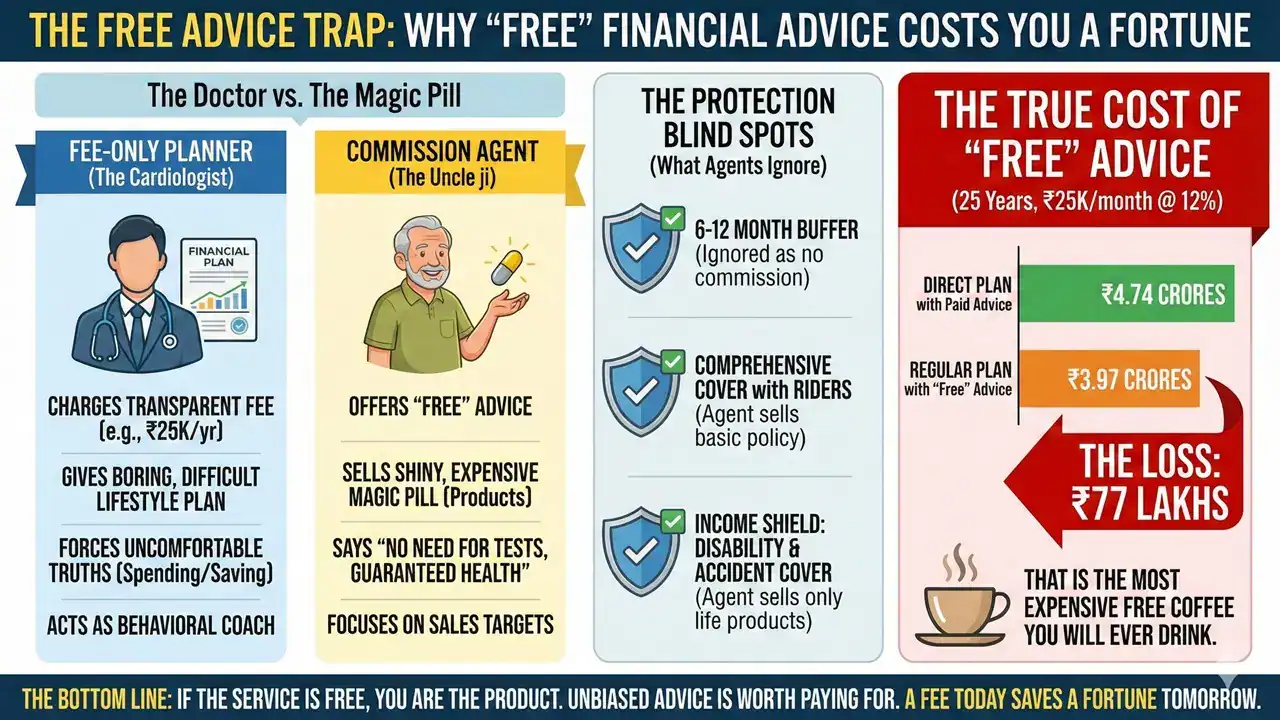
We run away from fee-only Financial Planners (the cardiologists of money) who charge a transparent fee for unbiased advice. Instead, we flock to bank relationship managers and insurance agents (the Uncle ji) who offer us free advice, which is actually just a sales pitch for commission-laden toxic products.
Why do we hate planning but love buying products? The answer lies in a complex mix of psychology, culture, and the illusion of free.
- The Allergy to Upfront Fees (The Psychology of Free)
The biggest hurdle for genuine financial planning in India is the fee.
Tell an average Indian professional to pay ₹25,000 a year to a SEBI-Registered Investment Adviser (RIA) for pure advice—no product sales—and they recoil in horror. Why pay just for talking? He isn’t even giving me a policy document!
We are culturally wired to value physical goods or tangible outcomes over intangible advice. We will happily overpay ₹5 Lakhs for a car but begrudge paying ₹5,000 for the advice that helps us to understand if we can afford the car now or later.
The Agent’s Advantage: The commission agent knows this. They never ask for a fee. They say, my service is free for you; the company pays me.
This is the greatest lie in finance. No financial product is free. The agent’s compensation is built into the product cost. It is a pain-free extraction. You don’t feel the money leaving your wallet today, but it bleeds out of your investment returns every year for the next two decades.
- The Fear of the Financial Mirror
Real financial planning is terrifying.
Sitting with a planner is like standing naked in front of a mirror under harsh fluorescent lights. It forces you to confront uncomfortable truths: you spend too much, you haven’t saved enough, and your retirement dreams are unrealistic based on your current trajectory. It involves shame, guilt, and the realization that you need to change your behaviour. It feels like homework.
The Agent’s Comfort: The product seller, on the other hand, doesn’t judge you. They sell you hope. Buy this ₹1 Lakh policy, and your child’s future is secure! Guaranteed! It’s a dopamine hit of feeling responsible without doing the hard work of actually being responsible.
- The Suit and AC Office Bias (Misplaced Trust)
In India, we confuse hierarchy and appearance with competence. When we walk into a plush private bank, and a well-dressed Relationship Manager (RM) sits us down in an AC cabin, we instinctively trust them.
We forget that the RM is not an advisor; they are a salesperson with aggressive monthly targets. Their loyalty is to their branch manager, not your retirement fund. We trust the suit, and the suit sells us junk.
- The I Can Google It Delusion (The Value Gap)
Even when people consider a planner, two common objections arise that prevent them from hiring one.
Scenario A: Why pay for an Index Fund? Objection
- The Customer Says: It is so easy to find the highest return mutual funds on Google. Why should I pay you ₹25,000 just for you to tell me to buy a simple Nifty 50 Index Fund? I can do that myself!
- The Reality: You aren’t paying the planner to pick the fund (that’s the easy part). You are paying them for the conviction to stick to it.
When the market crashes by 30%, and the news screams Recession, your instinct will be to sell that Index Fund and run. The planner is the one who stops you.
A planner ensures your asset allocation matches your risk appetite, not just a leaderboard on a website. You pay for the behavioural guardrails, not the ticker symbol.
Scenario B: The Action Bias Complaint
- The Customer Says: My planner is lazy. He doesn’t review my portfolio every month. He doesn’t tell me when the market will go up or down. He refuses to let me buy into the hype of new IPOs or NFOs. If he isn’t ‘doing’ anything, why am I paying him?
- The Reality: In investing, Activity ≠ Value. In fact, activity is usually the enemy of returns.
A planner who avoids IPOs/NFOs is protecting you from shiny object syndrome. A planner who doesn’t react to every market dip is saving you from tax and transaction costs.
Their job isn’t to predict the market (which is impossible); their job is to prepare you for it. They are boring by design because boring is what builds wealth. Excitement is what builds losses.
- The Protection Blind Spots (The Hidden Safety Net)
Beyond investments, the free advice trap often leaves critical gaps in your defense. Planners act as behavioral coaches, focusing on guardrails that agents often ignore because they don’t offer high-commission products.
- The Emergency Fund (The Liquidity Anchor):
- The Agent: Usually ignores this because there is no commission to be earned on money sitting in a savings account or a liquid fund.
- The Planner: Insists on a 6-12 month buffer of expenses as a boring lifestyle requirement before a single rupee is invested, ensuring a job loss doesn’t force you to sell your long-term portfolio.
- Comprehensive Health Insurance (The Medical Bunker):
- The Agent: Often sells a basic, one-size-fits-all policy (the magic pill) without discussing uncomfortable details like room-rent caps, co-pays, or restoration benefits.
- The Planner: Runs tests on your actual family medical history and existing corporate cover to recommend super-top-ups and specific riders that ensure a major hospital bill doesn’t wipe out your savings.
- Disability & Personal Accident Insurance (The Income Shield):
- The Agent: Focuses on the dopamine hit of life insurance or wealth products. They rarely discuss the uncomfortable truth of surviving an accident but losing the ability to earn.
- The Planner: Protects your career as your primary asset by advising on standalone disability covers that have zero investment value but provide massive financial stability if the unthinkable happens.
The Real-World Scenario: The Child Education Trap
Let’s look at how this plays out in reality. A 35-year-old father wants to save for his newborn’s college education, needed in 18 years.
The Uncle ji (Agent) Approach:
He pitches a Child Future Secure insurance policy. He appeals to emotion: Don’t you want to guarantee your child’s dreams? This plan gives money back at key milestones.
- The Reality: It’s a high-commission traditional endowment plan. You pay ₹1 Lakh a year. The returns are barely 4-5%. The insurance cover is tiny (e.g., ₹10 Lakhs). In 18 years, due to high education inflation, the maturity amount won’t even cover good college degree. The agent gets a huge upfront commission; you get a false sense of security.
The Financial Planner Approach:
You pay a flat fee of ₹20,000 for advice. It feels like a pinch.
- The Reality: The planner calculates education inflation at 10%. They tell you the hard truth: you need to save more than you thought. They advise buying a cheap Term Plan for ₹1 Crore cover (to protect the child’s future if you die) and investing the rest in diversified equity mutual funds to beat inflation over 18 years.
The outcome? We choose the Agent because his pitch feels safe, free, and easy, even though his product guarantees failure. We reject the Planner because their advice feels expensive and difficult, even though it is the only mathematical path to success.
The Cost of Avoiding the Doctor
What is the actual financial cost of avoiding a planner and buying commission products instead? Let’s look at the math of a Regular mutual fund (sold by a bank/agent with commission) vs. a Direct mutual fund (bought directly or advised by a fee-only planner).
Let’s say you invest ₹25,000 per month for 25 years (assuming a 12% return).
- Direct Plan Corpus: ₹4.74 Crores
- Regular Plan Corpus (with ~1% commission): ₹3.97 Crores
The Cost of Free Advice: ₹77 Lakhs.
You paid ₹77 Lakhs to the bank or agent over 25 years because you didn’t want to pay a planner a few thousand rupees a year to tell you to buy Direct plans. That is the most expensive free coffee you will ever drink.
The Bottom Line
Financial maturity is realising that in finance, if the service is free, you are the product.
Unbiased, expert advice is rare, valuable, and worth paying for. A financial planner doesn’t just tell you where to invest; they act as a behavioural coach, keeping you focused on your long-term goals.
Stop looking for financial painkillers sold by salespeople. Start looking for a financial doctor who cares enough to tell you the hard truths. It might cost you a fee today, but it will save you a fortune tomorrow.

Use our Robo-advisory Tool to create a complete financial plan! ⇐More than 3,000 investors and advisors use this! Use the discount code: robo25 for a 20% discount. Plan your retirement (early, normal, before, and after), as well as non-recurring financial goals (such as child education) and recurring financial goals (like holidays and appliance purchases). The tool would help anyone aged 18 to 80 plan for their retirement, as well as six other non-recurring financial goals and four recurring financial goals, with a detailed cash flow summary.
🔥You can also avail massive discounts on our courses and the freefincal investor circle! 🔥& join our community of 8000+ users!
Track your mutual funds and stock investments with this Google Sheet!
We also publish monthly equity mutual funds, debt and hybrid mutual funds, index funds, and ETF screeners, as well as momentum and low-volatility stock screeners.
You can follow our articles on Google News

We have over 1,000 videos on YouTube!

Join our WhatsApp Channel


- Do you have a comment about the above article? Reach out to us on Twitter: @freefincal or @pattufreefincal
- Have a question? Subscribe to our newsletter using the form below.
- Hit 'reply' to any email from us! We do not offer personalised investment advice. We can write a detailed article without mentioning your name if you have a generic question.
Join 32,000+ readers and get free money management solutions delivered to your inbox! Subscribe to get posts via email! (Link takes you to our email sign-up form)
About The Author
 Dr M. Pattabiraman (PhD) is the founder, managing editor and primary author of freefincal. He is an associate professor at the Indian Institute of Technology, Madras. He has over 13 years of experience publishing news analysis, research and financial product development. Connect with him via Twitter(X), LinkedIn, or YouTube. Pattabiraman has co-authored three print books: (1) You can be rich too with goal-based investing (CNBC TV18) for DIY investors. (2) Gamechanger for young earners. (3) Chinchu Gets a Superpower! for kids. He has also written seven other free e-books on various money management topics. He is a patron and co-founder of “Fee-only India,” an organisation promoting unbiased, commission-free, AUM-independent investment advice.
Our flagship course! Learn to manage your portfolio like a pro to achieve your goals regardless of market conditions! ⇐ More than 3,500 investors and advisors are part of our exclusive community! Get clarity on how to plan for your goals and achieve the necessary corpus no matter the market condition!! Watch the first lecture for free! One-time payment! No recurring fees! Life-long access to videos! Reduce fear, uncertainty and doubt while investing! Learn how to plan for your goals before and after retirement with confidence.
Increase your income by getting people to pay for your skills! ⇐ More than 800 salaried employees, entrepreneurs and financial advisors are part of our exclusive community! Learn how to get people to pay for your skills! Whether you are a professional or small business owner seeking more clients through online visibility, or a salaried individual looking for a side income or passive income, we will show you how to achieve this by showcasing your skills and building a community that trusts and pays you. (watch 1st lecture for free). One-time payment! No recurring fees! Life-long access to videos!
Our book for kids: “Chinchu Gets a Superpower!” is now available!


Must-read book even for adults! This is something that every parent should teach their kids right from their young age. The importance of money management and decision making based on their wants and needs. Very nicely written in simple terms. - Arun.Buy the book: Chinchu gets a superpower for your child!
How to profit from content writing: Our new ebook is for those interested in getting a side income via content writing. It is available at a 50% discount for Rs. 500 only!
Do you want to check if the market is overvalued or undervalued? Use our market valuation tool (it will work with any index!), or get the Tactical Buy/Sell timing tool!
We publish monthly mutual fund screeners and momentum, low-volatility stock screeners.
About freefincal & its content policy. Freefincal is a News Media organisation dedicated to providing original analysis, reports, reviews and insights on mutual funds, stocks, investing, retirement and personal finance developments. We do so without conflict of interest and bias. Follow us on Google News. Freefincal serves more than three million readers a year (5 million page views) with articles based only on factual information and detailed analysis by its authors. All statements made will be verified with credible and knowledgeable sources before publication. Freefincal does not publish paid articles, promotions, PR, satire or opinions without data. All opinions will be inferences backed by verifiable, reproducible evidence/data. Contact Information: To get in touch, please use our contact form. (Sponsored posts or paid collaborations will not be entertained.)
Connect with us on social media
- Twitter @freefincal
- Subscribe to our YouTube Videos
- Posts feed via Feedburner.
Our publications
You Can Be Rich Too with Goal-Based Investing
 Published by CNBC TV18, this book is designed to help you ask the right questions and find the correct answers. Additionally, it comes with nine online calculators, allowing you to create custom solutions tailored to your lifestyle. Get it now.
Gamechanger: Forget Startups, Join Corporate & Still Live the Rich Life You Want
 This book is designed for young earners to get their basics right from the start! It will also help you travel to exotic places at a low cost! Get it or gift it to a young earner.
Your Ultimate Guide to Travel
 This is an in-depth exploration of vacation planning, including finding affordable flights, budget accommodations, and practical travel tips. It also examines the benefits of travelling slowly, both financially and psychologically, with links to relevant web pages and guidance at every step. Get the PDF for Rs 300 (instant download)