Last Updated on December 29, 2021 at 12:59 pm
In this article, let us find out about the pros and cons of a virtual credit card or a virtual debit card and if they can replace real credit/debit cards. Digital Payments in the country have been on the rise since the last 2 to 3 years. New modes of payments have been rapidly adopted across the nation. However, more than 95% of trade in India is still offline.
According to a joint report by Omidyar, Bain & Company and Google, 160 million people transact online in India. 54 million people out of these 160 million, stopped transacting online after their first transactions owing to various reasons. One of the reasons why this population stopped transacting after their first online transaction is “Trust”. These first-time shoppers were concerned about their hard earned money being exposed online through Debit/Credit Cards/Internet Banking. The security of the hard earned money in the Digital Space is yet to be guaranteed. One of the solutions to the Security/Trust problems in Digital Payments is “Virtual Cards”. We will take a look at the What, Why, How etc for Virtual Cards.
What are Virtual Cards?
Virtual cards are just like your physical debit/credit cards, except for the fact that they are digital. They are created for a specific amount and for a specific time.
🔥Secure your future with our Robo-advisory tool trusted by over 3,500 investors and advisors. From effortless retirement planning to funding your children’s biggest dreams, turn your financial goals into reality. 🔥
Subscribe for money management solutions via email! (Link takes you to our email sign-up form) Join 32,000+ readers in our community.
👉 New Tool Alert! NaviPlan: A Privacy-Focused Multi-asset Tracker and Goal Planner 👈
Why do I need a Virtual Card?
All of us deeply value our hard earned money. Virtual Cards are relatively secure payment options as compared to normal debit/credit cards because they are created only for a specific amount that the user wants and remain active only for short time (generally 2 days).
Suppose you want to buy an item for Rs. 5000/- today. You will generate a virtual card for Rs. 5000/- today at 11.00 am and make the payment by 11:15 am. They are made for a specific purpose and for a specific amount. In this way, you restrict the risk to the extent of the amount loaded in the Virtual Card.
How to create a virtual card? Step by step guide
They can be created using:
- Internet Banking or
- Mobile Banking App of your Bank.
Majority of the banks today offer Virtual Cards. Below, is a step by step guide to creating a Virtual Card from one of the banks.
Step 1: Login to the Mobile Banking App from your Bank.

Step 2: Go to the services section of the App. Click on Generate Virtual Card.
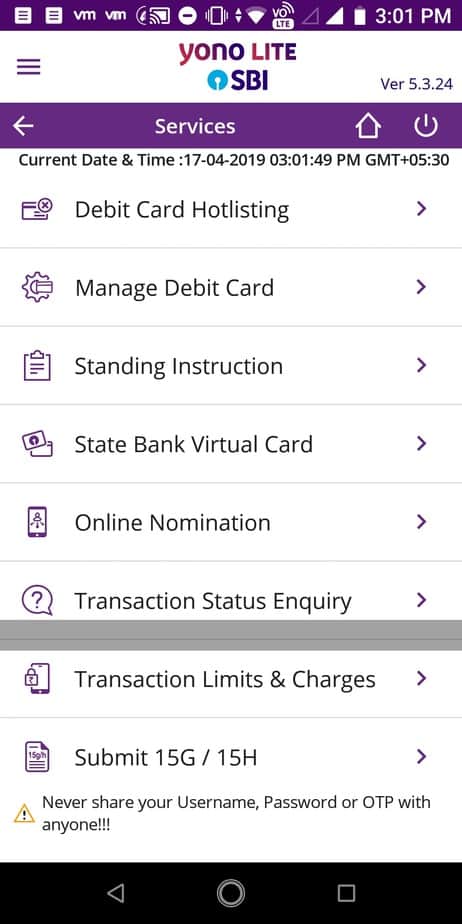
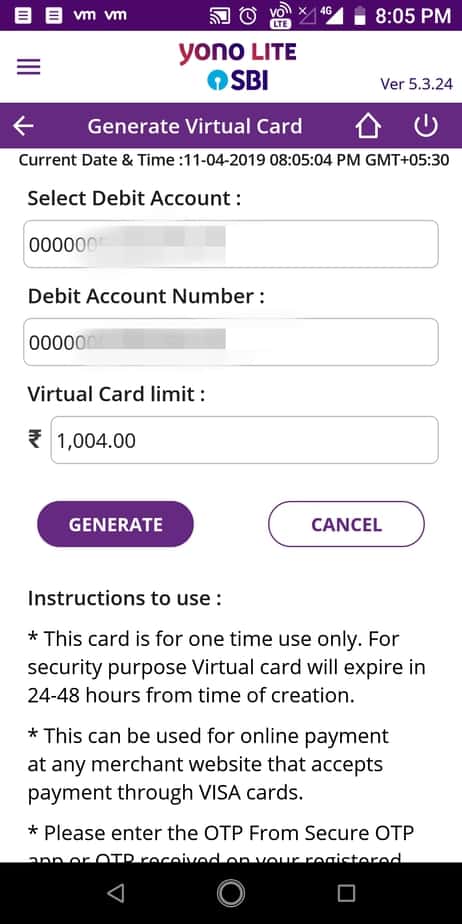
Step 3: Enter the desired amount & click Submit

Step 4: OTP will be generated. Submit it, to generate the card
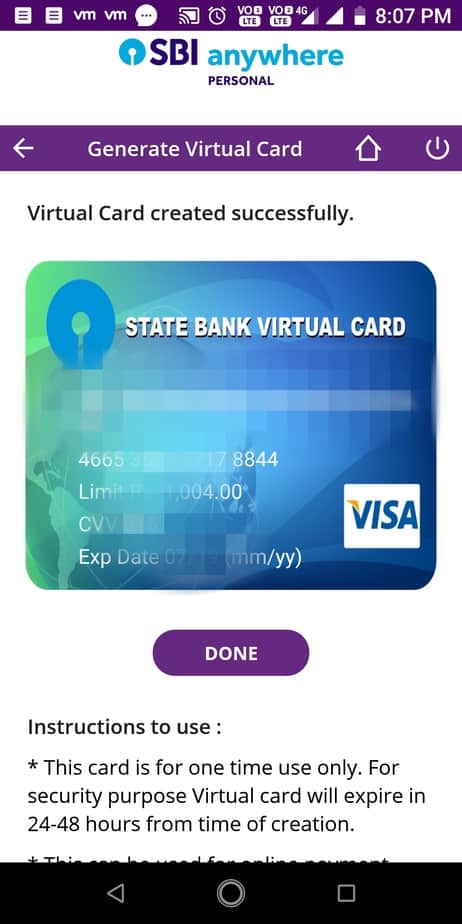
Step5: Congratulations! Your virtual card will look as under:
Note:-
The expiry date mentioned on Card image may be different from the actual expiry date of the Virtual Card. The expiry date is only for the purpose of filling the field while doing a transaction. It may not reflect the actual expiry date of the card as it is generally 48 Hrs.
How and Why are Virtual Cards more secure?
- Loss is restricted to the amount in the debit card.
- Underlying Account/card details are not exposed. Hence, the card is protected against hacking and other frauds.
- Validity period is generally 2 days or the complete usage of the amount in the card, whichever earlier.
- Transactions through Virtual Cards are further secured through OTP
- The card generation is also secure, as it goes through PIN and OTP validation.
What are the Benefits of Virtual Cards?
- Instant issuance- no physical printing and despatch of the card.
- No issuance fee.
- Easy to use.
- Ideal, when you are making a payment on a lesser known website or a website on which you are not sure of the security standards followed.
- Rare instances where someone would have lost money to fraud in Virtual Cards. (Probably, no such instances reported in Media)
- Higher Flexibility- Choose the amount that you wish.
- Easy issuance- There is no requirement of physical paperwork.
- Generally, the amount for which the card is generated is marked as a lien in the account. The amount gets debited from the account only during the actual transactions. Hence, you do not lose interest even for 1 day if the card is not used.
- Many banks do not put a cap on the number of cards that can be generated in one day.
If the card is not required, it can be cancelled. The unutilized amount is credited back instantly in the account.
Which Banks have a facility of Virtual Card?
The apps of the following bank offer Virtual Cards
- M Clip by Bank Of Baroda
- Pockets by ICICI Bank
- 811 by Kotak Bank
- DigiBank by DBS
- PayZapp by HDFC Bank
- UDIO by RBL Bank
- Virtual card by State Bank
- Payapt by IDBI Bank
- DigiPurse by Union Bank
- Yes Pay by Yes Bank
(The list is not exhaustive and the order of listing is random)
In addition, International online transfer portals like Payoneer and Entropay also offer this. However, not all services can transfer money to these cards or accept them for payment.
What are the Limitations of Virtual Cards?
The features vary from bank to bank. In general, below are certain limitations (if one may consider them to be):-
- You cannot reload the same card.
- Some banks may issue only a Single-transaction Card. You may have to create the card, every time you want to use
Generally, they are for Domestic use only. (Valid for payment in INR in India, Nepal & Bhutan)
Current Scenario in Online Payments
Wallets/ “Pay Later” options from companies like Simpl, PayTm, Flipkart, LazzyPay are also ways to protect you against losses from cyber fraud. They are high on convenience. However, post introduction of KYC regulations, they have not been able to retain the high customer base they have had in the past. A large number of Incidents of frauds/failure in transactions from Wallets can be read on Twitter handles of these companies.
Tokenisation:
Considering that nothing is 100% safe/secure, RBI has made efforts to make Card Payments more secure by introducing “tokenisation” in normal debit/credit cards. Through ‘Tokenisation” a unique digital token will be issued by the bank which will contain masked details of the card. As a result, the card number will not be exposed while making a payment. It will take some time before the widespread adoption of ‘tokenisation’ technology in India.
Summary
So folks, till that time, if you do not mind putting in a little extra effort & time to generate a Virtual Card, it can be your insurance against cyber frauds!!
Note: This article was written in collaboration with a commissioned writer who is from the banking industry.