Last Updated on December 18, 2021 at 10:33 pm
When the markets start to move for a few days, investors tend to look at the index PE to check if the market is overvalued or not. Before we caution ourselves (and others) about ‘high PE’ levels, it would be quite instructive to pause and think about the historical evolution of the index PE .
Before we ask, what a high index PE is, we should be asking, what factors affect the PE of an index?
These are quite obvious, but it makes a difference to stop and think about it.
1. Each sector has its own definition of high and low PE.
🔥Secure your future with our Robo-advisory tool trusted by over 3,500 investors and advisors. From effortless retirement planning to funding your children’s biggest dreams, turn your financial goals into reality. 🔥
Subscribe for money management solutions via email! (Link takes you to our email sign-up form) Join 32,000+ readers in our community.
👉 New Tool Alert! NaviPlan: A Privacy-Focused Multi-asset Tracker and Goal Planner 👈
2. Indices like the Sensex and the Nifty consist of stocks from different sectors. So the index PE is ‘some kind of’ weighted average of the sector PEs.
3. An index is only as good as its stocks. If there are marked changes in the composition of the index, the definitions of high and low PE will also change. On Aug 19th 1996, half the composition of the Sensex was changed in one-shot. This implies what a ‘high PE’ was up until then had to be thrown out of the window in one shot. (vertical line in the graph below).
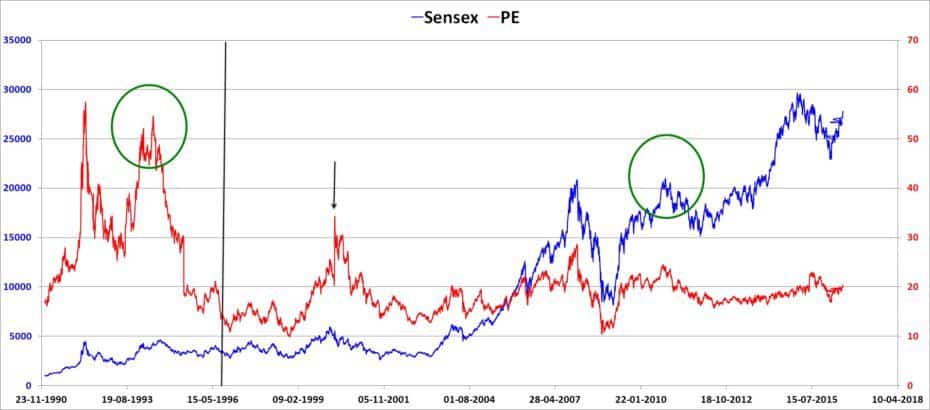
4. Change is the only constant. Blue chips in the 80s found the going tough as liberalisation set in. Then came the rapid growth of the software giants, pharma companies and FMCGs. The composition of the Sensex has been changing over time. The future will be no different.
5. On April 20, 2000, Satyam Computer, Zee Telefims, Dr. Reddy’s Labs, and Reliance Petroleum replaced Indian Hotels, Tata Power, Tata Chemicals and IDBI. The PE shot up by 10 points immediately! (arrow above)
6. Now consider major events which led to sharp downturns: The Harshad Mehta Scandal – 23 April 1992. The dot-com crash in 2000, the sup-prime crisis in 2008. These were specific events which had nothing to do with market valuations. They could have occurred at any PE. If they had not occurred, or not occurred when they did, we will never know how high the market would have gone up.
7. I can think of at least two instances (green circles above) when the market came down from ‘high PE’ due to no specific event. Even here, the high PE in each case was different.
Some things to ponder
- Markets need not crash because the PE is ‘high’.
- Markets can crash at any time, for any number of reasons.
- The markets can hover around a ‘high’ PE for months, moving up and down.
Before you wish to adopt a PE-based investing strategy, I would invite you to read,
Relevance of the Nifty PE for the long-term investor
Misconceptions about the Nifty PE
Stare at the “long-term” moving averages of PE and other metrics using the
Nifty Valuation Analyzer: PE, PE, Div Yield, ROE, EPS Growth Rate
Ps. the NSE indices are toddlers. So don’t take these numbers too serious.
Conclusion: I repeat, change is the only constant. When the ground is shifting beneath our feet, it would be wise not to hang onto to rules based on past data about what is ‘high’ and what is ‘low’
Reference: Making sense of the Sensex