A reader says, ” After watching all portfolio management videos. I purchased the robo-advisory tool. I have set goals. Now I am good to go. Goal: Son’s education. 13 years time period. As per the robo advisory tool, for the debt portion, I have two options. One is Gilt funds & 2nd one is PPF (up to 06 years locked)”.
“Case 1: If I selected Equity with PPF as a Debt component, 1st 06 years’ money is locked, so I am not allowed for rebalancing. Assumed Returns expect 7 %.
Case 2: If I select equity with Debt as gilt funds, I can rebalance but returns slightly lower than the former due to recent taxation rule.
Case 3: Debt portion 50% in PPF (assumed 7%) and rest in Debt fund for rebalancing.
My query is Case 2 /Case 3. Which one is risk-free? ”
🔥Secure your future with our Robo-advisory tool trusted by over 3,500 investors and advisors. From effortless retirement planning to funding your children’s biggest dreams, turn your financial goals into reality. 🔥
Subscribe for money management solutions via email! (Link takes you to our email sign-up form) Join 32,000+ readers in our community.
👉 New Tool Alert! NaviPlan: A Privacy-Focused Multi-asset Tracker and Goal Planner 👈
The answer to your question can be found once you appreciate the asset allocation recommendation of the freefincal robo advisory tool. For a goal 13 years away, the tool typically recommends an initial equity allocation of 50%, with the rest in fixed income.
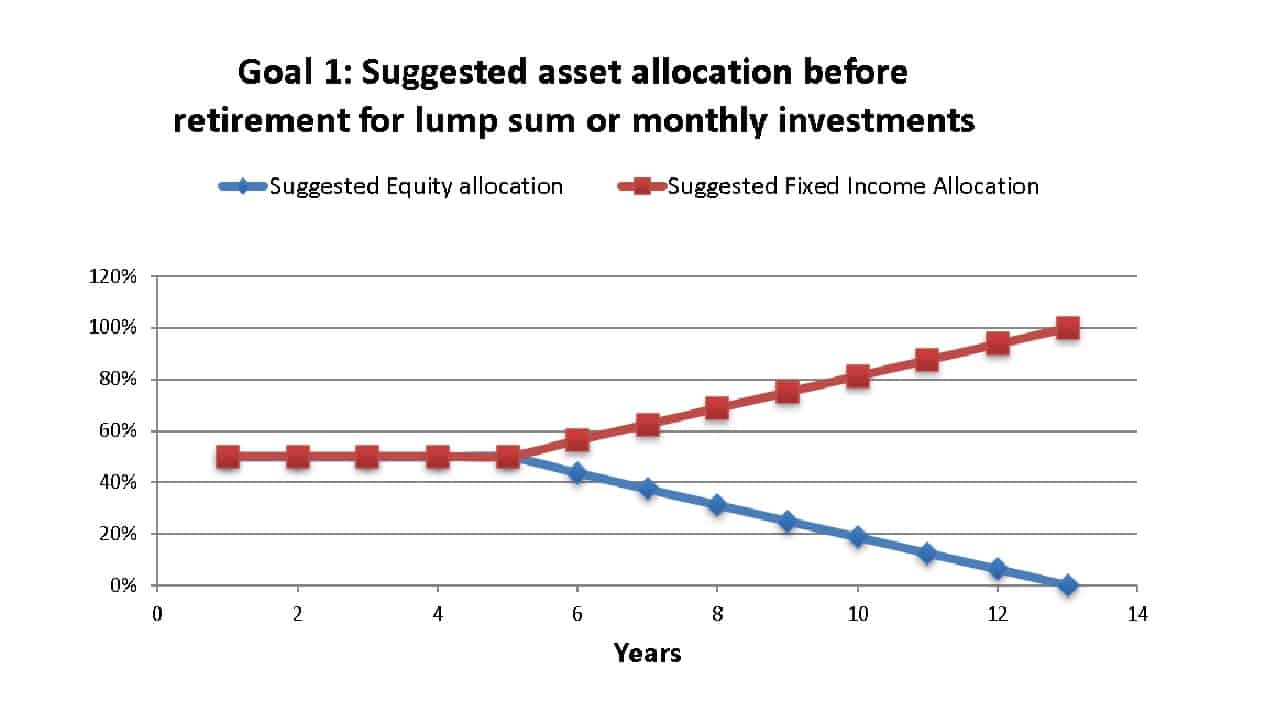
The tool recommends tapering the equity allocation well before the goal deadline to ensure that we achieve our goals no matter the future market conditions. In this case, from the sixth year onwards. This means significant chunks of equity will have to be gradually shifted to fixed income with higher and higher investment in fixed income.
Therefore while it is perfectly fine to hold a PPF account (even though the goal is in 13 years and a new PPF matures in 15 years, college education expenses are spread out over a few years, and it is okay), a second debt instrument is also necessary.
The change in debt fund taxation is not a crucial factor. The post-tax returns from a debt fund may or may not beat a PPF. Again that does not matter, as the liquidity of a debt fund is essential here.
We have the following recommendations:
In addition to the PPF, include one of the following depending on your risk appetite.
- If you do not want any risk, use a combination of recurring and fixed deposits (for the monthly investment) when you shift money from equity. This is the simplest and safest option. Don’t fret too much about interest rates. This is particularly suited for those with little experience with debt funds and worried if the extra risk is worth the reward after tax.
- If you are a little more adventurous, you can consider a corporate bond debt fund (which is typically less volatile than a gilt fund).
- Gilt funds can be used, but sometimes they can be frustrating to hold. So do not use it unless you have some experience with debt mutual funds.
- If you are even more adventurous, you can use Parag Parikh Conservative Hybrid Fund and PPF for the fixed income component. However, this will be volatile and has some equity and REIT exposure. So tread with caution, only for those with a high-risk appetite.
No option is free from risk. However, you can lower the risk to reasonable levels by educating yourself about the products you invest in.