A reader asks, “One common trend I see in your analysis is that the active MFs are always considered against the benchmark indices and not index funds themselves. Why are active mutual fund returns compared with TRI (total return indices) and not index fund returns?”
“Also, since index fund investment recommendation is limited only to N50 and NN50 index funds, why are we not comparing active mutual fund returns in any category (large, large & midcap, midcap, small cap) against the returns of these two funds?”
One can see the reasoning behind this question. We cannot directly invest in the index. We need to choose either index funds or ETFs. The actual return I get is subject to expenses and tracking errors. So why not compare active fund returns with index (ETF) returns?
There are two reasons why comparing active funds with index fund returns is incorrect.
(1) An actively managed mutual fund’s mandate is to beat the index after expenses, not other index funds. We pay good money for them to try and do this. They do not offer us a refund of expenses if they fail to do so. So why should we cut them some or any slack?
🔥Secure your future with our Robo-advisory tool trusted by over 3,500 investors and advisors. From effortless retirement planning to funding your children’s biggest dreams, turn your financial goals into reality. 🔥
Subscribe for money management solutions via email! (Link takes you to our email sign-up form) Join 32,000+ readers in our community.
👉 New Tool Alert! NaviPlan: A Privacy-Focused Multi-asset Tracker and Goal Planner 👈
I am an active fund investor. I expect my funds to beat the index and not some passive fund. See, for example, this chart sourced from Plot the growth of your mutual fund portfolio with this Google Sheet!
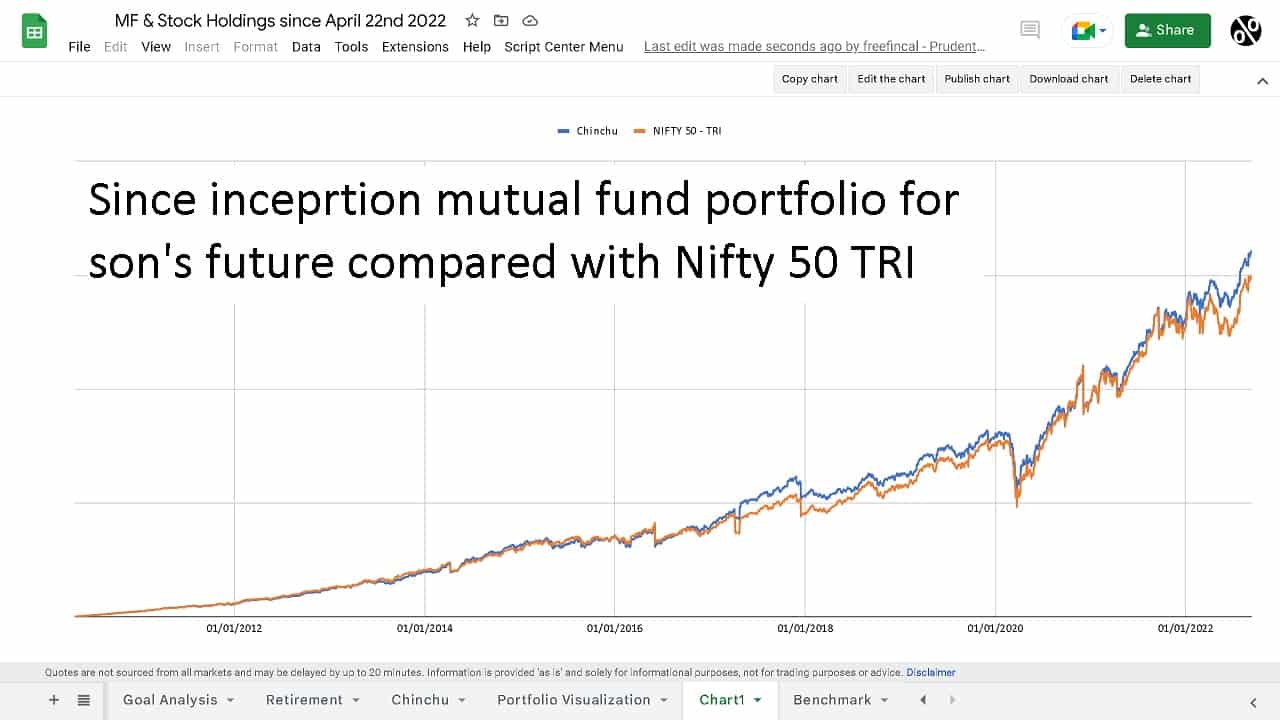
That my active funds don’t beat the benchmark all the time is bad enough. Should I be content with using a passive fund NAV instead and say, “ok, the number of outperformance durations has now come down?” No, Thank you. As the saying goes in Tamil(!), “I pay money, phut chutney!”.
(2) Such a comparison will inherently be biased. Which index fund or ETF should I choose for the comparison? Most readers would expect me to choose UTI Nifty 50 Index fund (direct plan) or the Nifty BeES ETF. Why? Because these funds have the lowest tracking error in the industry. Unfortunately, such a comparison is laced with hindsight bias.
If I compare index funds or ETFs from, say, Jan 2013 to Sep 2022, there is no way for me to know which index fund is worthy of comparison in Jan 2013. There is no way to know which ETF will have the lowers price-NAV deviation in future (a reason why we recommend avoiding ETFs for investments, even the great Nifty BeES)
Readers would appreciate that there are many new passive funds. Even in the Nifty Next 50 space, only a few “old” funds exist. Beyond that, no passive fund can be used for comparison in the mid cap and small cap segments.
So any comparison of active funds with index funds will always be cherry-picked. And that is one of the reasons to avoid it. Anyway, as long as we are fully aware of this flaw, we can look at some data.
We will have to use UTI Nifty 50 Direct Plan because choosing anything else will not satisfy the passive funds. Hence the unavoidable bias.
In any case, what is the objective here?
To find out if using an index fund instead of the index dramatically changes results.
We shall use rolling return outperformance consistency as a metric. The fund returns are compared with category benchmark returns over every 3Y, 4Y, and 5Y period. Higher the outperformance consistency, the better. Suppose 876 fund returns were compared with 876 benchmark returns, and the fund has beaten the benchmark 675 times. The consistency score will be 675/876 ~ 77%.
There are 25 large cap funds with more than 1000 rolling return data points over 3Y, 4Y and 5Y.
Five years
| Rolling returns outperformance consistency | Large Cap versus UTI Nifty 50 | Large Cap versus Nifty 50 TRI |
| > 50% | 13 out of 25 | 12 out of 25 |
| > 70% | 8 out of 25 | 5 out of 25 |
Four years
| Rolling returns outperformance consistency | Large Cap versus UTI Nifty 50 | Large Cap versus Nifty 50 TRI |
| > 50% | 13 out of 25 | 12 out of 25 |
| > 70% | 4 out of 25 | 3 out of 25 |
Three years
| Rolling returns outperformance consistency | Large Cap versus UTI Nifty 50 | Large Cap versus Nifty 50 TRI |
| > 50% | 15 out of 25 | 14 out of 25 |
| > 70% | 5 out of 25 | 5 out of 25 |
Using an index fund (selected with bias) hardly makes any difference to the results: Most large cap funds struggle to beat the index and the index fund. At least for new investors, the message is clear: Do not make the mistakes that we older guys made and clutter up your portfolio with active funds. Buy passive fund(s) and focus on your career, skills, and income. Show your aggression in your investment amount and not in your fund choices! See Three factors that make a difference to our financial success.