Last Updated on December 29, 2021 at 6:16 pm
Each time the market hits an all-time high, several investors get jittery and start wondering if they should stop their SIP investments or delay their lump sum investment (including STPs). Here is why there is no benefit in doing so.
We recently discussed who should “book profits: and who should not: Is it time to book profits from mutual funds? Now we shall consider these questions: If we have SIPs running, should we pause them during all-time highs? If I have a lump sum to invest, should I wait for the market to fall from the all-time high? Can I start an STP when the market is at an all-time high?
The market hitting an all-time high is a fairly common event. This is not some “signal” for the market to “correct”.
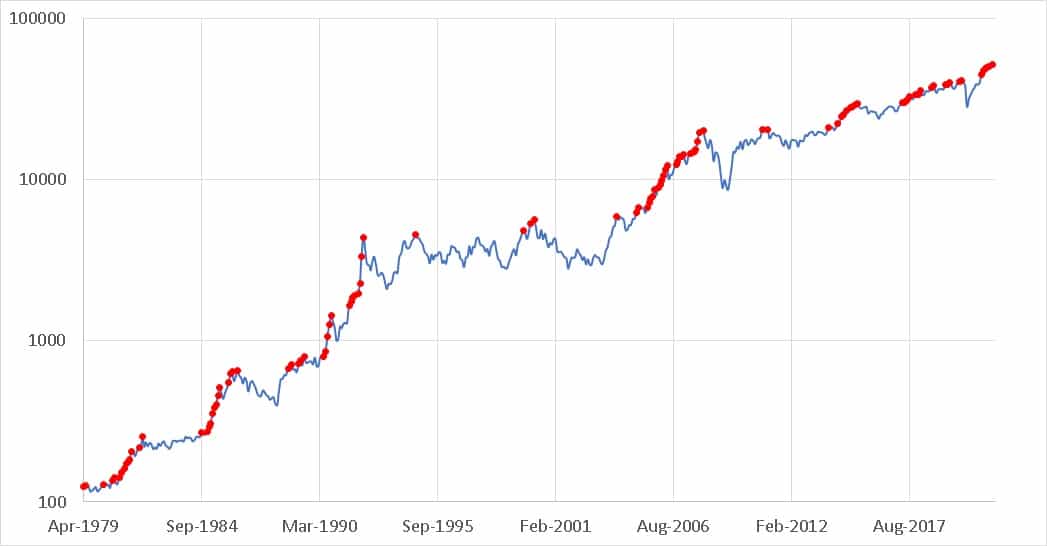
Lump sum investing and market all-time highs
Suppose we wish to invest a lump sum for ten years. There are two ways to do this. We can invest it in one shot or we can stagger the investment over 12 months. The duration over which we spread out the lump sum investment does not matter as previously established: When the market is at an all-time high, how should a lump sum be invested? One-shot or gradually?
🔥Secure your future with our Robo-advisory tool trusted by over 3,500 investors and advisors. From effortless retirement planning to funding your children’s biggest dreams, turn your financial goals into reality. 🔥
Subscribe for money management solutions via email! (Link takes you to our email sign-up form) Join 32,000+ readers in our community.
👉 New Tool Alert! NaviPlan: A Privacy-Focused Multi-asset Tracker and Goal Planner 👈
Now, this lump sum or staggered investment (STP or systematic transfer plan to comply with common parlance) can be started at two different times: When the market is at an all-time high (ATH) and when the markets are not at ATH.
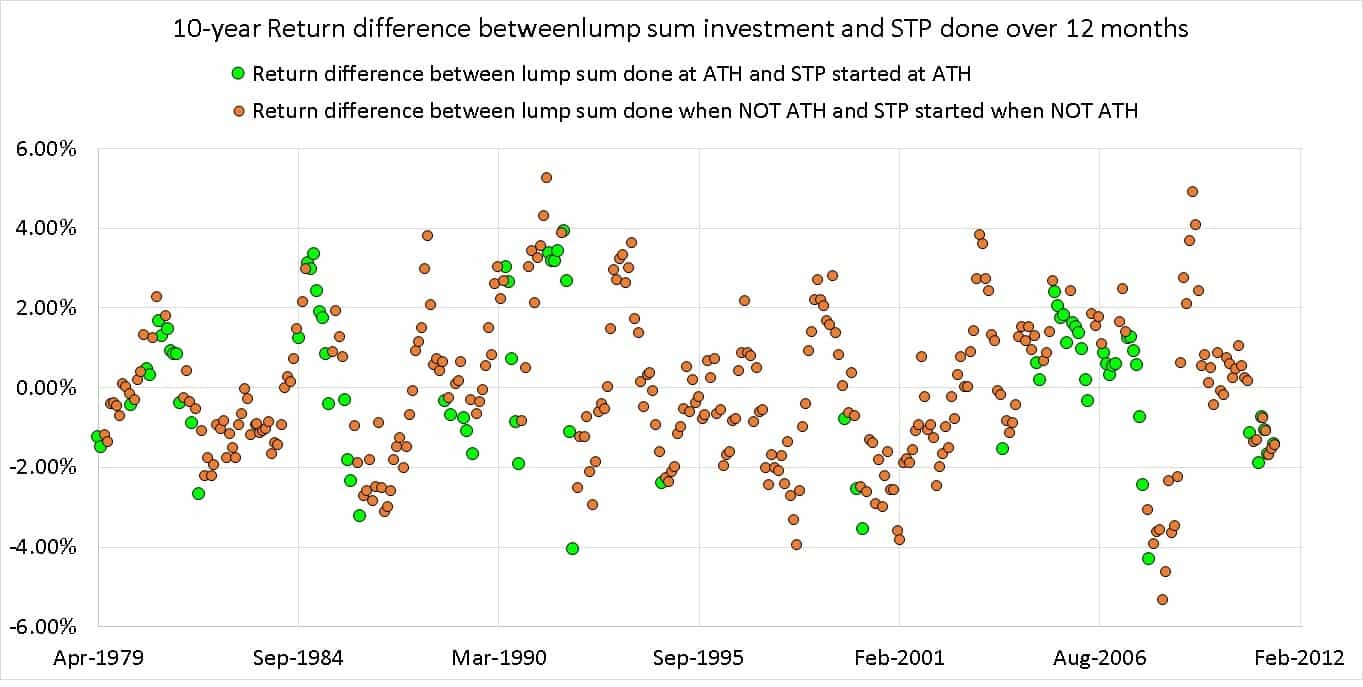
The green dots represent the 10-year return difference between lump sum and STP investments started at ATH. The brown dots represent the 10-year return difference between lump sum and STP investments started when the market is not at ATH. There is practically no difference!
Sometimes lump sum did better (positive return difference) and sometimes STP. There is no way to tell which would be better when we start our investments. This is simply a manifestation of the sequence of returns or timing luck.
If you have a lump sum by all means stagger investments over a few months (just pick a duration you are comfortable with) but do not wait because the market is at an all-time high. That is would be a loss of precious time.
SIP investing and market all-time highs
Let us consider a 15-year SIP with three scenarios
- Normal SIP: We inevst regardless of market conditions
- Pause SIP: The SIP is paused when the market hits an ATH and resumed later.
- Pause SIP with make-up: Here too the SIP is paused when the market hits ATH. when the SIP is resumed, the total paused amount is also invested. For example: if an Rs. 1000 SIP is paused for four months because the market was at ATH, in the fifth month the investment will be Rs. 1000 + total paused amount of Rs. 4000*.
* Please do not get fancy ideas about investing that amount in a liquid fund to get some “extra”. For a monthly interest of about 0.5%, there is no difference between keeping the paused amount in an SB account and in a liquid fund.
Each line in the plot below contains 327 15-year rolling SIP data points. There is practically no difference in return whether you invest without looking at market levels, whether you pause SIP during all-time highs and invest it later or whether you pause SIP, invest it in say, a liquid fund and inevst it later.
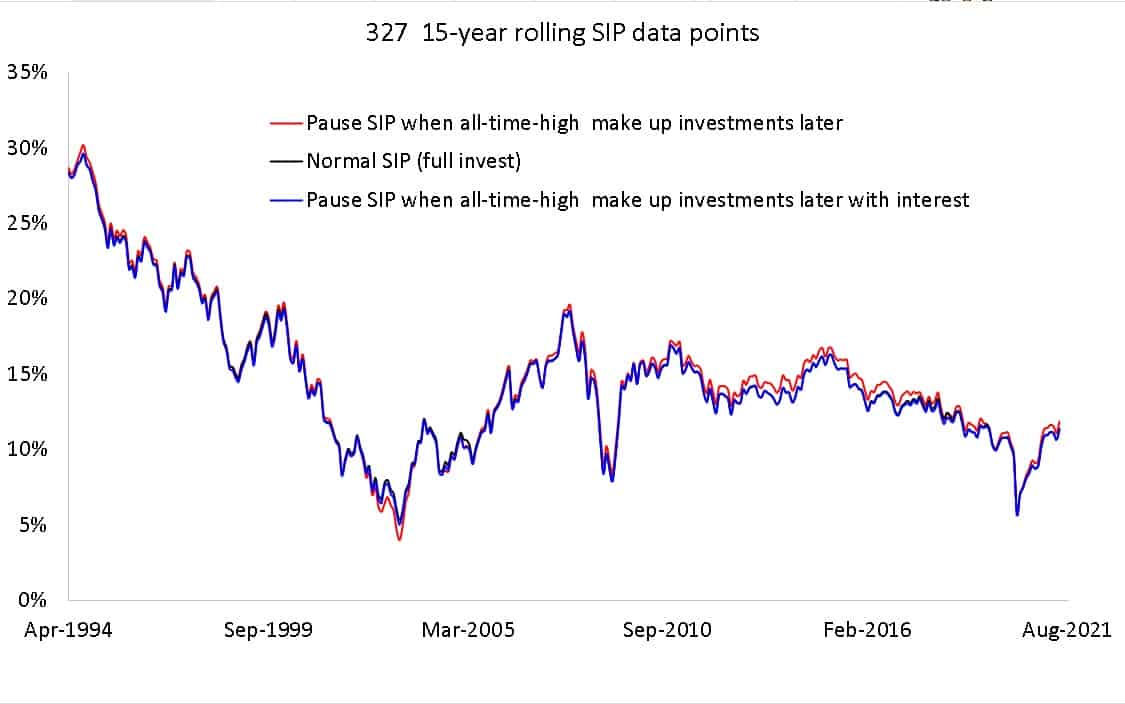
Shown below is the return difference between pause-sip and normal sip (orange dots) and pause-sip with make up and normal SIP (blue dots). Investing the paused SIP instalments reduces the spread in returns

Again we see that pausing SIPs when the markets are at all-time highs does not help in any way over the long term. We will simply have to get used to investing as soon as income becomes available systematically without fearing immediate loss. Waiting for the right time to inevst is one of the worst mistakes you can commit. Always remember that loss is the shadow of return. You cannot shake it off. If you wait for returns, loss will also wait and strike after you invest (whenever that may be!)