Last Updated on February 12, 2022 at 6:14 pm
In this article, we discuss a question posed by Suresh: “sir, the market has slowly started falling after budget 2021. Is it time to book some profits from mutual funds?” Even a casual observer would agree with Suresh. Let us first try to visualise this.
The Sensex price movement in pink and the corresponding one-year rolling returns in yellow to measure market momentum are shown below. By price return, we refer to returns computed with Sensex closing price excluding dividends. For our purposes, this would suffice.
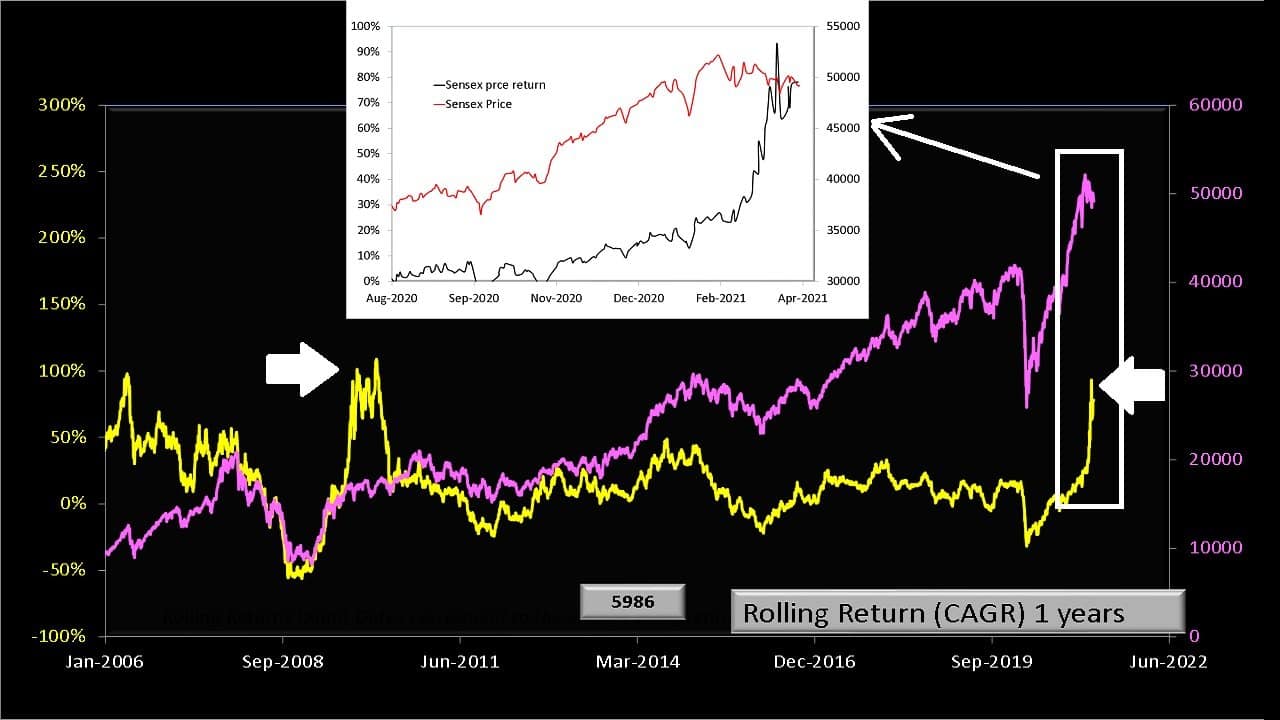
First, notice the two horizontal white arrows. While the market did not fall in 2020 as much as it did in 2008, it certainly recovered as much! The return a year after the crash for both years is approximately the same.
Naturally, the party would not last forever, as seen in the inset. Both the Sensex and its one-year rolling return have begun their descent. No one can predict what will happen in future, but we must admit Suresh’s question is natural, and we should do better than dismiss it with insipid epithets such as “don’t try to time the market”, “stay invested for the long term” etc.
🔥Secure your future with our Robo-advisory tool trusted by over 3,500 investors and advisors. From effortless retirement planning to funding your children’s biggest dreams, turn your financial goals into reality. 🔥
Subscribe for money management solutions via email! (Link takes you to our email sign-up form) Join 32,000+ readers in our community.
👉 New Tool Alert! NaviPlan: A Privacy-Focused Multi-asset Tracker and Goal Planner 👈
Investors in the same mindset as Suresh will need to answer some questions. Suppose you wish to book some profit now because your portfolio is a nice deep green,
- Where will you put it?
- More importantly, will you re-enter equity? If so, when? Would you re-enter just as arbitrarily as you wish to exit?
In short, is there a plan other than following every random thought that passes between your ears? Sure, when I see the above graph, I can see my gains gradually melting away.
My son’s education portfolio and retirement portfolio now have an equity allocation of approximately 3-5% more than their target equity allocations of 55% and 60% equity, respectively (some transactions have not yet been accounted for).
So I am not considering a portfolio rebalance: Shift about 5% equity from both portfolios to fixed income. I might do it once I overcome my inertia to update fresh investments over the last few months.
Yes, this is a “profit booking”. Let us call it goal-based profit-booking. That certainly sounds more attractive and friendly than portfolio rebalancing! So it is ok to go ahead and “book some profits” as long as there is a plan.
And by a plan, we refer to a plan that is/was created either without looking at market movements or by looking at market movements quantitatively. For example, via 6-month + 12-month moving averages.
If you are worried about losing your gains and wish to book profits just because the market has not moved as much as it did a few months ago, it would be quite hard for wealth to grow.
It is like an episode in Curious George. George is asked to plant carrots in his garden. So plants the seeds and waters them regularly. After a while, he sees tiny leaves. They get bigger each day.
Now, he wants to know if the carrot is growing underneath or not. So every day, he pulls out each leaf tuft and checks the carrot underneath. Initially, there is not much change underneath, but after a while, the carrots he had pulled out every day have not grown much compared to those he had left alone.
You cannot leave your investments alone forever, nor can you keep exiting at first sight of “green”. A balance between the two extremes is necessary. Either we make decisions only based on our goals or use some quantitative risk management measure. Here are some general recommendations.
Who should book profits now
- If you have invested 100% equity, this is a good time to plan for your goals systematically, draw up an asset allocation plan and shift some money from equity to debt. You decide what percentage of your investments would be invested in equity and what percentage in fixed income for your goal, and how you would change them in the future.
- If you need the money within the next five years, thank your lucky stars and exit completely to fixed income safety.
- If your equity exposure is higher than what you planned it to be. For example, you wanted 60% in equity, and you now find that it is close to 70%. Then redeem about 10% of your equity investments and shift it to debt.
- If you need money within the next ten years, this is a good time to reduce your equity exposure. For example, I started investing for my son’s future in Dec 2009, a month before he was born. At that point, I was investing for an 18-year goal. I had maintained an asset allocation of close to 60% equity during the last ten years – until yesterday. I saw the equity allocation had shot up to 67%. Considering that the goal deadline – at least the first deadline when he starts UG is only eight years away, I have now removed about 12-13% of equity to fixed income (details in my yearly audit coming up).
- If you are holding multiple types of mutual funds – four large caps, five midcaps, etc.- you can consolidate your portfolio. You can redeem units free from exit load and within the one lakh tax-free LTCG limit and reinvest elsewhere as per an asset allocation.
Who should not book profits now
- To first answer the question asked above, never use returns as a gauge for removing money. On March 23rd 2020, at the bottom of the crash, my retirement portfolio equity MF return was 2.75%. By Sep 2020, the return was 9% and 13% by Dec 2020. During this time, the equity asset allocation only varied by about 10% (55% in March, 58% in Sep and ~ 65% in April 2021). What matters is the amount of money in equity and not by how much it gains. You could have got 25% returns with only 10% equity exposure. In such a case, removing money out of fear makes no sense.
- Investors whose equity exposure is less than what it should be. For example, you may have started investing late with 80% debt and 20% equity for a 20-year goal. Your desired equity allocation could be 50-60%, So it makes no sense to book profits now and reduce equity allocation further. Leave it alone and get used to volatility. I am not considering a rebalance from equity to debt for the first time in my retirement portfolio. For my sons’ future portfolio, this would be the fourth such rebalance.
In summary, asset allocation is the key. Nothing gives meaning to investment decisions as much an asset allocation provided it was decided with some thought. Decisions based on random thoughts will result in random consequences. Our money deserves better respect than speculation.