Last Updated on July 3, 2026 at 9:56 am
Jijesh has designed a comprehensive retirement planning tool for aspiring and early retirees. He describes its key features in this article.
Please note: Freefincal is not associated with this tool in any way. It is published because we strongly believe that DIY investors’ efforts to help the community should be promoted. Please exercise due diligence in using the tool and interpreting results.
Update July 2026: The app is now freemium (meaning there are some free features but payment is necessary to unlock the tool).
What Is This Tool and Who Is It For? The Retirement Planning Simulation Dashboard is a free, publicly accessible online tool designed to help individuals at any stage of life answer one fundamental question: “Am I on the right path for a comfortable retirement?”
🔥Secure your future with our Robo-advisory tool trusted by over 3,500 investors and advisors. From effortless retirement planning to funding your children’s biggest dreams, turn your financial goals into reality. 🔥
Subscribe for money management solutions via email! (Link takes you to our email sign-up form) Join 32,000+ readers in our community.
👉 New Tool Alert! NaviPlan: A Privacy-Focused Multi-asset Tracker and Goal Planner 👈
Unlike simple calculators that return a single number, this dashboard models the complete financial arc of retirement — from today’s savings and monthly contributions, through the transition to retirement, and year-by-year through to your projected life expectancy. It accounts for real-world complexity: multiple income streams, outstanding loans, large one-time expenses, market volatility, and the crucial risk that markets behave badly at the worst possible moment.
Who Should Use This Dashboard
- Aspiring retirees (age 35–55): People still accumulating wealth who want to know if their current savings rate and investment mix will be sufficient to sustain their lifestyle for 25–35 years after they stop working.
- Early retirement planners (FIRE): Individuals targeting retirement well before 60, who need rigorous stress testing of aggressive retirement timelines against adverse market scenarios.
- Near-retirees (age 55–65): Those approaching retirement who want to validate that their corpus, combined with pension or rental income, covers all projected expenses through life expectancy — including healthcare and discretionary spending.
- NRIs and global users: The dashboard supports six currencies (INR, USD, AUD, GBP, EUR, SGD) with country-appropriate market-return assumptions, making it equally useful for the Indian diaspora planning for retirement in their country of residence.
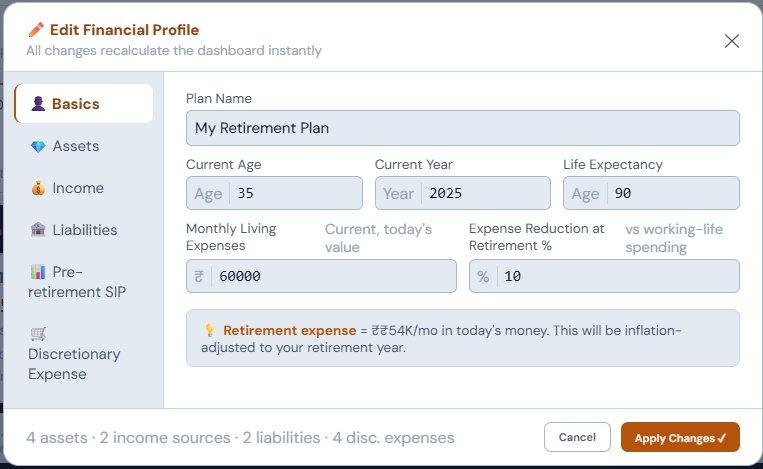
Core planning question: Given my current corpus, monthly contributions until retirement, all income I expect during retirement, and all expenses, loans, and large one-time costs — will my money last to my projected life expectancy? And what happens if markets crash in my early retirement years?
What the Dashboard Models — A Complete Retirement Picture
The tool is structured around five input categories that together define the full financial picture. The main dashboard displays key metrics — projected corpus at retirement, comfortable retirement age, safe withdrawal rate, corpus at life expectancy, and more — all recalculated instantly as inputs change.
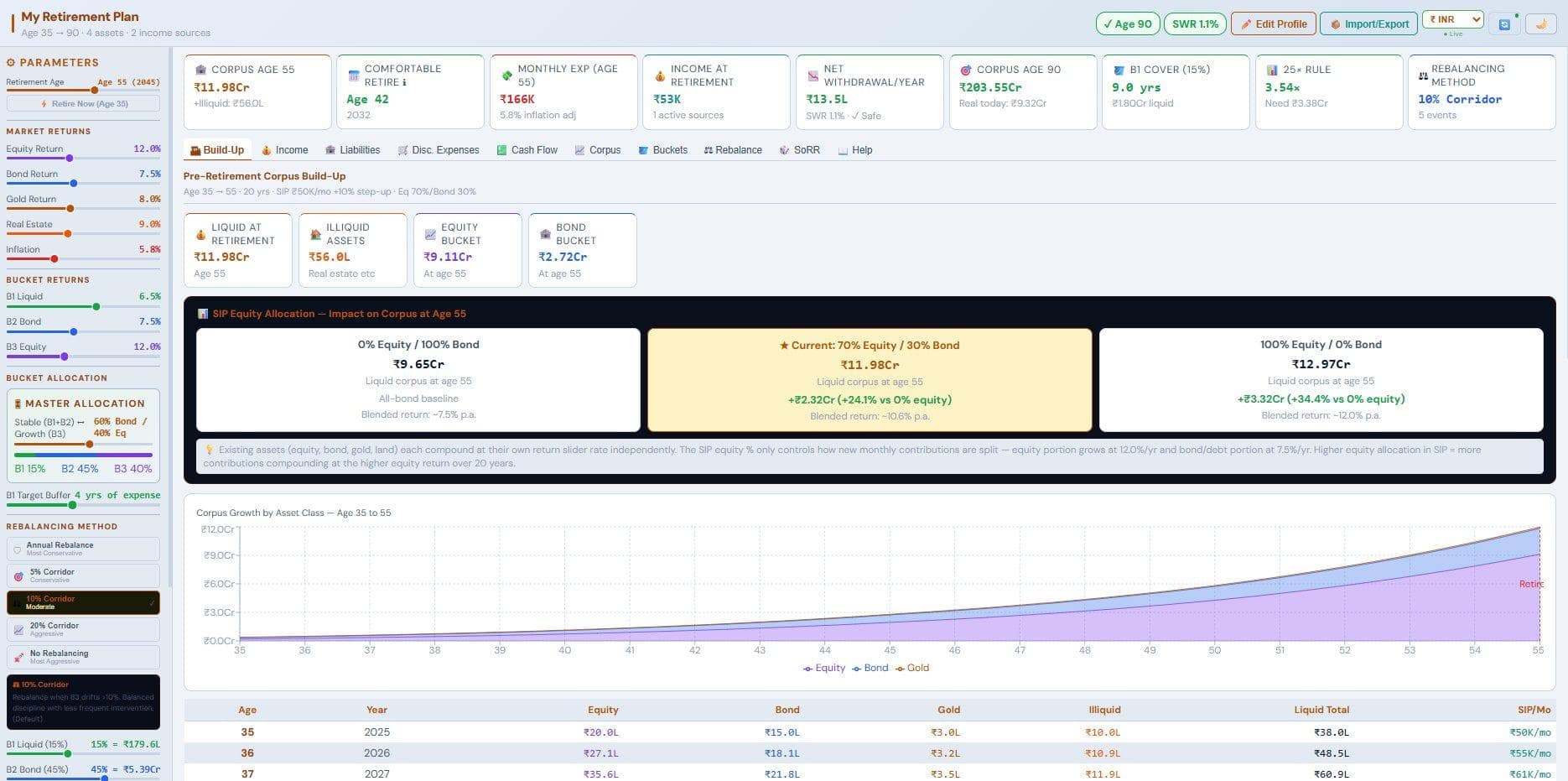
| Input Category | What to Enter |
| Retirement Profile | Current age, retirement age, life expectancy, and monthly living expenses in today’s money. Includes an optional Expense Reduction at Retirement % to account for lower spending after stopping work. |
| Assets & SIP | All existing assets (mutual funds, EPF/PPF, NPS, property, gold, FDs, NCDs, REITs, InvITs) tagged by type. Monthly SIP amount with equity/bond split; supports multiple SIP legs at different life stages. |
| Retirement Income | Pension, rental income, part-time work, dividends, annuity — any income received during retirement. Each source has a start age and end age. Income reduces annual corpus withdrawal directly. |
| Liabilities | Ongoing loan EMIs (home, car, personal) continuing after retirement. Added automatically to annual withdrawal needs. |
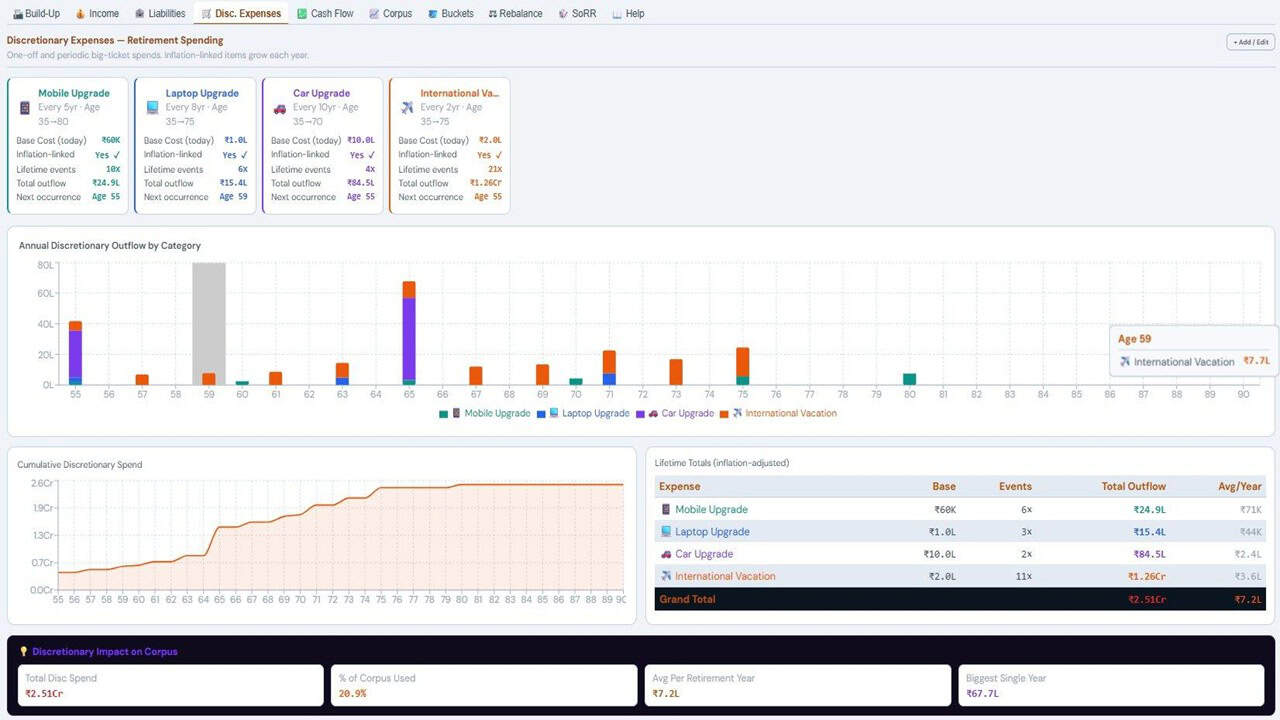
| Discretionary Expenses | Major periodic spending: home renovation, vehicle upgrades, travel, and medical procedures. Entered as a base cost and frequency, the tool inflates each event to its future value and plots total lifetime impact. |
Bucket Strategy — Structuring Retirement Withdrawals
The most dangerous mistake in retirement is holding all savings in a single pool. A market crash in the first few years can force a retiree to sell investments at depressed prices just to cover living expenses — permanently damaging the corpus. This dashboard implements the three-bucket strategy — a structured drawdown framework that isolates money by time horizon, protecting against this risk.
| BUCKET 1 Cash & Liquid 2–4 Years of Expenses | BUCKET 2 Bonds & Fixed Income 5–10 Years of Expenses | BUCKET 3 Equity & Growth 10+ Years Horizon |
| Savings accounts, liquid funds, short-term FDs. The money is spent every month. Never needs to grow — it just needs to be available. | G-Secs, debt mutual funds, and bonds. Earns 6–8% with low volatility. Feeds Bucket 1 when it runs low. Refilled from Bucket 3 when equity markets are favourable. | Equity mutual funds, REITs, and gold. High long-term returns (10–14%) but volatile. Never withdrawn directly — feeds Bucket 2 when markets are up. |
Day 1 of Retirement — Restructuring Your Portfolio
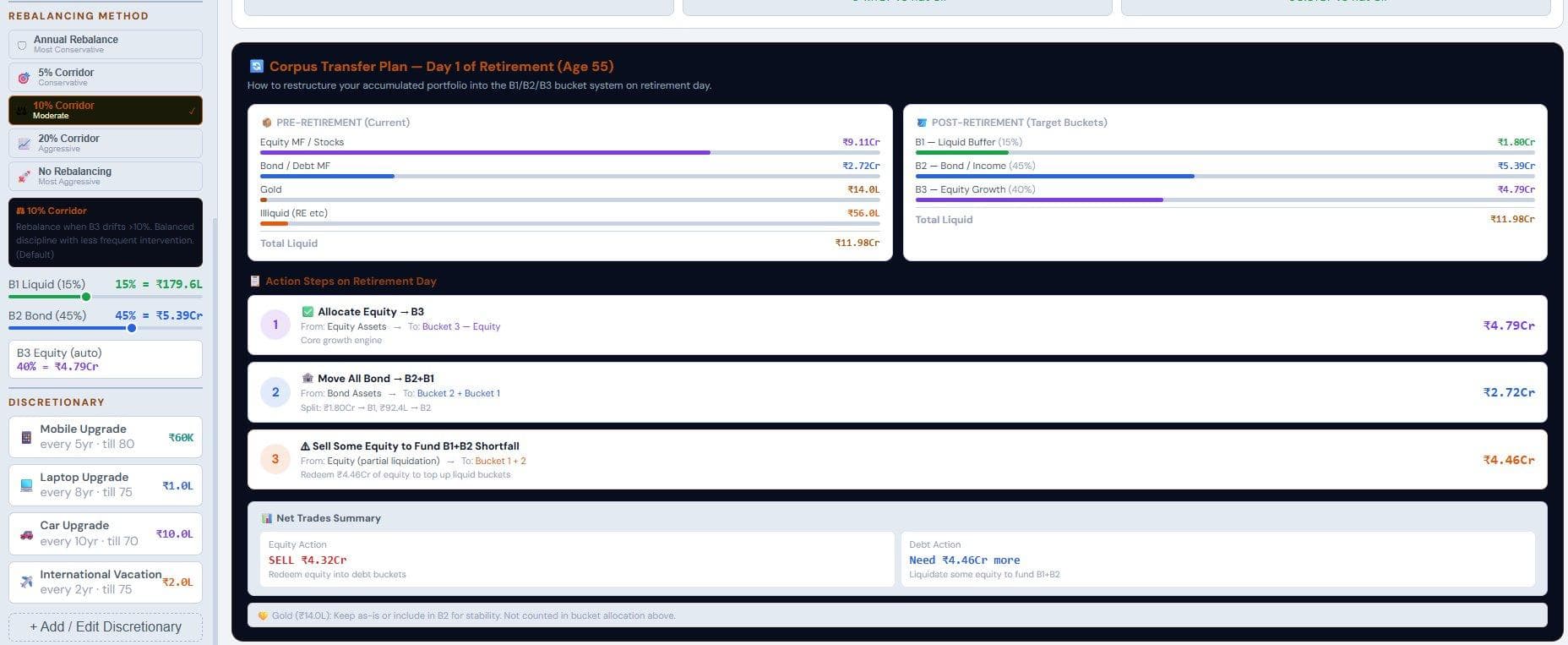
On retirement day, the dashboard generates a step-by-step Corpus Transfer Plan — showing exactly how to restructure your accumulated pre-retirement portfolio (equity MFs, bond MFs, gold, illiquid assets) into the B1/B2/B3 bucket structure. Each action step specifies the amount and direction of transfer, with a net trades summary for execution.
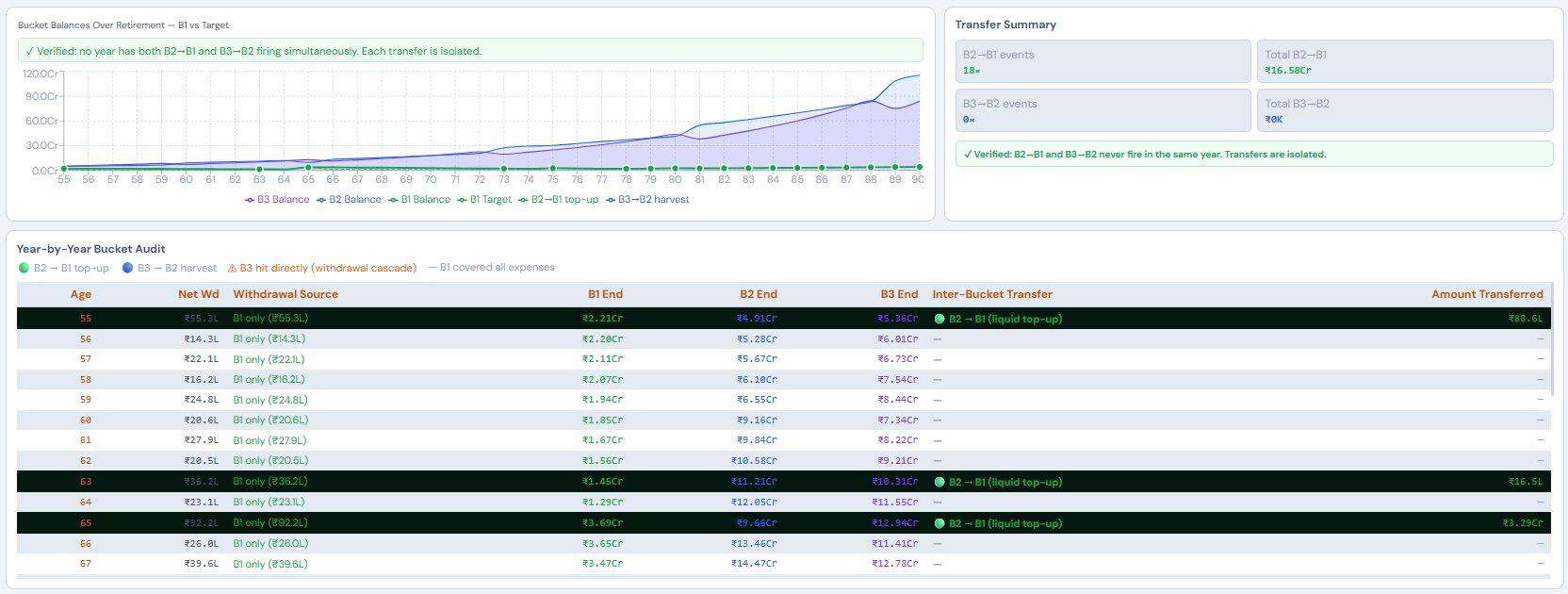
Bucket Balances Over Retirement — Year-by-Year Audit
The Buckets tab shows how the three buckets evolve across every year of retirement. The year-by-year audit table logs every inter-bucket transfer — B2 topping up B1 when the cash buffer falls low, and B3 harvesting into B2 when equity is favourable — giving complete transparency into the withdrawal mechanics.
Rebalancing Corridor — Maintaining Your Target Allocation
Over time, different asset classes grow at different rates, and the portfolio drifts from its target. The dashboard models four rebalancing strategies — Annual, 5% Corridor, 10% Corridor (default), 20% Corridor, and No Rebalancing — and compares their impact on final corpus, allowing the user to select the approach that matches their temperament and discipline.
| Strategy | How It Works | Best For |
| Annual Rebalancing | Resets all weights to target once per year. Simple and disciplined. | Most retirees — low effort, consistent |
| 5% / 10% / 20% Corridor | Triggers only when an asset drifts beyond the corridor band. Acts when needed, not on a schedule. | Efficient — fewer events than annual |
| No Rebalancing | Portfolio drifts freely. Highest growth potential but highest risk. | Those comfortable with rising volatility |
| Lifecycle / Glide Path | Equity allocation reduces automatically as the retiree ages. | Those wanting automatic risk reduction |
Market Return Assumptions — Country-Aware and Adjustable
Every projection is only as reliable as its underlying assumptions. The dashboard provides sensible country-specific defaults drawn from long-run historical data, with live inflation figures fetched from the World Bank API, and allows every parameter to be overridden manually via sliders.
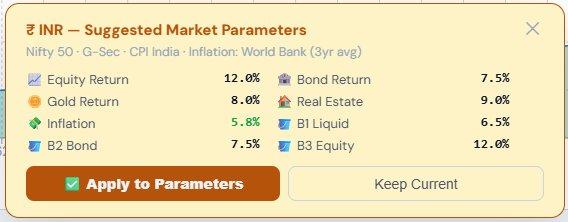
Country-Specific Default Parameters
| Parameter | 🇮🇳 INR | 🇺🇸 USD | 🇦🇺 AUD | 🇬🇧 GBP | 🇪🇺 EUR | 🇸🇬 SGD |
| Equity Return | 12.0% | 10.5% | 9.5% | 9.0% | 8.5% | 8.5% |
| Bond Return | 7.5% | 4.5% | 4.5% | 4.5% | 3.5% | 3.5% |
| Gold Return | 8.0% | 7.5% | 7.5% | 7.5% | 7.0% | 7.0% |
| Real Estate | 9.0% | 6.5% | 7.5% | 5.5% | 5.0% | 5.5% |
| Inflation | 6.5% | 3.0% | 2.8% | 3.0% | 2.5% | 2.2% |
| Benchmark | Nifty 50 | S&P 500 | ASX 200 | FTSE All-Sh | Euro Stoxx | STI |
All eight parameters — equity return, bond return (B1/B2/B3 separately), gold, real estate, and inflation — are independently adjustable via sliders in the sidebar. When a user switches currency, a confirmation banner appears showing the new country parameters, which can be applied with a single click or kept at the current values.
Stress Testing — Validating the Plan Against Adversity
A plan based solely on average expected returns gives a false sense of security. Real retirement outcomes depend on the sequence of returns — the order in which good and bad years arrive — not just the long-run average. The dashboard provides two complementary stress-testing tools that go far beyond single-scenario projections.
Sequence of Return Risk (SoRR) — Crash Scenario Analysis
A market crash in the early years of retirement is disproportionately damaging: the corpus is at its peak (largest absolute loss), withdrawals continue regardless of market conditions, and fewer units remain to participate in the recovery. The SoRR module simulates four scenarios simultaneously:
- Base Case: Smooth average returns every year — the textbook scenario.
- Crash in Retirement Year 1–2: The worst-case timing — a major market decline immediately upon retirement.
- Crash in Retirement Year 5: A crash five years in, when the cash buffer has partially depleted, but equity has had time to compound.
Crash in Retirement Year 10: A later crash, by which time the equity bucket has compounded significantly, and the corpus has broader buffers.
The crash magnitude (−5% to −65%), duration (1–6 years), and recovery period are all configurable. The tool shows final corpus at life expectancy for all four scenarios and flags survival or depletion for each. An optional Crash Rebalancing toggle models a disciplined buy-the-dip strategy — transferring controlled amounts from bonds into equity during crash years — and quantifies the resulting corpus improvement.
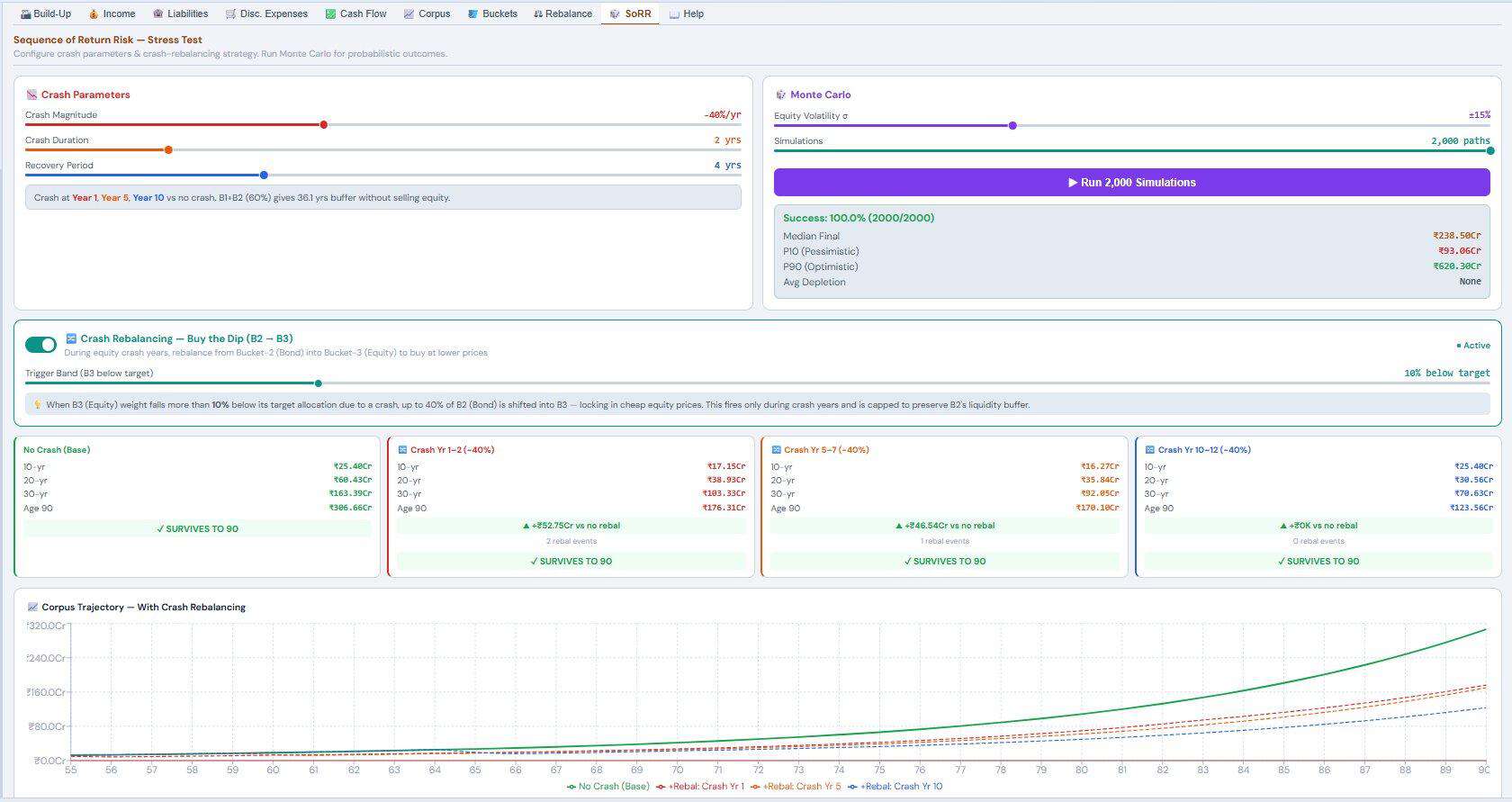
Monte Carlo Simulation — Probability of Retirement Success
Monte Carlo runs 500–2,000 independent simulations, each assigning a random sequence of annual equity returns drawn from a distribution around the assumed mean at the user-specified volatility. The result is a probability of success — the percentage of paths in which the corpus survives to life expectancy.
| Success Rate | What It Means | Recommended Action |
| 90% and above | Plan is robust. Survives nearly all historical return sequences. | Proceed with confidence. |
| 75% – 90% | Moderate resilience. Fails in roughly 1-in-4 market histories. | Consider slightly higher savings or a later retirement date. |
| Below 75% | High failure risk. Plan is sensitive to market timing. | Revise: increase savings, reduce expenses, or shorten retirement. |
In addition to the headline success rate, the simulation reports the Median final corpus, P10 (pessimistic — worst 10% of scenarios), P90 (optimistic — best 10% of scenarios), and the average depletion age in paths where the corpus does not survive. This gives a complete probabilistic picture rather than a single-point forecast.
Saving and Sharing Your Plan — Import / Export
Retirement planning is an ongoing process, not a one-time calculation. Plans need to be revisited as income, expenses, markets, and life circumstances evolve. The dashboard’s Import/Export feature makes it simple to preserve, revisit, and share your complete plan across sessions.
Exporting Your Plan
Click the Import/Export button in the top header to export your complete retirement plan as a single .json file. This file captures everything: your profile, all assets, SIP details, every income source, every liability, every discretionary expense, all parameter settings (returns, inflation, bucket allocations, rebalancing method), and the selected currency. The export takes one click and produces a compact, human-readable file that can be stored on any device or shared with a financial advisor.
Recommended practice: Export your plan at the end of every review session — especially after updating income, expenses, or market assumptions for the year. Label the file with the date (e.g. retirement-plan-may-2025.json) to maintain a history of how your plan has evolved over time.
Importing a Saved Plan
On the same Import/Export panel, use the Import option to load a previously saved JSON file. The entire dashboard — all inputs, parameters, and settings — is instantly restored to exactly the state it was in when last exported. No data entry is needed. This makes it straightforward to:
- Resume a planning session exactly where you left off, even on a different device.
- Compare two scenarios by exporting the current plan, modifying inputs, and re-importing the original to compare side-by-side.
- Share your plan with a financial advisor, family member, or trusted colleague for a second opinion — without giving access to any online account.
- Maintain plan history by keeping dated exports, enabling you to track how your retirement projection has improved or changed over successive years.
The JSON export file is plain text and entirely portable. It contains no sensitive authentication data — only the financial figures and settings you have entered. It can be opened and read in any text editor, giving full transparency into what is being stored.
Access, Privacy, and Design Principles
The dashboard is accessible at https://www.investapps.in/. All calculations run locally in the browser. No financial data is transmitted to any server.
Design Principles
- Transparency: Every number is traceable to the user’s inputs and stated assumptions. A built-in Help tab explains every financial term, tab, and parameter in plain English — no finance background required.
- Conservative defaults: Return assumptions are based on long-run historical averages, not peak performance periods. The dashboard actively encourages testing with conservative inputs to build genuine margins of safety.
- Complete privacy: No financial data is stored, transmitted, or shared. Three non-personal external calls are made (live exchange rates, World Bank inflation, Google Fonts) — all optional and containing no user data.
- Multi-currency support: Six currencies with country-appropriate assumptions make the tool equally useful for residents and NRIs across India, USA, Australia, UK, Europe, and Singapore.
For financial advisors: This tool is designed to complement professional financial advice. Its primary value is giving clients a clear, visual understanding of their retirement trajectory — and surfacing the right questions before an advisory session. What is my safe withdrawal rate? Does my plan survive a 40% market crash in Year 1? How much does rental income extend my corpus by? The dashboard turns abstract concepts into concrete, personalised numbers.
Please note: Freefincal is not associated with this tool in any way. Please exercise due diligence in using the tool and interpreting results.
We are on Google News
Use this button to add freefincal.com as a preferred personal finance source on Google News.

Explore 1,400+ videos on YouTube!

Subscribe to get posts via email!
Join 32,000+ readers and get free money management solutions delivered to your inbox! (Link takes you to our email sign-up form)Join our WhatsApp Channel

Explore our products
🔥Join our community of 9000+ users! 🔥- Use our Robo-advisory Tool to create a complete financial plan! More than 3,500 investors and advisors use this! Use the discount code robo25 for 20% off. Plan your retirement (early, normal, before, and after), plus non-recurring financial goals (such as child education) and recurring financial goals (such as holidays and appliance purchases). The tool helps anyone aged 18 to 80 plan for retirement, plus six non-recurring and four recurring financial goals, with a detailed cash flow summary.
- Our Flagship Course! Learn to manage your portfolio like a pro to achieve your goals regardless of market conditions! More than 3,500 investors and advisors are part of our exclusive community! Get clarity on how to plan for your goals and achieve the necessary corpus no matter the market conditions! Watch the first lecture for free! One-time payment! No recurring fees! Lifelong access to videos! Reduce fear, uncertainty and doubt while investing! Learn how to plan for your goals before and after retirement with confidence.
- Join the freefincal investor circle! An exclusive space for investors, advisors, fintech employees and students to access financial planning and insurance tools, mutual fund and stock analysis tools, coding strategies and Excel macros for data extraction. 750+ members are now part of our investor circle.
- Increase your income by getting people to pay for your skills! More than 900 salaried employees, entrepreneurs and financial advisors are part of our exclusive community! Learn how to get people to pay for your skills! Whether you are a professional or small business owner seeking more clients through online visibility, or a salaried individual looking for side or passive income, we will show you how to do it by showcasing your skills and building a community that trusts and pays you. (Watch the 1st lecture for free). One-time payment! No recurring fees! Lifelong access to videos!
- Portfolio Tracker! Track your mutual funds and stock investments with our Google Sheet!
- We also publish monthly screeners for
Our Podcast: Let's Get Rich With Pattu
On Spotify: Let's Get RICH With PATTU! Every single Indian CAN grow their wealth! On Audible: Listen to the Let's Get Rich with Pattu Podcast

Listen to the Let's Get Rich With Pattu podcast on YouTube.
Now watch Let's Get Rich With Pattu தமிழில் (in Tamil)!About The Author

Dr M Pattabiraman giving a lecture
- Dr M. Pattabiraman (PhD) is the founder, managing editor and primary author of freefincal. He is an associate professor at the Indian Institute of Technology, Madras.
- He has over 14 years of experience publishing news analysis, research and financial product development. He has over 28 years of teaching and research experience. He is also a public speaker and keynote presenter.
- He is a patron and co-founder of “Fee-only India,” an organisation promoting unbiased, commission-free, AUM-independent investment advice.
- Connect with him via @pattufreefincal on X LinkedIn YouTube
- Pattabiraman has co-authored three print books.

This book helps you ask the right questions and find the right answers. It also includes nine online calculators to create custom solutions.
(2) Gamechanger: Forget Startups, Join Corporate & Still Live the Rich Life You Want. 

Both the boy and girl versions of "Chinchu Gets a Superpower".
Most investor problems stem from a lack of poor decision-making. We made bad decisions and money mistakes when we started earning, and we spent years undoing them. Why should our children go through the same pain? What is this book about? As parents, what if we had to groom one ability in our children that matters not only for money management and investing but for every aspect of life? My answer: Sound decision-making. So, in this book, we meet Chinchu, who is about to turn 10. The story follows what he wants for his birthday and how his parents plan it, while also teaching him key ideas about decision-making and money management. What readers say! 
Feedback from a young reader after reading Chinchu Gets a Superpower!
Must-read book even for adults! This is something that every parent should teach their kids right from a young age. The importance of money management and decision-making based on their wants and needs. Very nicely written in simple terms. - Arun.
About freefincal & its content policy
Freefincal is a News Media organisation dedicated to providing original analysis, reports, reviews and insights on mutual funds, stocks, investing, retirement and personal finance developments. We do so without conflict of interest and bias. Follow us on Google News. Freefincal serves more than three million readers a year (5 million page views) with articles based only on factual information and detailed analysis by its authors. All statements made will be verified with credible and knowledgeable sources before publication. Freefincal does not publish paid articles, promotions, PR, satire or opinions without data. All opinions will be inferences backed by verifiable, reproducible evidence/data. Contact Information: To get in touch, please use our contact form. (Sponsored posts or paid collaborations will not be entertained.)Our publications
- Your Ultimate Guide to Travel. This is an in-depth exploration of vacation planning, including how to find affordable flights, budget accommodations, and practical travel tips. It also examines the benefits of travelling slowly, both financially and psychologically, with links to relevant web pages and guidance at every step. Get the PDF for Rs 300 (instant download)

- How to profit from content writing: Our ebook is for those interested in getting a side income via content writing. It is available at a 50% discount for Rs. 500 only!