Last Updated on August 22, 2021 at 8:13 am
In the previous article, Anil explained how he achieved financial independence without mutual funds or stocks by building a 70X portfolio in fixed income ((where X is the annual expense that will persist in retirement). In this sequel, he discusses how he wishes to invest in the future, lessons he learnt about financial independence and some resources for young earners.
If you have not read the first, please do following the link above and then come back here. These articles are part of our reader audit series. I am grateful to readers for sharing intimate details about their financial lives for the benefit of readers.
This is the 16th such reader audit. Previous editions are linked at the bottom of this article. If you would like to contribute to the DIY community in this manner, send your audits to freefincal AT Gmail. They will be published anonymously (such as this one) if you so desire. Please note: publishing a person’s opinion does not mean we endorse it. We are only presenting a different point of view and a different take on achieving financial independence. Now over to Anil.
With this portfolio of fixed income assets, now I am very comfortable and sleep much better at night without worrying about anything in the world. Now I am looking to invest in other avenues and new areas to generate cash flow (Robert Kiyosaki: Rich Dad Poor Dad).
🔥Secure your future with our Robo-advisory tool trusted by over 3,500 investors and advisors. From effortless retirement planning to funding your children’s biggest dreams, turn your financial goals into reality. 🔥
Subscribe for money management solutions via email! (Link takes you to our email sign-up form) Join 32,000+ readers in our community.
👉 New Tool Alert! NaviPlan: A Privacy-Focused Multi-asset Tracker and Goal Planner 👈
The first item I am looking for now is constructing a rental building on my Bangalore plot, which I bought in 2019 and is in a good demanding location for the IT world population. This will likely generate 1X of income each year (i.e. it will cover all our annual expenses in retirement).
This will consume 2 years of my annual salary savings. After that, I plan to start mutual funds and stocks from my monthly salary savings without touching my fixed income portfolio corpus of 70X. I want to maintain that 70X of fixed income portfolio throughout my life.
For this mutual fund investment, I started to watch Dr Pattu’s YouTube videos from the last 2 years. I got confidence after going through 100s of his YouTube videos. I started my 1st direct stock purchase slowly in the 2020 stock market crash and invested a small amount of about 1X from my salary savings of 2020.
I started to teach my 11 years old daughter about compounding and multiplying money in the stock market and other investments apart from teaching mathematics. I opened a demat account in my wife’s name to invest my daughter’s birthday gifts from relatives.
In one of the recent IPOs, her money was doubled on listing day, and she was excited that she can buy a new bicycle with this profit. This was a WOW Moment for her. I have no plans of early retiring or retiring at all.
Inspired by Dr ArogyaSwami Paulraj, who started teaching at Harvard in 2nd innings of his life after retiring from his govt job in India. I want to pursue a part-time PhD sometime down the line to take a 2nd career in academics in some university in Hills in India.
I plan to open a company from a tax efficiency point of view so that lots of income is on the company’s books instead of mine as companies are taxed on profits and not income. This is a huge difference between personal income tax (income tax) and taxes on companies (Learning from Rich Dad poor dad: Tax chapter).
Tax is a huge expense, and legally minimizing taxes on everything is a step in the right direction. Working towards this and talking to CAs, tax experts, company law experts. I have few lawyer contacts to make my Will and consult on legal matters as they help me on various matters, be it Land purchase, house purchase etc.
Why I invested heavily in a fixed income portfolio? It’s because of many reasons. Firstly, I had no time for many years, and all my time was consumed in my professional work. I had no time for almost a decade to read and understand anything beyond technology. I only got some time in the last 4 years.
Also, a fixed income portfolio helps calculate and predict actual position anytime and where I am headed. Was not sure of the stock market as always worried what if the market remains sideways for 8-10 years (both Indian and US market have remained sideways in the past for very long time).
I had no time to research more on stock markets, and I don’t invest in something I don’t understand well. I never trusted those sales guys on TVs who had conflicts of interest. The fixed-income investment was easy and quick to do. Real estate investment is tougher than the Stock market (especially in India, where one needs to take care of many things while buying real estate), but I had a genuine interest in real estate.
In the last 4 years, after devoting time towards the stock market and reading on money-related matters, I am now more confident and comfortable with the stock market, especially after understanding the bucket theory/strategy (Thanks to Dr Pattu’s YouTube videos on it).
So, in the future, I will start putting away my new savings in the market for a very long time (Money which I may never need and probably that money will remain invested in the market forever). I can do this comfortably at this stage after achieving a super conservative way of Financial Independence where my next 50+ years of expenses are taken care of in fixed income portfolio and real estate.
I can speak hours and hours on real estate but do not want to put too much effort into typing on it. It’s a myth that real estate rental yields are low (2~3%). These are low for those who do not think out of the box or are not creative about it. In any place, if one wants a guaranteed higher return, then one has to put that extra effort to get it.
For real estate, I can suggest a combination of bank auction, own construction (instead of buying from builders) and owning these through your own company instead of owning in your own name.
I thought I was the only super conservative in investment until I recently read Nassim Nicholas Taleb (Fooled by Randomness), where he mentioned his own personal wealth investment strategy. Taleb was a stock market trader/investor by profession in his early career, but he was very conservative regarding his personal money.
My Books recommendations
Although in my early life, I used to read stories books of Munshi Premchand, Harishankar Parsai (satirical comic), Rahul Sankrityayan. Etc. To date, my best books have been those written by Rahul Sankrityayan.
I get goosebumps reading his books on various topics (Volga Se Ganga, scientific Materialism, religion and philosophy books, etc. I am amazed by his quality of research and writing. Rahul Sankrityayan was a true master class and genius.
Books on money or allied/varied areas which helped me in my financial journey are: –
- Rich Dad Poor Dad by Robert Kiyosaki: This is an instrumental book clearly stating what an asset is and liability, cash flow, bank auction properties, Taxes etc. Don’t watch his youtube videos. His youtube videos are highly repetitive and boring.
- The Intelligent Investor by Dr Benjamin Graham (I liked the Margin of safety chapter, which I applied for real estate purchases and 1st time a few stock purchases in the 2020 market crash).
- The richest man in Babylon by George Samuel Clason
- One up on wall street by Peter Lynch (studied in 2020 and bought few stocks during the market crash for the first time).
- The millionaire Next door by Dr Thomas J Stanley (takeaway is the simplicity of living)
- Think and Grow Rich by Napoleon Hill (One of my extremely favourite books, a must-read book)
- Value Investing and Behavioral Finance by Parag Parikh and a few of his other books.
- Common stocks and uncommon profits by Philip A Fisher
- Black Swan, Fooled by randomness, Antifragile by Nassim Nicholas Taleb
- The Ascent of Money by Professor Niall Ferguson( a brilliant researcher)
- Art of War by Sun Tzu. And many more books. Read about 25-30 non-technology books like above in the last ~4 years. Applied some of those learnings in real life.
Suggestions to my younger versions and other folks
Focus on your career growth, learning newer things.
Your Number 1 wealth-building tool is your income.
Take control of your income, followed up by savings. Dump these savings into investments every month, every year. Rest will follow even with poor investment or highly suboptimal investment as long as your real post-tax return is 0 and not –ve.
Learn and grow in your career. All salary hikes should translate into more savings and investments without increasing/inflating your lifestyle. Maintain a constant lifestyle. I still maintain the same lifestyle I maintained in IIT Hostel (except for a car that my wife uses and drives. I still use public transport as I don’t have a driving license).
Don’t spend money based on peer pressure or follow the herd. Spend if it brings value or happiness to your life. My extra spending goes into eating in expensive hotels like the Marriott in Bangalore, where I hang out on many weekends. Rest I don’t see anywhere splurging.
Read diverse books to broaden your horizon. Never take any loan (Home loan, car loan, personal loan etc.). There are multiple ways to solve any problem, be it financial independence or any other problem. Multiple possible solutions to a common problem.
Never buy a home too early in life by taking loans and foregoing all your savings. First, build a large corpus, be financially strong, be open to work across countries, cities, build corpus rapidly. After this, spend a fraction of your corpus (my suggestion is not more than 25% of your corpus) to buy a ready-to-move house in Cash (Without a loan).
Don’t buy expensive cars if your corpus is small. I don’t recommend buying more than 2% of your corpus. Tag your investments to your goals. Achieving financial freedom might take 10-15 years of effort. Lower time frame if you are good with investment or higher time range of additional 4-5 more years if poor in investments like me. But you will reach to FI stage if savings and investing are followed consistently, nonstop, in a disciplined manner.
Learn from different cultures. I am a north Indian guy and learnt many things from south Indians (Simple living, no showoffs etc., even though I was more like south Indians right from the beginning. Learnt from South Koreans value of working extremely hard to succeed in life and change the course of your country.
Learnt the importance of planning and sticking to those from Europeans and Americans. There are so many things one can learn from people of different cultures if one is open-minded.
Utility and value of money: In my early career, one of my close friends was studying in PhD and had a hard time with money. He had to drop out of PhD if he did not get money. I supported him with practically all of my early savings, and he completed his PhD and returned the money later (without interest). Again I gave the same money to another close friend who required it during his marriage.
That PhD friend is now a faculty in govt college in Kolkata and doing good in life. It gives immense pleasure and satisfaction to see that money is well spent and helped others achieve their own dreams. Money is a potent tool, and it gives lots of freedom and choices which one can have. Better use of money can help improve other’s life and society in general.
Similar audits by other readers
As regular readers may know, we publish a personal financial audit each December – this is the 2020 edition: How my retirement portfolio performed in 2020. We asked regular readers to share how they review their investments and track financial goals.
- First audit: How Suhas tracks his MF investments and reviews financial goals.
- Second audit: How Avadhoot Joshi evaluates his investment portfolio.
- Third audit: How a single mom is on track to financial freedom
- Fourth audit: How Gowtham started goal-based investing & took control of his money
- Fifth audit: Why my financial independence & early retirement plans were postponed by four years
- Sixth audit: How Abhisek funded his marriage & is on track to financial freedom.
- Seventh audit: How Rohit’s early struggles defined his investment journey
- Eighth audit: Why my investments are still on track despite job loss and lower-income
- Ninth audit: How a retirement planning calculation scared me to take action
- Tenth audit: I made several investment mistakes but have turned my life around.
- Eleventh audit: My net worth doubled in the last financial year thanks to patient investing!
- Twelveth audit: My financial journey: from novice to goal-based investor.
- Thirteenth audit: My journey: from a negative net worth to goal-based investing.
- Fourteenth audit: From Fixed Deposits to Goal-based investing in MFs.
- Fifteenth audit: My 10-year financial journey – mistakes made and lessons learnt.
- Sixteenth audit (part 1): How I achieved financial independence without mutual funds or stocks
These published audits have had a compounding effect on readers. If you would like to contribute to the DIY community in this manner, send your audits to freefincal AT Gmail. They could be published anonymously if you so desire.
We are on Google News
Use this button to add freefincal.com as a preferred personal finance source on Google News.

Explore 1,400+ videos on YouTube!

Subscribe to get posts via email!
Join 32,000+ readers and get free money management solutions delivered to your inbox! (Link takes you to our email sign-up form)Join our WhatsApp Channel

Explore our products
🔥Join our community of 9000+ users! 🔥- Use our Robo-advisory Tool to create a complete financial plan! More than 3,500 investors and advisors use this! Use the discount code robo25 for 20% off. Plan your retirement (early, normal, before, and after), plus non-recurring financial goals (such as child education) and recurring financial goals (such as holidays and appliance purchases). The tool helps anyone aged 18 to 80 plan for retirement, plus six non-recurring and four recurring financial goals, with a detailed cash flow summary.
- Our Flagship Course! Learn to manage your portfolio like a pro to achieve your goals regardless of market conditions! More than 3,500 investors and advisors are part of our exclusive community! Get clarity on how to plan for your goals and achieve the necessary corpus no matter the market conditions! Watch the first lecture for free! One-time payment! No recurring fees! Lifelong access to videos! Reduce fear, uncertainty and doubt while investing! Learn how to plan for your goals before and after retirement with confidence.
- Join the freefincal investor circle! An exclusive space for investors, advisors, fintech employees and students to access financial planning and insurance tools, mutual fund and stock analysis tools, coding strategies and Excel macros for data extraction. 750+ members are now part of our investor circle.
- Increase your income by getting people to pay for your skills! More than 900 salaried employees, entrepreneurs and financial advisors are part of our exclusive community! Learn how to get people to pay for your skills! Whether you are a professional or small business owner seeking more clients through online visibility, or a salaried individual looking for side or passive income, we will show you how to do it by showcasing your skills and building a community that trusts and pays you. (Watch the 1st lecture for free). One-time payment! No recurring fees! Lifelong access to videos!
- Portfolio Tracker! Track your mutual funds and stock investments with our Google Sheet!
- We also publish monthly screeners for
Our Podcast: Let's Get Rich With Pattu
On Spotify: Let's Get RICH With PATTU! Every single Indian CAN grow their wealth! On Audible: Listen to the Let's Get Rich with Pattu Podcast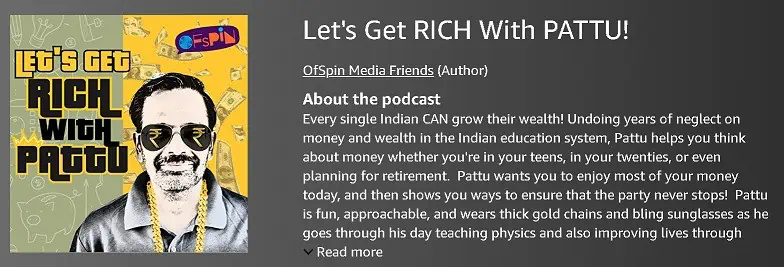
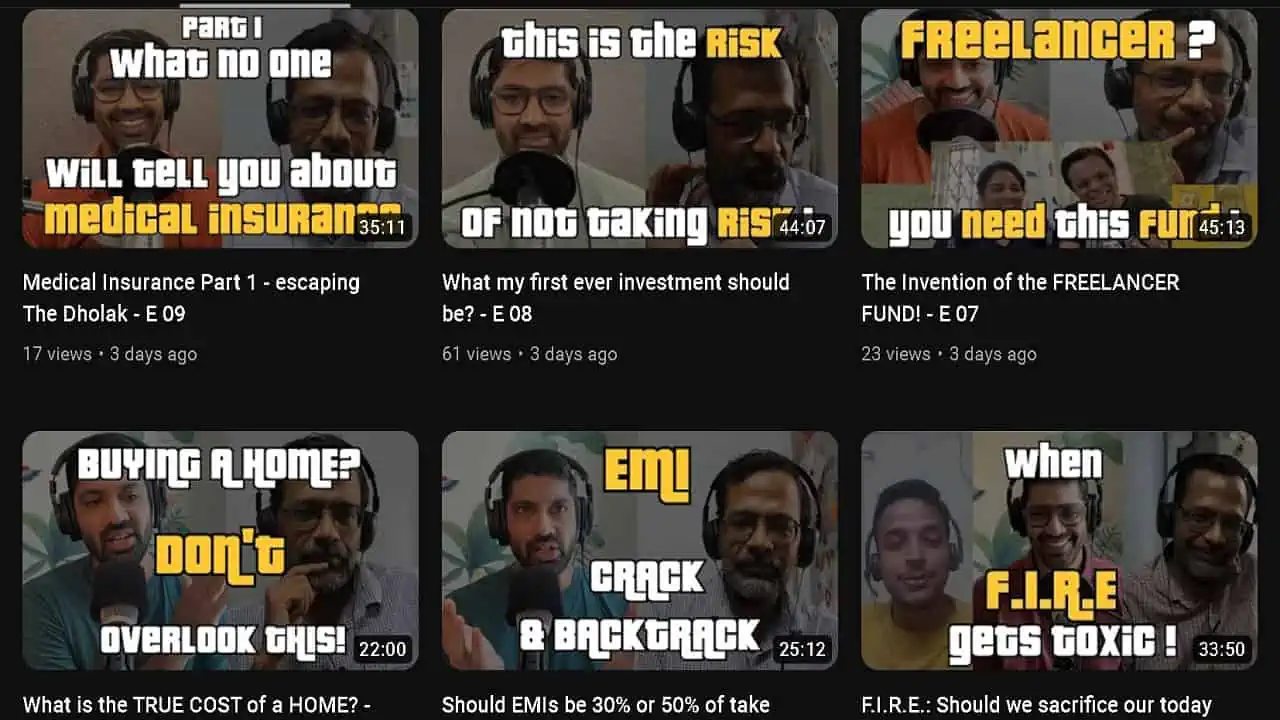
Listen to the Let's Get Rich With Pattu podcast on YouTube.
Now watch Let's Get Rich With Pattu தமிழில் (in Tamil)!About The Author
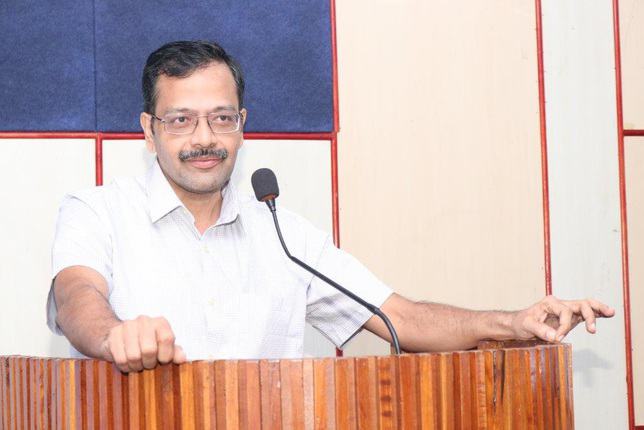
Dr M Pattabiraman giving a lecture
- Dr M. Pattabiraman (PhD) is the founder, managing editor and primary author of freefincal. He is an associate professor at the Indian Institute of Technology, Madras.
- He has over 14 years of experience publishing news analysis, research and financial product development. He has over 28 years of teaching and research experience. He is also a public speaker and keynote presenter.
- He is a patron and co-founder of “Fee-only India,” an organisation promoting unbiased, commission-free, AUM-independent investment advice.
- Connect with him via @pattufreefincal on X LinkedIn YouTube
- Pattabiraman has co-authored three print books.

This book helps you ask the right questions and find the right answers. It also includes nine online calculators to create custom solutions.
(2) Gamechanger: Forget Startups, Join Corporate & Still Live the Rich Life You Want. 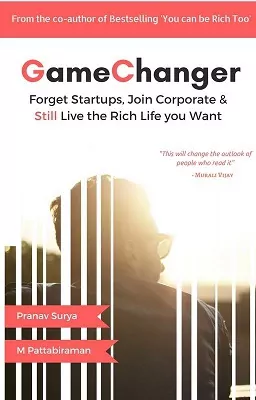

Both the boy and girl versions of "Chinchu Gets a Superpower".
Most investor problems stem from a lack of poor decision-making. We made bad decisions and money mistakes when we started earning, and we spent years undoing them. Why should our children go through the same pain? What is this book about? As parents, what if we had to groom one ability in our children that matters not only for money management and investing but for every aspect of life? My answer: Sound decision-making. So, in this book, we meet Chinchu, who is about to turn 10. The story follows what he wants for his birthday and how his parents plan it, while also teaching him key ideas about decision-making and money management. What readers say! 
Feedback from a young reader after reading Chinchu Gets a Superpower!
Must-read book even for adults! This is something that every parent should teach their kids right from a young age. The importance of money management and decision-making based on their wants and needs. Very nicely written in simple terms. - Arun.
About freefincal & its content policy
Freefincal is a News Media organisation dedicated to providing original analysis, reports, reviews and insights on mutual funds, stocks, investing, retirement and personal finance developments. We do so without conflict of interest and bias. Follow us on Google News. Freefincal serves more than three million readers a year (5 million page views) with articles based only on factual information and detailed analysis by its authors. All statements made will be verified with credible and knowledgeable sources before publication. Freefincal does not publish paid articles, promotions, PR, satire or opinions without data. All opinions will be inferences backed by verifiable, reproducible evidence/data. Contact Information: To get in touch, please use our contact form. (Sponsored posts or paid collaborations will not be entertained.)Our publications
- Your Ultimate Guide to Travel. This is an in-depth exploration of vacation planning, including how to find affordable flights, budget accommodations, and practical travel tips. It also examines the benefits of travelling slowly, both financially and psychologically, with links to relevant web pages and guidance at every step. Get the PDF for Rs 300 (instant download)

- How to profit from content writing: Our ebook is for those interested in getting a side income via content writing. It is available at a 50% discount for Rs. 500 only!