Last Updated on December 29, 2021 at 5:33 pm
After the Feb-March 2020 market crash, 80% of active large cap mutual funds have outperformed Nifty 50 and Nifty 100 total return indices. This is likely due to the two-year imbalance among Index stocks that was destroyed due to the crash. A performance report on active large cap funds. Have they returned? Will they do better in the future?
After 1st Feb 2018, the equity market went in two different directions. A few stocks with the most weight in the Nifty/Sensex moved up while the rest of the market – the remaining Nifty stocks, Nifty Next 50, midcaps and small caps started moving down. As a result, the outperformance of several actively managed mutual funds, especially in the large cap category became prominently visible. This trend seems to have reversed now.
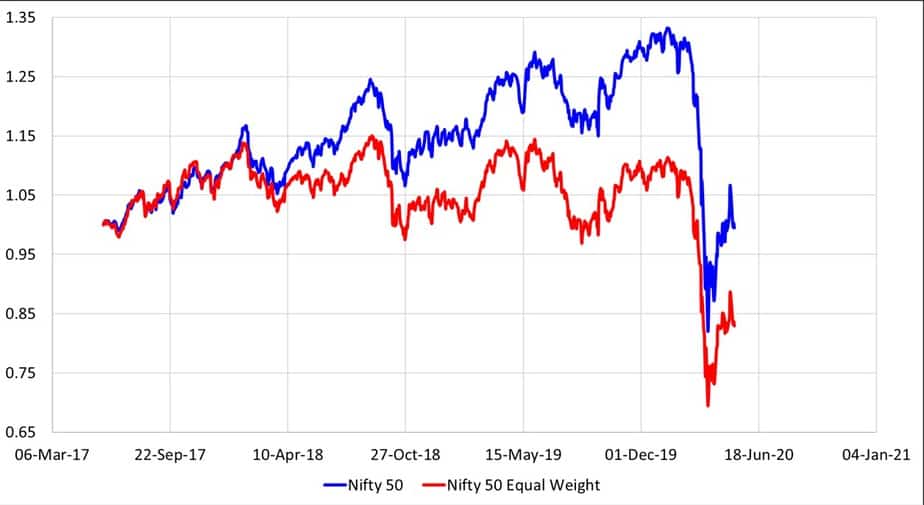
If you have checked the past 1-year returns in the large cap category just a few months ago, Sensex and Nifty index funds would have dominated the table (prior Feb 2018 Nifty Next 50 funds were on top). Today all these index funds are closer to the bottom of the table.
🔥Secure your future with our Robo-advisory tool trusted by over 3,500 investors and advisors. From effortless retirement planning to funding your children’s biggest dreams, turn your financial goals into reality. 🔥
Subscribe for money management solutions via email! (Link takes you to our email sign-up form) Join 32,000+ readers in our community.
👉 New Tool Alert! NaviPlan: A Privacy-Focused Multi-asset Tracker and Goal Planner 👈
All trailing returns were calculated wrt May 15th 2020. We looked at these 27 active large cap funds:
- Canara Rob Bluechip Equity Fund(G)-Direct Plan
- Axis Bluechip Fund(G)-Direct Plan
- BNP Paribas Large Cap Fund(G)-Direct Plan
- JM Large Cap Fund(G)-Direct Plan
- IDBI India Top 100 Equity Fund(G)-Direct Plan
- LIC MF Large Cap Fund(G)-Direct Plan
- IDFC Large Cap Fund(G)-Direct Plan
- Invesco India Largecap Fund(G)-Direct Plan
- Baroda Large Cap Fund(G)-Direct Plan
- Kotak Bluechip Fund(D)-Direct Plan
- HSBC Large Cap Equity Fund(G)-Direct Plan
- UTI Mastershare(G)-Direct Plan
- Edelweiss Large Cap Fund(G)-Direct Plan
- L&T India Large Cap Fund(G)-Direct Plan
- PGIM India Large Cap Fund(G)-Direct Plan
- Mirae Asset Large Cap Fund(G)-Direct Plan
- Essel Large Cap Equity Fund(G)-Direct Plan
- SBI BlueChip Fund(G)-Direct Plan
- Taurus Largecap Equity Fund(G)-Direct Plan
- DSP Top 100 Equity Fund(G)-Direct Plan
- ICICI Pru Bluechip Fund(G)-Direct Plan
- Indiabulls Blue Chip Fund(G)-Direct Plan
- Aditya Birla SL Frontline Equity Fund(G)-Direct Plan
- Franklin India Bluechip Fund(G)-Direct Plan
- Tata Large Cap Fund(G)-Direct Plan
- HDFC Top 100 Fund(G)-Direct Plan
- Nippon India Large Cap Fund(G)-Direct Plan
Over the last seven years, 22/27 (81%) funds beat the NIfty and Nifty 100 TRI. Note all returns are after expenses. Over the last year too, 22/27 funds (not the same ones!) outperformed the two indices. This is what happened in the middle!
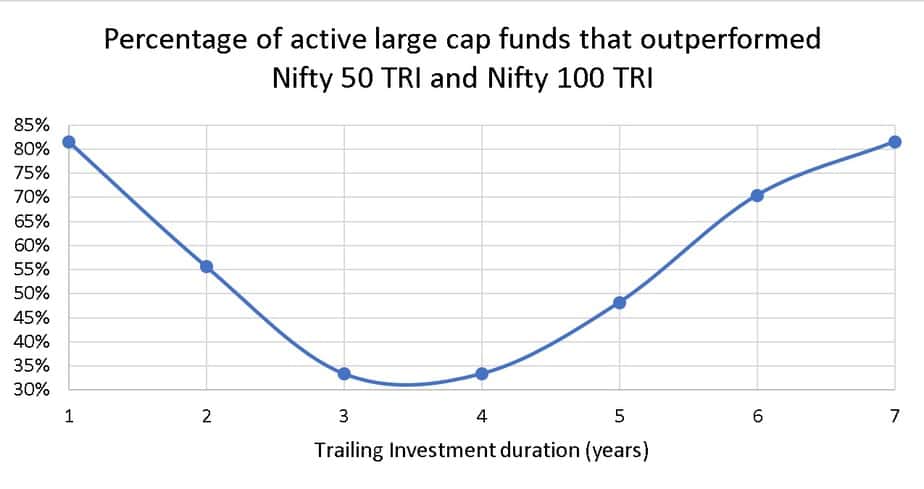
Clearly the overvaluation of a few NIfty stocks (which we have not seen at least since the 2000s) and the subsequent correction has impacted how well active funds fared before and after the crash.
What does this mean to the investor? Does this mean active large cap funds are back?
No. In Dec 2018 only Five Large Cap funds had comfortably beaten Nifty 100 and this was a thorough study based on rolling returns. Using the same criterion on the May 2020 Equity Mutual Fund Performance Screener we get only three funds!
Even if we use regular large cap funds and investigate bet April 2006 to Dec 2017 (before the onset of this market homogeneity) only 9/22 fund have consistently beaten NIfty 100 TRI over 3,5,7 and 10 years (over 70% of all rolling return data points).
So clearly even before the “80% from Nifty 100” SEBI mandate, active large cap funds had trouble beating the Nifty 100.
So why are you confusing us with data then? There is always going be some data like this. Some Yes Bank, some Vedanta, some index fund moving up the star rating ladder, moving down etc. If you chose index funds because that is going to outperform active funds “in the long run” then you are likely to be disappointed at least from time to time.
Choose passive funds only because of the additional risk in active funds – loss of performance risk, star ratings change risk, fund manager losing it risk, fund manager quitting-risk. If you think you will get better returns from index funds then behavioural risks could sabotage your investments!