In this edition of the “fund performance report”, we look at Axis Bluechip fund. Launched in Jan 2010, the fund has an AUM of about Rs. 34,000 Crores – the highest among actively managed large cap funds.
Disclaimer: Fund performance reports present return and risk analysis of a fund with representative benchmarks and not investment recommendations. It must be expressly understood that the data below reflect only past performance and is in no way an indication of future performance. Our investment recommendations can be found here: Handpicked List of Mutual Funds Oct-Dec 2021 (PlumbLine).
Considering the performance of active large cap funds, this report is more relevant to existing investors of the fund than potential new investors. See: Have active large cap funds performed better after the March 2020 market crash?
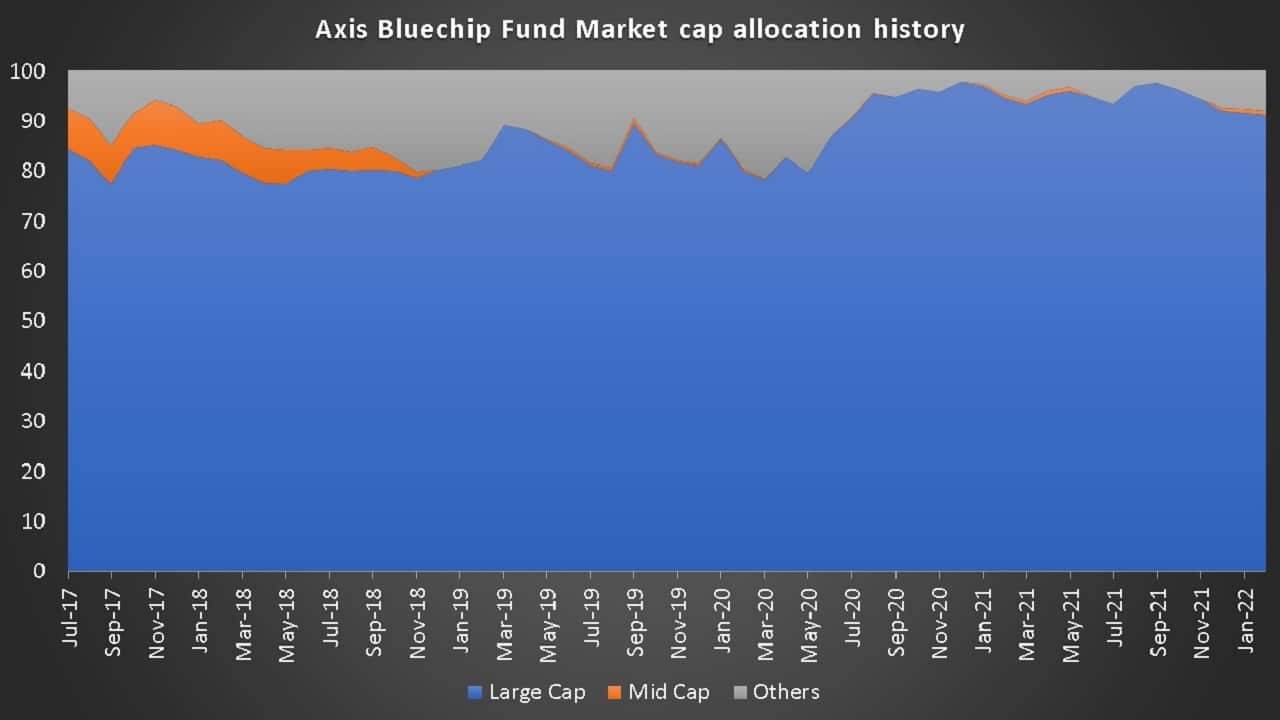
The market allocation history of the fund is shown below. The fund has largely been large cap oriented with a small exposure to mid cap stocks now and then.
We will use three metrics to analyze performance consistency compared to the fund’s benchmark – Nifty 100 TRI. Analysis such as this can be found for 350+ equity funds in our monthly mutual fund screener.
🔥Secure your future with our Robo-advisory tool trusted by over 3,500 investors and advisors. From effortless retirement planning to funding your children’s biggest dreams, turn your financial goals into reality. 🔥
Subscribe for money management solutions via email! (Link takes you to our email sign-up form) Join 32,000+ readers in our community.
👉 New Tool Alert! NaviPlan: A Privacy-Focused Multi-asset Tracker and Goal Planner 👈
1 Rolling return outperformance consistency: the fund returns are compared with category benchmark returns over every possible 3Y,4Y, 5Y period. Higher the outperformance consistency, the better. Suppose 876 fund returns were compared with 876 benchmark returns, and the fund has beaten the benchmark 675 times. The consistency score will be 675/876 ~ 77%.
Three Years
| No of rolling return entries Index (3 Years) | 1518 |
| No of rolling return entries Fund (3 years) | 1518 |
| No of times fund has outperformed the index (3 years) | 1344 |
| rolling return outperformance Consistency Score (3 years) | 89% |
Four years
| No of rolling return entries Index (4 Years) | 1271 |
| No of rolling return entries Fund (4 years) | 1271 |
| No of times fund has outperformed the index (4 years) | 1268 |
| rolling return outperformance Consistency Score (4 years) | 100% |
Five years
| No of rolling return entries Index (5 Years) | 1024 |
| No of rolling return entries Fund (5 years) | 1024 |
| No of times fund has outperformed the index (5 years) | 1024 |
| rolling return outperformance Consistency Score (5 years) | 100% |
That is indeed excellent consistency.
2 Upside performance consistency over every possible 3Y,4Y, 5Y: Higher the better. A score of 70% means, 7 out of 10 times, the fund performed better than the category benchmark when the benchmark was moving up. This is a measure of reward. It is computed from rolling upside capture data (see link below).
| upside performance consistency (3 years) | 33% |
| upside performance consistency (4 years) | 29% |
| upside performance consistency (5 years) | 12% |
This is not uncommon. Most funds do not exhibit consistent upside capture > 100% (higher returns than the benchmark’s positive monthly return). See for example: Strange, but true! How mutual funds beat the index!
3 Downside performance consistency over every possible 3Y,4Y, 5Y. Higher, the better. A score of 60% means, 6 out of 10 times, the fund performed better than the category benchmark when the benchmark was moving down. This is a measure of risk protection. It is computed from rolling downside capture data. Read more: An introduction to Downside and Upside Capture Ratios.
| downside protection consistency (3 years) | 52% |
| downside protection consistency (4 years) | 60% |
| downside protection consistency (5 years) | 69% |
These numbers are reasonable if not excellent.
Trailing returns and volatility
These are the returns and volatility as of 4th March 2021. Source: Equity Mutual Fund Screener Mar 2022.
| Metric | Nifty 100 TRI | Axis Bluechip Fund – Direct Plan |
| 1Y return% | 9.42% | 7.04% |
| 1Y volatility% | 3.96% | 4.08% |
| 2Y return% | 21.74% | 16.79% |
| 2Y volatility% | 7.79% | 6.59% |
| 3Y return% | 15.14% | 17.39% |
| 3Y volatility% | 6.79% | 5.67% |
| 4Y return% | 12.72% | 15.73% |
| 4Y volatility% | 6.05% | 5.17% |
| 5Y return% | 14.36% | 18.17% |
| 5Y volatility% | 5.56% | 4.74% |
The performance of Axis Bluechip Fund since March 2020 has been quite poor. There are opinions on this floating around like “Axis Bluechip was a growth chaser’ the cycle has turned and now is the time for value which is why you see funds like ICICI Value Discovery Fund doing better” etc.
Since the definitions of growth investing and value investing are arbitrary, I would rather stick to the facts and take comfort in a simple observation. No one can escape the law of averages (including Parag Parikh Flexicap fund!). I don’t know about growth vs value cycles but outperformance and underperformance wrt benchmark is the inescapable law of nature and the curse of actively managed funds.
Existing investors will have to appreciate that the bang for the buck (expense ratio) has significantly reduced in the last two years. It is perfectly fine to stay on having faith in the fund manager just as it is perfectly fine to exit. Whatever we choose as long as we do not feel superior about it, we should be reasonably happy.
Either way is it a gamble and either way no one knows the future. All I can say is, if I were an investor in Axis Bluechip fund (I am not), I will be inclined to wait a bit longer. But then again, I have tons of patience and don’t fret about fees. I still hold Quantum Long Term Equity, so you can imagine! I do plan to phase it out with UTI Low Volatility index fund (see link in the next para). Btw I hold Mirae Large Cap and we shall evaluate that next time. For full holdings see Portfolio Audit 2021: How my goal-based investments fared last year.
While existing investors have a dilemma at hand, the message is clear for new investors: buy a large cap index fund. Those who are uncertain or undecided on the active vs passive debate can consider aggressive hybrid funds. At the time of writing all funds in this category are actively managed. At least we would get a bit lower risk and tax-efficient bond holdings for the fees charged. See: Aggressive Hybrid Funds vs Low Volatility Index Funds: Which is better?