Axis Multicap Fund is an open-ended equity scheme investing across large cap, mid cap, small cap stocks. Launched in Nov 2017, it has beat its benchmark comfortably but already has raked in an AUM of Rs. 4850 Crores thanks to its Axis Bank connection. In this review, we look at the features of the fund and its portfolio history to find out if it can be considered for investment.
The fund was not affected by the SEBI Mutual Fund Categorization rules and only changed its benchmark from BSE 200 to Nifty 500 in May 2018. Although this gives the impression of a wider investment universe, it is not the case. It has only picked an easier benchmark to beat!
According to SEBI, multicap mutual funds have not market cap or sectoral limitations. They should only maintain 65% equity to comply with equity fund tax status. Axis Multicap Fund, in its short history, has behaved like a largecap mutual fund.
Marketcap History of Axis Multicap Fund
The fall in mid and small cap indices just three months after launch seems to have helped the fund. The fund manager -Shreyash Devalkar, who also manages Axis Bluechip and Axis Midcap (links points to fund reviews) – was quick to reduce mid and smallcap exposure while holding significant portion in bonds.
🔥Secure your future with our Robo-advisory tool trusted by over 3,500 investors and advisors. From effortless retirement planning to funding your children’s biggest dreams, turn your financial goals into reality. 🔥
SEBI should (among other things!) curb the practice of mutual funds offering “extra” information in scheme promotional material. For example, the scheme leaflet and scheme presentation both refer to the scheme having a largecap-tilt (50% to 100%). However, the scheme document (the only legally binding one) does not.
Both promotional materials refer to the investment strategy of the fund as the search for (1) stocks that are expected to grow faster than the benchmark and (2) stocks that are at an inflection point. An inflection point is one where the business changes direction for the better (or worse!)
It aims to first identify stocks with “Growth potential corresponds to sustainable earnings, growth potential, credible management and acceptable liquidity”. Then filter based on the following inflection indicators.
Market Share Gain due to Competitive Advantage
Industry Consolidation
Sunrise Industry
Improved management focus & Capital Allocation
Regulatory & Policy Changes
There is no mention of the above parameters and filters in the Axis Multicap Scheme document!
Expense Ratio History
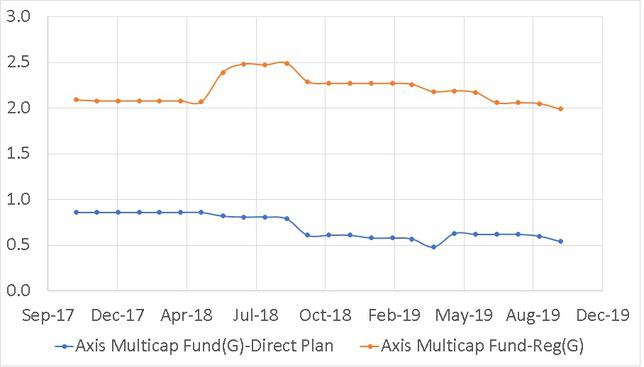
This is the expense ratio history of Axis Multicap Fund. At 0.6%, the direct plan is fairly attractive but could be subject sudden hikes after significant inflows as see earlier: Why SEBI should stop frequent mutual fund expense ratio changes. Also, the regular plan expense is 2.05% pointing to a strong incentive for selling this fund. This can be a problem with regard to the AUM.
AUM Trend
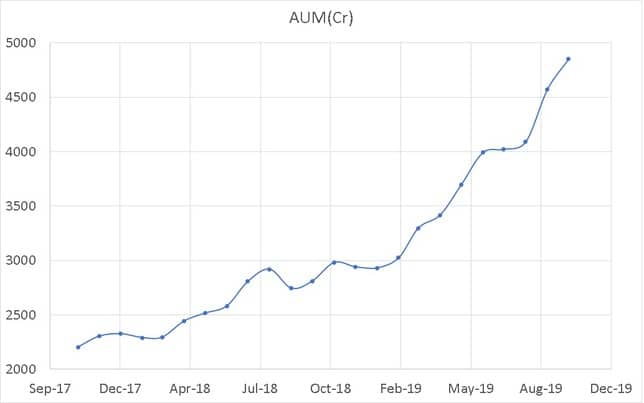
The AMC was able to mobilize significant AUM 2000 Crores plus during the NFO period! Since then too, the growth has been quite brisk.
The fund should safely be able to tolerate a sudden AUM spike resulting in approximately 3X or so growth and this is possible because of the push from banks. The selling points of “ability to invest across the market cap and change it as per market conditions to lower risk and increase returns” can be used to push the fund in good times and bad.
Direct and Regular AUM Split Average Assets under Management (AAUM) for the quarter of July – September 2019 (Rs in Lakhs) (source AMFI)
Direct Plan – Dividend
7793.65
Direct Plan-Growth
23015.87
Regular Plan – Dividend
21746.12
Regular Plan-Growth
356588.83
Sector Allocation History
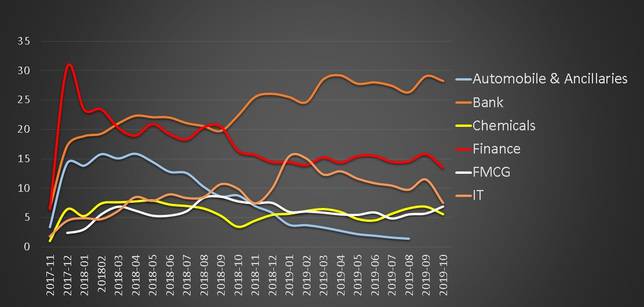
Besides the right change in market cap allocation, one can see below that the fund manager has also made some apt sector calls, reducing exposure to the automobile industry and financial services.
Performance
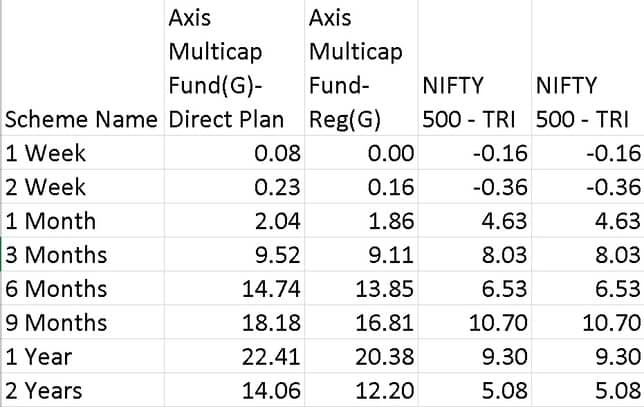
The fund in its short history has done quite well. Notice the huge impact of commissions – the big difference in direct and regular plan returns. The two-year returns show for the fund is approximate and as on 15th Nov 2019. The fund only completes two years as on 19th Nov.
Summary: Should You Invest or Stay Invested?
Axis Multicap is indeed an inviting prospect. A good fund manager with an impressive dossier, a low expense ratio for the direct plan (although possibly temporary) and good performance in its short history. The main problem is the possibility of rapid AUM growth thanks to banking channels.
At its current AUM level, the size problem is not immediate and existing investors can continue but to benefit must have significant exposure. New investors who either have an actual need for a multi-cap fund or are looking to restructure their portfolio can consider this fund.
Both types of investors must be aware of the risks specific to the fund (besides the usual ones): Possibility of increase in mid and small cap stocks; Too much dependence on the fund manager; future hike in direct plan expenses and sudden AUM influx affecting performance
Do share this article with your friends using the buttons below.
Create a complete financial plan with our Robo-advisor!
Trusted by 3500+ investors and advisors! Use code robo25 for a 20% discount!