Last Updated on December 29, 2021 at 4:53 pm
Here is how you can calculate returns from an insurance policy. The next time an insurance agent shows you a policy benefit illustration or the next time your friend or relative asks you, “Is this a good policy to invest in?”, use this method to show the annualized return they can expect (before bonuses which will not make a significant impact).
Let us take an example of PNB MetLife Guaranteed Savings Plan. This illustration was shared in FB group Asan Ideas for Wealth a few days ago. I love this example because it teaches always to compute XIRR and NOT IRR!! For those who an introduction to these terms, please consult: What is XIRR: A simple introduction
There are so many variations possible with these numbers to illustrate the time value of money. I have already done one example here: Why Time is Money and How Life Insurance Plans Exploit it! When I can, will make a video on the variations. For now, I will stick to the numbers as given by the insurer.
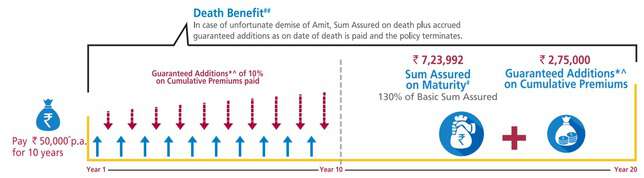
Shown below is an illustration for a 20Y policy with 10Y premium paying term. The sum assured ~ Rs. 5.56 Lakh and the annual premium is Rs. 50,000 or Rs. 59,000 with GST (notice that illustrations will not include taxes). These premia are shown as upward blue arrows below.
🔥Secure your future with our Robo-advisory tool trusted by over 3,500 investors and advisors. From effortless retirement planning to funding your children’s biggest dreams, turn your financial goals into reality. 🔥
Subscribe for money management solutions via email! (Link takes you to our email sign-up form) Join 32,000+ readers in our community.
👉 New Tool Alert! NaviPlan: A Privacy-Focused Multi-asset Tracker and Goal Planner 👈
At the end of 20Y, the policy will pay out Rs. 7,23,992 as a guaranteed benefit. It will pay out Rs 2,75,000 over the first 11 years of the policy in the following manner. After one year, the total premium paid is Rs. 50,000. So in the second policy year, 10% of this amount or Rs. 5000 will be paid.
In the third policy year, it will pay 10% of total premiums paid so far (Rs. 1 lakh) or Rs, 10,000 and so on. These are shown as the red down arrows that increase in size. The sum of all these payouts is Rs. 275,000. Now how to compute annualized returns?
First, we need to tabulate all the cash outflow and inflow as below.
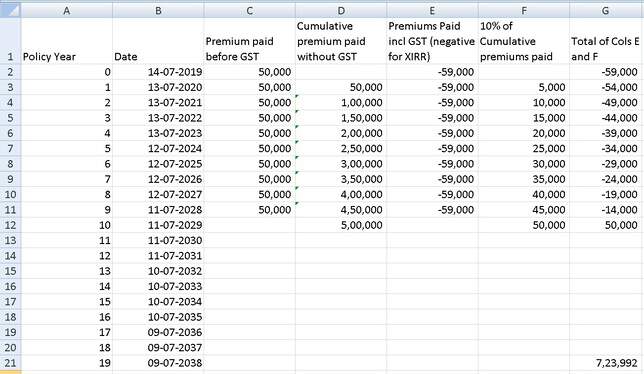
- Col A is just the year no starting with zero (the 1st premium).
- Col B a set of imaginary premium paying dates. We shall assume the annual payout from the insurer is also on the same date
- Col C the premium paid (before GST)
- Col D the sum of total premiums paid each year.
- Col E actual premium paid (including GST). Shown as negative for return calculation. The money we pay is shown as negative and the money we receive is positive.
- Col F 10% of cumulative premiums paid is given to us (so this is positive).
- Col G is the total cash flow that is the sum of Col E and Col F. The final payout of Rs. 7,23,992 is shown as the final entry (20th year).
The XIRR or annualized return formula is as shown below. The XIRR formula is = XIRR(set of cash flow values, dates)
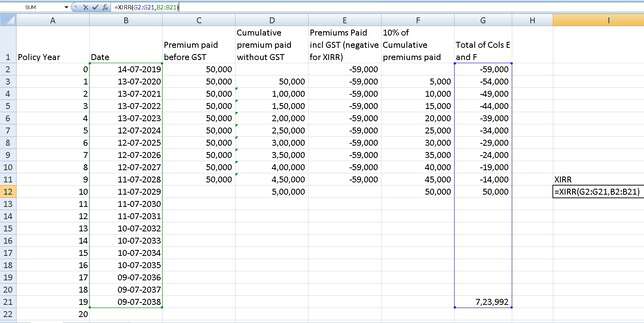
The annualized return is 5.11%
Note: IRR (a variant of XIRR for regular cashflows and therefore dates are not used) gives an inflated wrong answer. I have not dug deeper into this problem. This example shows that it is better to use dates + payouts and use XIRR at all times.