Last Updated on December 29, 2021 at 11:52 am
Here is how one can choose a liquid fund in 2019 by minimizing credit risk. The recipe is simple: stop chasing returns; stop using star ratings and understand investment strategies. In the past couple of years, we have seen huge losses in liquid funds – something that was considered to be impossible. So we would need to tread with caution.
What is a liquid fund?
It is a debt mutual fund designed as an alternative to a savings bank account, but with market risks. It will only invest in bonds that mature on or before 91 days. This means that possibility of the NAV reacting sharply to interest rate movement is small (although there are exceptions, see below). Since these are short-term bonds the risk of a credit downgrade and/or default is relatively low as these many of these funds buy bonds with a higher rating. Again, that is not true for all funds!
A liquid fund has special rules governing NAV applicability for redemption. I will discuss in a separate article. An overnight mutual fund is a liquid fund that invest only in overnight bonds. So this has the lowest interest rate risk and credit rating risk.
If you wish to understand about these risks and how a debt mutual fund works, download the free E-book: A Beginner’s Guide To Investing in Debt Mutual Funds
🔥Secure your future with our Robo-advisory tool trusted by over 3,500 investors and advisors. From effortless retirement planning to funding your children’s biggest dreams, turn your financial goals into reality. 🔥
Subscribe for money management solutions via email! (Link takes you to our email sign-up form) Join 32,000+ readers in our community.
👉 New Tool Alert! NaviPlan: A Privacy-Focused Multi-asset Tracker and Goal Planner 👈

When should you use a liquid fund?
A liquid fund is for parking money and not investing or even saving. So use it only as (1) a component of your emergency fund and (2) when you need to spend some money but are not exactly sure when – it could be in the next few months or a year.
History of Liquid Fund losses
The myth that liquid fund NAV cannot fall was first busted in July 2013 when there was a sudden spike in the overnight interest rate by RBI. Liquid funds fell, but regained in the next few days.
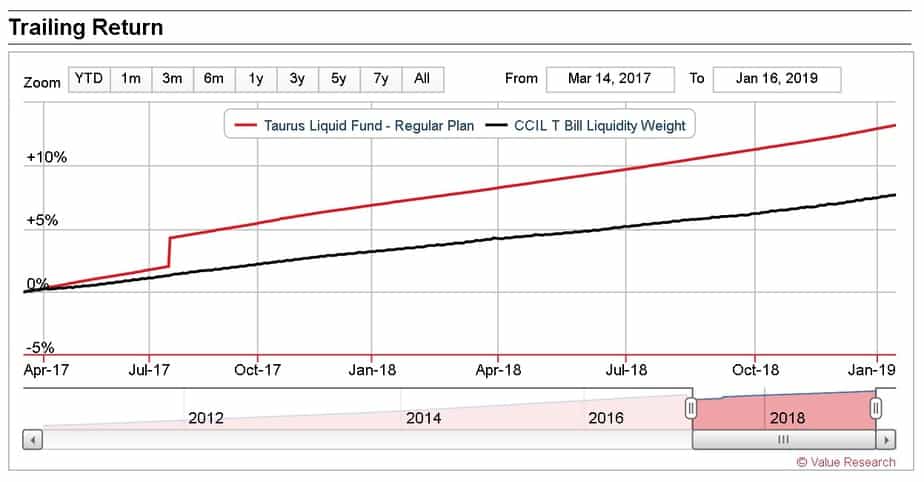
Taurus liquid fell 7.2% overnight when Ballarpur Industries was downgraded and subsequently defaulted in Feb 2017. Since they can factor credit risk into a star rating algorithm, the fund fell five stars to one stars. For the same reason (that they cannot account for credit risk), the fund is currently rated four-star because the NAV moved up a little since Taurus got back part of their money (check out the video for details). If this does not teach you not to use start ratings for choosing debt mutual funds, nothing will.
Figure shows the fall and partial recovery of Taurus Liquid Nav. All screenshots below are from Value Research.

Since the last 18 month window shows a sharp increase in NAV, Taurus Liquid Fund is currently rated 4-stars (it was 5-stars in Sep 2018!)
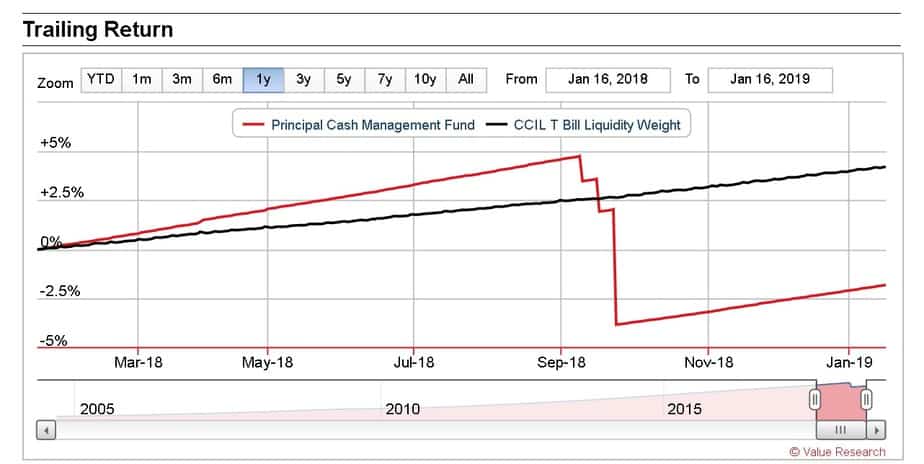
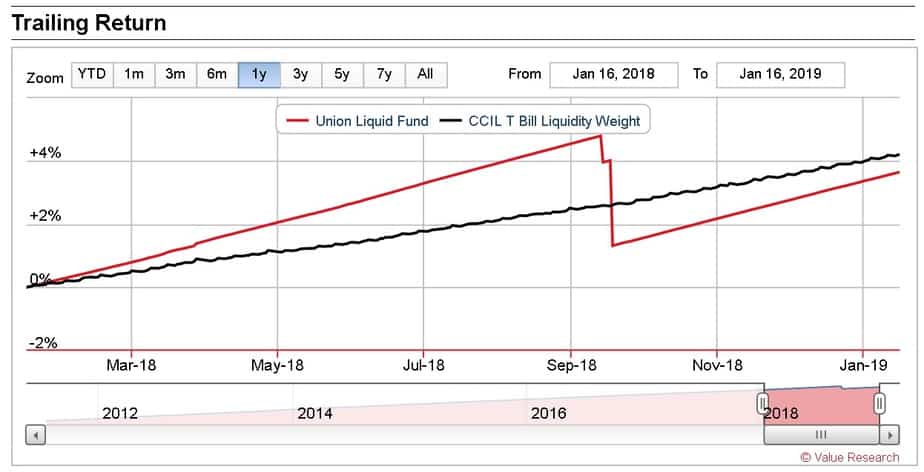
Then in Sep. 2018, came the IL & FS fiasco when rating agencies downgraded bonds by ten notches literally overnight! Liquid funds like Principal Cash Management and Union Liquid Fund fell by about 7.5% and 4.5% respectively.
Is there a way to eliminate such credit risks in liquid funds?
The obvious answer is no. However it can be minimised to a large extent with the following steps
How to select liquid funds with minimal credit risk?
- Choose overnight mutual funds and settle for a lesser return
- Choose Reliance Liquid Bees ETF. The price to pay is dividend distribution tax as the fund will declare daily dividends. There will be not capital gains as the NAV will always be Rs. 10 daily (because they pay the daily profits out as dividends). It is a pity that Value Research rates this fund is one-star rated for no fault of its. It holds cash and if you compare this with other liquid funds that hold longer-term bonds, the returns will be lower. ICICI Liquid ETF has a similar mandate but is only a few months old.
- Choose Quantum Liquid fund. Although expensive due its low AUM, this fund,
does not take exposure in private sector corporations and invest only in government securities, treasury bills and highest quality instruments issued by public sector undertakings (PSU) Source: Quantum Newsletter
- Finding such funds that state where they will not invest is rare. An alternative is to go the Value Research Liquid fund page and sort the funds by decreasing AUM.
- List the top fund in terms of AUM. I mention the no of bonds that each fund holds in brackets
- HDFC Liquid (254)
- ICICI Liquid (205)
- ABSL Liquid (240)
- SBI Liquid (147)
- Reliance Liquid (176)
- Higher the AUM of the fund, higher the no of bonds held and lower the exposure to each bond. That is lower than the 10% allowed maximum individual exposure. This reduces big NAV falls when credit ratings change. A better reason is, higher the AUM, higher the institutional money and higher the responsibility of the AMC. So they are more likely to play it safe than try for higher returns and risk business.
- Naturally this is a rather crude method and far from a guarantee of minimal credit risk, but I cannot see any other alternative when most scheme documents list every type of short-term bond under the sun where the scheme can invest.
- Now navigate to the performance tab of each fund at Morningstar. This is a screenshot of HDFC Liquid.
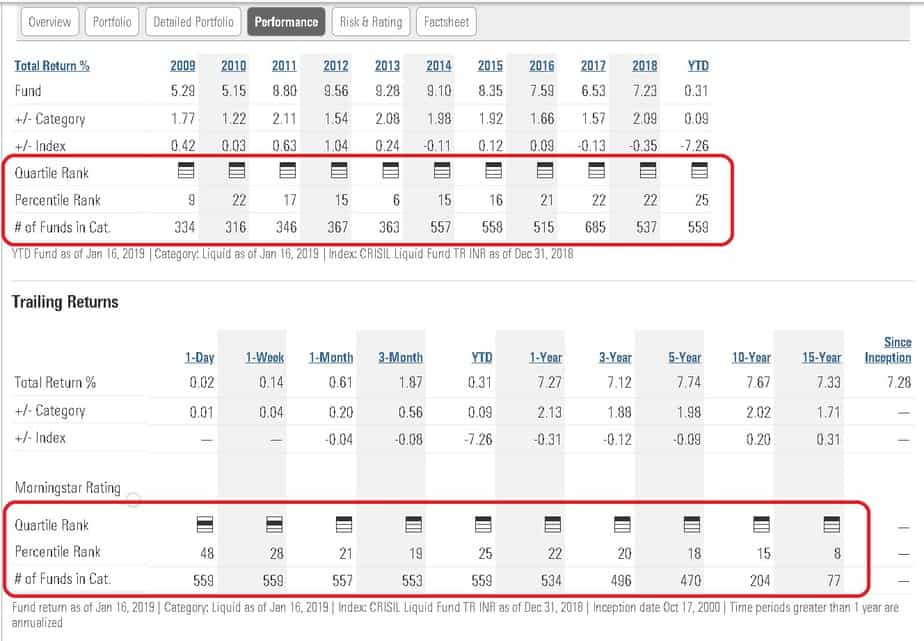
Ensure that the fund was neither a top nor bottom performer in any of the periods considered. This is an approximate way to check if the fund held risky bonds and generated high returns. High returns can stem from other causes like rate movements and use of government bonds, but that is all that one can do.
The alternative is rather boring: Read the scheme document, explore past fund factsheets to check the kind of bonds it uses. It still is not a guarantee, but at least you tried!
That is as far as my thinking takes me. If you have any other suggestions, let me know. The ideal liquid fund would be one that uses only Govt bonds (gilt). Although Parag Parikh Liquid fund holds a significant amount of gilts, it does not have an exclusive mandate to do so.
I wonder what surprises and lessons 2019 would spring from the debt mutual fund space! Watch this space.
Watch the video version
Other videos from freefincal on YouTube