Last Updated on December 29, 2021 at 5:36 pm
This is a review of Edelweiss Mid Cap Fund that hopefully serves to illustrate why investors should not ignore past changes to a fund and need to study past fund factsheets and not go by current star ratings.
According to Value Research (VR), Edelweiss Mid Cap Fund Direct Plan has a four-star rating (June 2020). Those who have read the star rating methodology would recognise that a rating is given to a fund only if it has a history of at least three years. However, that alone is not enough. The fund portfolio must have been homogenous over this period or longer.
That is, there is little point in rating a large cap fund that suddenly became a midcap fund after a year. The SEBI categorization rules (early 2018) changed the fundamental attribute of most mutual funds. VR claimed they have retained the star ratings only for those funds that did not change type. However, that is not the case as shown here several times before. See for example SBI Focused Equity Fund Review
🔥Secure your future with our Robo-advisory tool trusted by over 3,500 investors and advisors. From effortless retirement planning to funding your children’s biggest dreams, turn your financial goals into reality. 🔥
Subscribe for money management solutions via email! (Link takes you to our email sign-up form) Join 32,000+ readers in our community.
👉 New Tool Alert! NaviPlan: A Privacy-Focused Multi-asset Tracker and Goal Planner 👈
Fund History: Like most funds, Edelweiss Mid Cap Fund has a colourful past. It is always important to consider the changes in the nature of a fund in the past before crunching NAV data. An easy way to do this would be to search for “fund name change in a fundamental attribute” and follow the results.
Another would be to randomly download AMC factsheets and look for changes in fund names and attributes. Funds typically mention such dates in the factsheet. As on June 2013, the oldest factsheet available online the AMC has a fund called Edelweiss Select Midcap Fund.
Investment objective: “The primary investment objective of the Scheme is to generate long term capital appreciation from a portfolio predominantly comprising of equity and equity-related securities of MidCap Companies”. Benchmark: S&P BSE Midcap Index.
From Aug 2015, the fund was renamed as Edelweiss Emerging Leaders Fund and the objective modified to, “The primary investment objective of the scheme is to generate capital appreciation from a diversified equity portfolio predominantly comprising of equity and equity-related securities of mid and small cap companies.” Benchmark: CNX Midcap Index.
Then JP Morgan sold out to Edelweiss. From Nov 2016, Edelweiss Emerging Leaders Fund was merged with JPMorgan India Mid and Small Cap Fund and renamed as Edelweiss Mid and Small Cap Fund! Benchmark: Meanwhile NSE went through changes of its own and the benchmark became Nifty Free Float Midcap 100!
The investment objective became: to seek to generate long term capital appreciation from a portfolio that is substantially constituted of equity and equity-related securities focused on smaller companies. Generally, the universe will be the companies constituting the bottom fourth by way of the market capitalization of stocks listed on the NSE or the BSE. The fund manager may from time to time include other equity and equity-related securities outside the universe to achieve optimal portfolio construction.
Then came the SEBI regulations and surprise, surprise! Another name change, another change in objective. From March 28th 2018, the fund became Edelweiss Mid Cap Fund and will have to hold 65% of mid cap stocks.
Edelweiss started this fund in August 2011, but because of the scheme merger with an older fund, today the inception date is listed as Dec 2007! Please take some time to study the history of a fund before calculating returns and other metrics.
Once you get into the history of a fund, the last 3Y, 5Y, etc returns make no sense. The fund has been a mid cap fund for only the last two years as is evident from the market cap history.
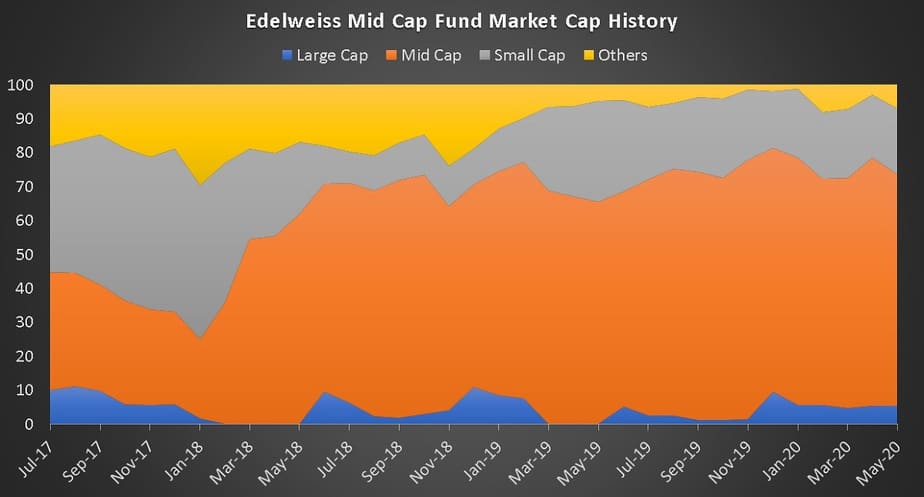
For what it is worth, the fund has not done well over the past five years even though the small cap allocation was reduced just as small cap indices began their slide. The fund is the black line at the bottom of the pack.
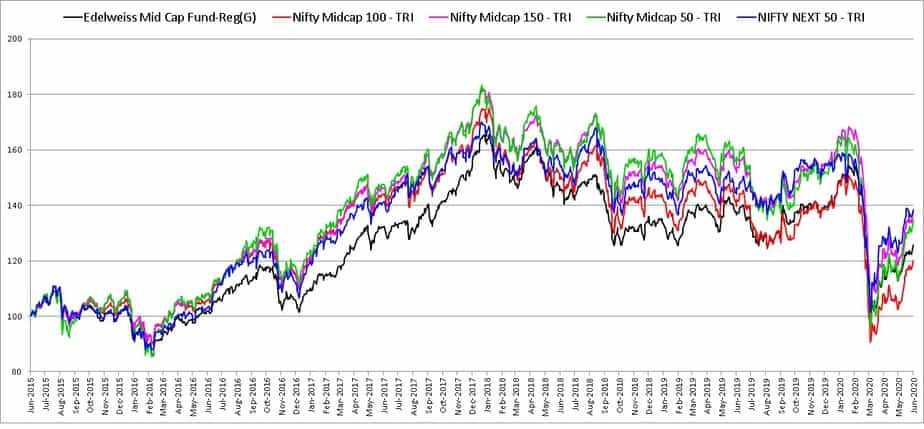
This the performance over the last two years when the fund has operated as a mid cap fund.
| Name Duration | 1 Y | 2Y |
| Edelweiss Mid Cap Fund(G)-Direct Plan | -6.6 | -5.4 |
| Nifty Midcap 100 – TRI | -14.0 | -9.8 |
This is quite good. Let us consider the pros and cons of investing in Edelweiss Mid Cap Fund. Cons: lack of history, the expense ratio (0.68%) is high for AUM of 780 Crores. There are less expensive more popular alternatives like Axis Midcap fund (review link) 0.56% or Kotak Emerging Equity (review link), 0.63% or the new kid on the block, Mirae Asset Midcap Fund, 0.48% (all nos as of June 2020 and subject to upward revision when the AUM increases or decreases!!).
Pros: AUM growth unlikely to be as high as the above-mentioned funds when the market starts to move up (yes most investors get in at the wrong time and repent later). So this might one of those “quiet funds”. If your expectations are not too high and if you do not mind a “new fund” then you consider Edelweiss Mid Cap Fund.
Please take some time to dig through old factsheets of your funds. There could be a few surprises buried in the closet!