Last Updated on December 29, 2021 at 12:18 pm
Here is a ready reckoner FAQ on the basics Real Estate Investment Trusts (REIT’s) and Infrastructure Investment Trusts (InvITs) in the form of an FAQ. This covers key information for the layman and is meant to serve as a basic introduction. With Embassy office Park REIT IPO, there is a renewed interest in these instruments. However, investors should be cautious and avoid them as the risk are unknown and the expected reward not high enough.
FAQ on Real Estate Investment Trusts (REIT’s)
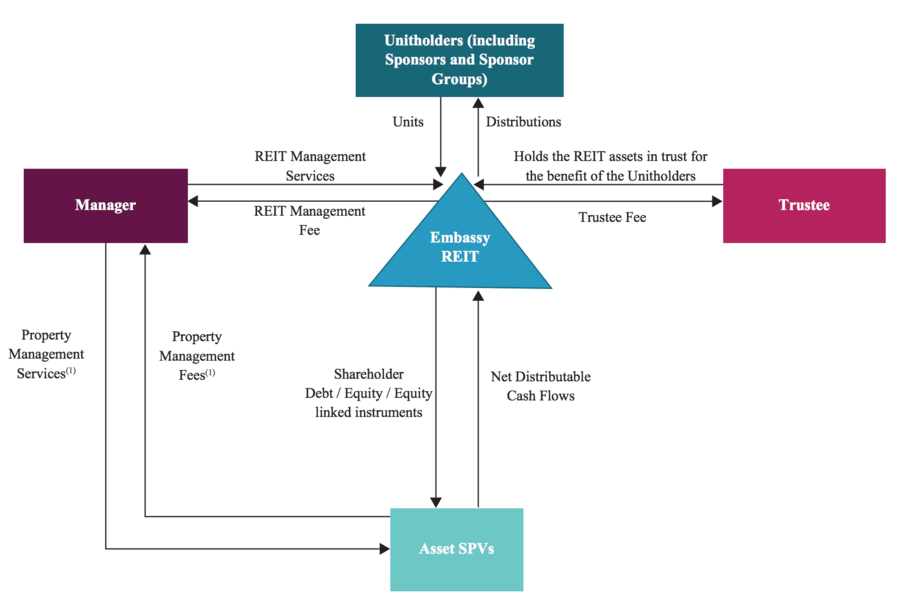
1: What are REITs? It is a mutual fund that invests in real estate. It has a structure that is similar to how mutual fund houses operate. The following a screenshot from page 64 from the offer document of Embassy Park REIT (download link below)
2: Where can they invest? Commercial real estate only through a special investment vehicle (a 3rd party firm) or directly.
🔥Secure your future with our Robo-advisory tool trusted by over 3,500 investors and advisors. From effortless retirement planning to funding your children’s biggest dreams, turn your financial goals into reality. 🔥
Subscribe for money management solutions via email! (Link takes you to our email sign-up form) Join 32,000+ readers in our community.
👉 New Tool Alert! NaviPlan: A Privacy-Focused Multi-asset Tracker and Goal Planner 👈
3: What is the asset allocation? Eighty per cent in completed rent-generating properties. Rest in cash, money market bonds, govt or corporate bonds, realty stocks and property under construction.
4: What is the minimum investment required? Two lakh. And when it is listed in the exchange the trading lot will be worth one lakh.
For the Embassy Office Parks REIT, You will have to buy a minimum of 800 units at Rs. 300 per unit or Rs, 2.4 Lakh.
5: Will I get a dividend? There is no “growth” option! Twice a year (at least), the REIT will have to distribute 90% of the income as a dividend. There will also be some growth in the value of the units
6: How are they taxed? The dividends are tax-free. The dividend distribution tax associated with them has been scrapped. Moreover, capital gains from units less than 3Y old will be taxed at 15%+ cess and above that is taxed at 10% +cess.
7: What are the risks? The REIT combines the concentration risk of a sectoral mutual fund and the credit risks of a debt mutual fund. Legal issues in ownership and construction or occupation delays can hit income. Recessions can hit developing commercial real estate pretty bad. There can be defaults or lack of tenants. There is no benchmark to compare with, aside from say, a fixed deposit. Rental yields are low and hence one cannot expect inflation-beating returns (inflation will be the at the lending rate).
8: How much return can I expect from a REIT: If you refer to page 79 of the Embassy Office Parks Offer Document, the RE income yield from India is about 7.5-8.5%. In a nice review, S R Srinivasan calculates a projected yield of 7.44% for Embassy Parks REIT in FY 2020. This is simply not worth the associated risk in my opinion.
9: My equity or debt mutual fund wants to invest in REIT. Is it okay to continue with it? Yes. The investment limit is capped at 10%. If you invest directly in a REIT, the risk would be much higher. Even if the REIT portion does not result in better returns, it could (repeat, could) lead to better diversification and lower risk. This remains to be seen though. There is no need to exit a fund just because it wants a slice of the REIT or InvIT pie.
10: What is the structure of a REIT? Besides the unit holder (you or me) on one end and the asset (the property) on the other, there are three other entities:
- The sponsor who set up the REIT and hold the min no of units to make it valid.
- The sponsor appoints a Trustee who holds the investor units and oversees the fund management.
- The fund manager who is responsible for security selection

A FAQ on Infrastructure Investment Trusts (InvITs)
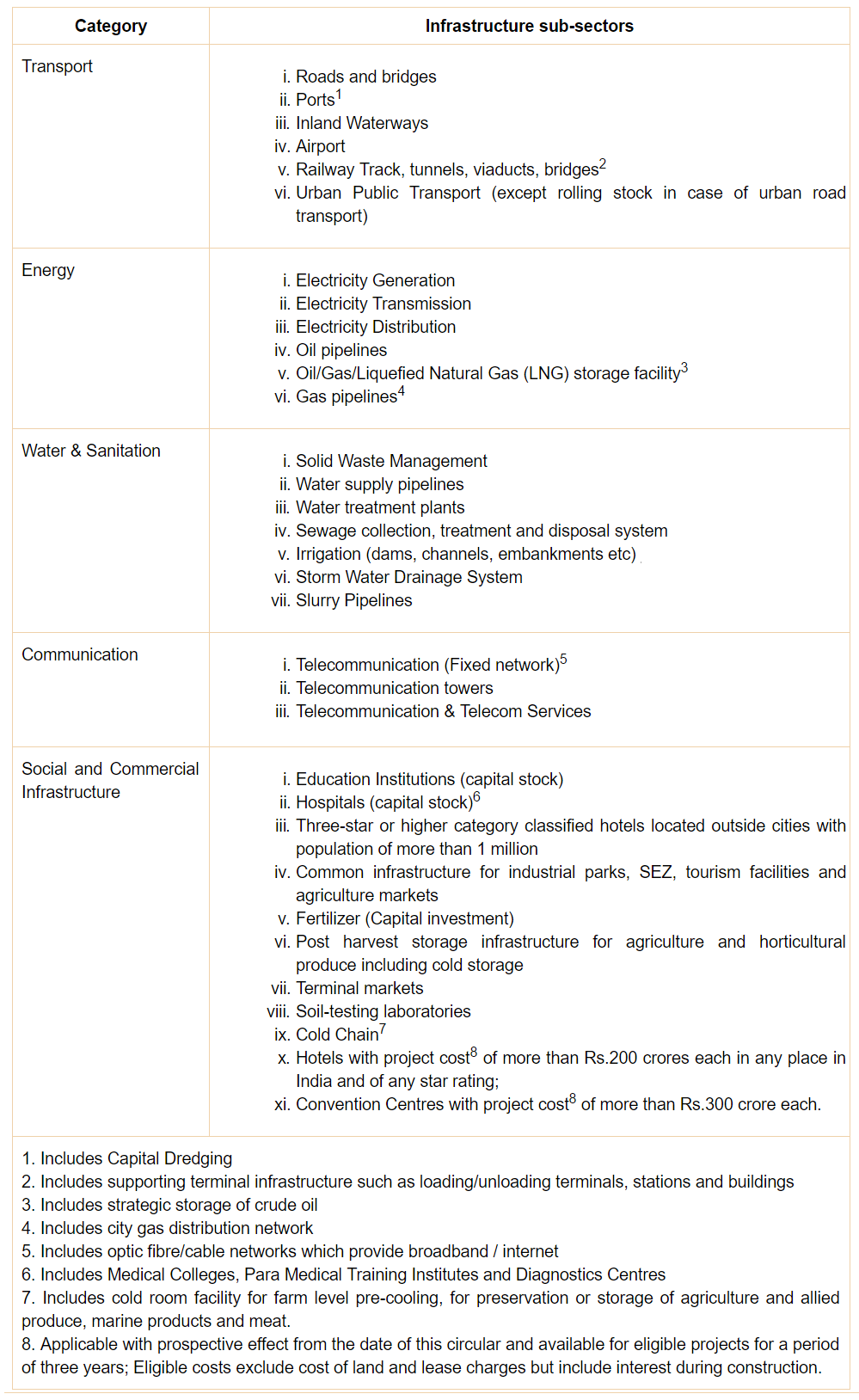
1: What are InvIT’s? An InvIT is a mutual fund that investments in infrastructure projects as defined by the Ministry of Finance.
2: Where can they invest? In projects such as these. Source: RBI
3: What is the asset allocation?
There are two types of InvITs.
Public InvITs have to invest greater than 80% in completed revenue generating projects and not more than 10% in under construction projects.
Private InvITs can have more than 10% in under construction projects.
4: What is the minimum investment required?
Public InvITs: 10 Lakh
Private InvITs: 1 Crore
5: Will I get a dividend? There is no “growth” option! Twice a year (at least), the public or private InvIT will have to distribute 90% of the income as a dividend.
6: How are they taxed? The dividends are tax-free. The dividend distribution tax associated with them has been scrapped. Moreover, capital gains from units less than 3Y old will be taxed at 15%+ cess and above that, it is 10% +cess.
7: What are the risks? In addition to the risks associated with REITs, the possibility of government intervention is a risk to the amount of income one can generate with this instrument.
8: What is the structure of an InvIT? In addition, the three entities associated with a RIET, an InvIT also has a project manager to undertake projects (need to learn more about this).
This covers the basic ground on both these instruments. Do let me know if there are any mistakes or anything important has been left out. Will update this FAQ from time to time.
Should you invest? As of now enjoy the 10% REIT or InvIT stake in equity/debt mutual funds and don’t get your hands messy directly. My impression is that the reward may not be in proportion to the investment ticket and risks involved. Once the NAV data is available, we can take a deeper look. If I am going to get fixed income kind of return, then I must only take on fixed income kind of risk. REITs have far higher risk and therefore make no sense.