Last Updated on January 7, 2024 at 10:19 am
In his new book, Same as Ever, Morgan Housel says, “A good summary of investing history is that stocks pay a fortune in the long run but seek punitive damages when you demand to be paid sooner.”
“Consider a long stretch of history, from 1871 to 2018. During that period, the odds that the US stock market was positive on any given day was about 50%, a coin toss. Over any three-month period, it was a little better, about 60%. Over a one-year period, it was 68%, getting better.”
“Over five-year periods, the stock market has been higher 80% of the time. Over 10-year periods, 88% of the time. And over 20-year periods, 100% of the time. One way to think about this is that there is a most convenient investing time horizon, probably around ten years or more. That’s the period in which markets nearly always reward your patience. The more the time horizon compresses, the more you rely on luck and tend to ruin.”
He then says 90% of investing blunders are due to investors trying to compress this natural time horizon. There is no disagreement here, and most readers will agree that equity is for the long-term.
🔥Secure your future with our Robo-advisory tool trusted by over 3,500 investors and advisors. From effortless retirement planning to funding your children’s biggest dreams, turn your financial goals into reality. 🔥
Subscribe for money management solutions via email! (Link takes you to our email sign-up form) Join 32,000+ readers in our community.
👉 New Tool Alert! NaviPlan: A Privacy-Focused Multi-asset Tracker and Goal Planner 👈
However, the suggestion here is that all long-term investors are bound to be successful. This is far from true. The stock market always moves up in the long term, but returns move up and down!
To better appreciate this, we need sufficient market history. Using the Schiller PE data, we shall turn to the S&P 500 Total Returns index for this. The S&P 500, when plotted on a log scale, again underpins the sentiment that the markets will move up over the long term.
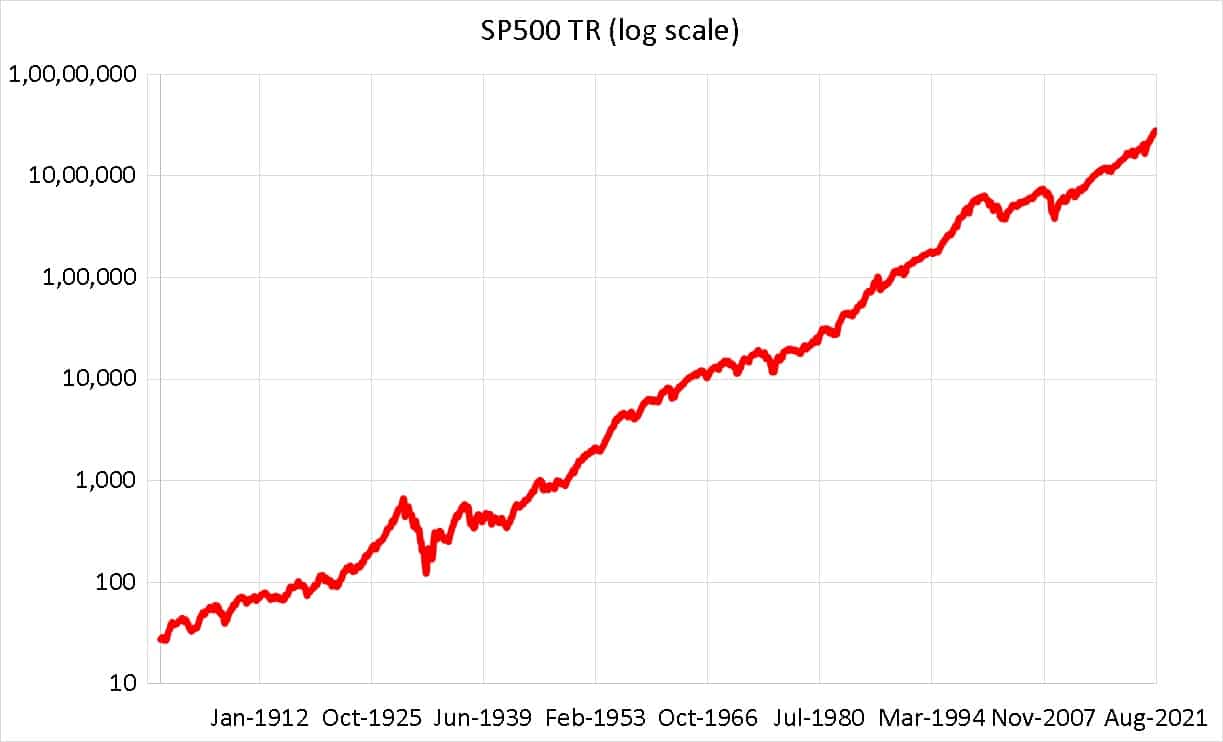
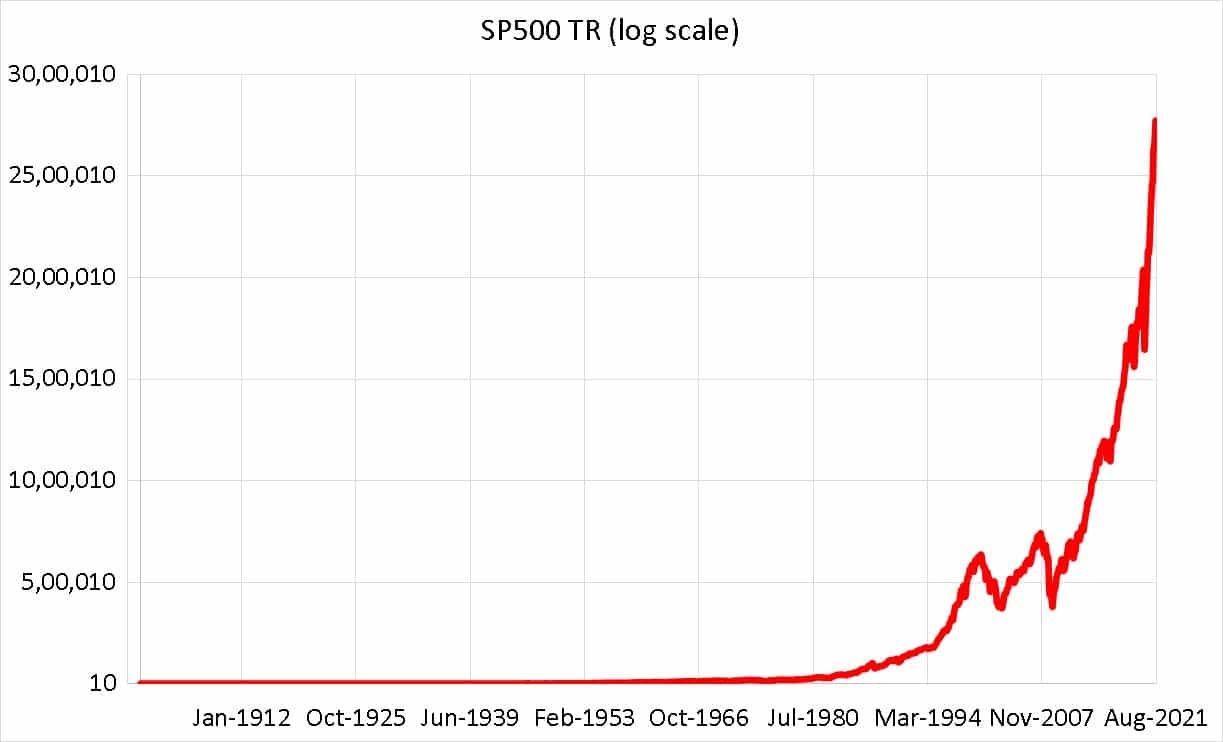
It looks bizarrely extraordinary when plotted normally because it extends beyond the normal human lifespan.
When we look at the 15-year rolling SIP returns data – there are 1279 such data points! – it is nothing short of extraordinary! The true cyclic nature of long-term equity returns is seen.
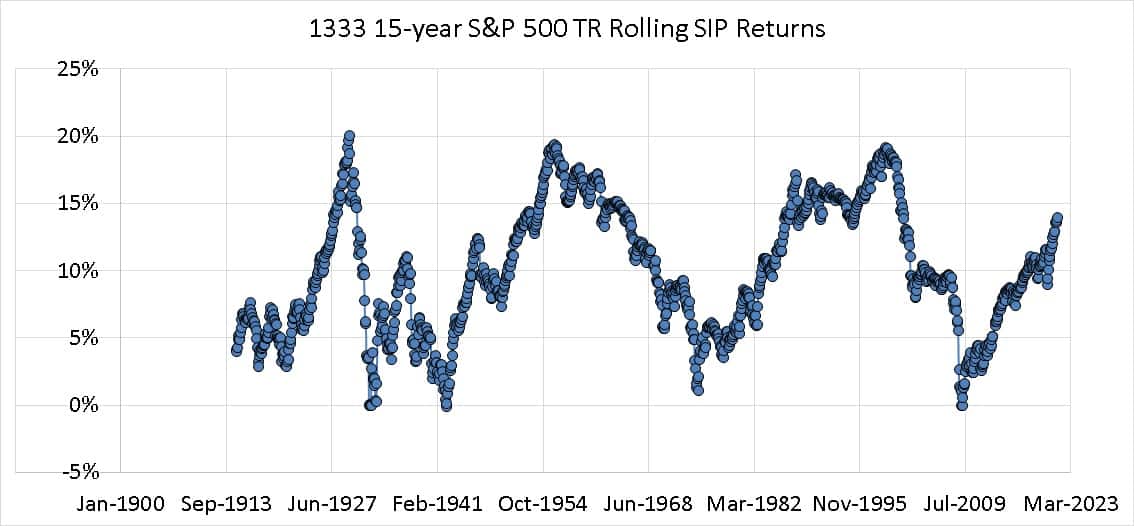
We only see an arm and leg of this cyclicity in the case of the Sensex because of its short history – meaning we have to be more careful about what to expect from equity in the future.
From the above graph, we can see that the chances that “over the long term” the (US) stock market will beat (US) inflation is high but not 100%. Even more important, the chances of your stock market investment beating your return expectation (which is always higher than inflation) after tax is well below 100%. See: Equity may beat inflation, but that doesn’t mean you will!
Moran Housel appreciates this. Later in the book, he says, “If it is 2010 and I have a 10-year time horizon, your target date is 2020, which is when the world fell to pieces. If you were a business or an investor, it was a terrible time to assume the world was ready to give you the reward you have been patiently awaiting”.
However, the solution he recommends is far from practical. “A long-time horizon with a firm end date can be as reliant on chance as a short-term horizon. Far superior is flexibility. Time is compounding magic. And its importance can be minimized. But the odds of success fall deepest in your favour when you mix a long term horizon with a flexible end date or an indefinite horizon. Benjamin Graham said the purpose of the margin of safety is to render the forecast unnecessary. The more flexibility you have, the less you need to know what happens next”.
One cannot be flexible with (personal) financial goals like retirement and a child’s college fees. Sure, in some cases, retirement can be preponed or postponed, but not always, and one cannot assume this is possible five years or ten years from now.
We must be flexible with our asset allocation, not our end date. Long term investors must have a solid systematic risk management plan by gradually de-risking their equity exposure. Our research – explained in the goal-based portfolio management course and incorporated into the freefincal robo advisor shows that this has more than a reasonable chance of success regardless of market conditions. This is also explained here: do not expect returns from mutual fund SIPs! Do this instead!
Such a gradual and systematic equity de-risking is the margin of safety that will make our chances of success reasonably independent of future market conditions and their forecasts, not a flexible end date. Morgan Housel’s approach to equity investing* over the long term, as outlined in Same as Ever, is, unfortunately, the same as ever – dependent on chance or flexibility. We need a much better plan.
* If memory serves me right, in “The Psychology of Money”, he mentioned that he holds 30% cash “just in case”, – which is commendable from a risk management standpoint. However, very few of his readers would follow suit.