Last Updated on August 7, 2016 at 2:55 pm
Are the markets overvalued? Is the Nifty PE too high? Should I exit and re-enter later? Aided by ‘experts’ who advice ‘caution’, such questions are doing the rounds again. Here are some misconceptions and myths about the Nifty PE.
In a previous post on the relevance of the Nifty PE for the long-term investor, I had shown that exiting at high PE and re-entering at low PE does not guarantee loss-prevention or large gains! The spread in possible returns is too high.
I wrote, the case for not investing at high PE (~ 25) remains strong enough, whereas the case for investing only at low PE (< 15) has weakened, thanks to the wide range of returns possible.
Dumb me, I missed the obvious corollary:
🔥Secure your future with our Robo-advisory tool trusted by over 3,500 investors and advisors. From effortless retirement planning to funding your children’s biggest dreams, turn your financial goals into reality. 🔥
Subscribe for money management solutions via email! (Link takes you to our email sign-up form) Join 32,000+ readers in our community.
👉 New Tool Alert! NaviPlan: A Privacy-Focused Multi-asset Tracker and Goal Planner 👈
If I exit at PE = 25, when do I enter? The answer is whenever!
So one could, and must argue, why exit in the first place if your goal is several years away?
Unfortunately, neither can we rely on past data (our market history is too short), nor can we invest without emotion. So for someone with considerable net worth, it is not a terrible idea to reduce equity exposure at 25 PE.
There is the danger that after exit the markets may create history and keep moving up but I think it is not such a terrible issue for a mature person.
With that out of the way, let us consider what Prof. Sanjay Bakshi writes in an article titled, “Keeping you out of trouble: your resolutions for 2009 and beyond”, he says
Resolution 1: You will avoid equities when they become historically expensive
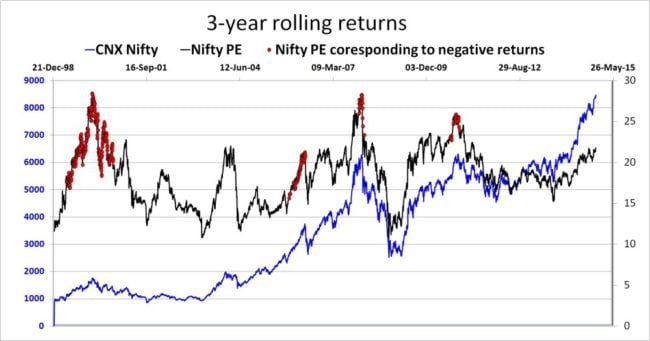
Notice most of the data is centered around the dot-com crash. PE values from about 16 to 20 led to negative returns and not just 22.
Notice the small bunch of red points right in the middle of the so-called ‘bull run’. Related reading: Anatomy of a bull market
Then we have some points just before the 2008 crash and some points in 2010 when PE was close to 25.
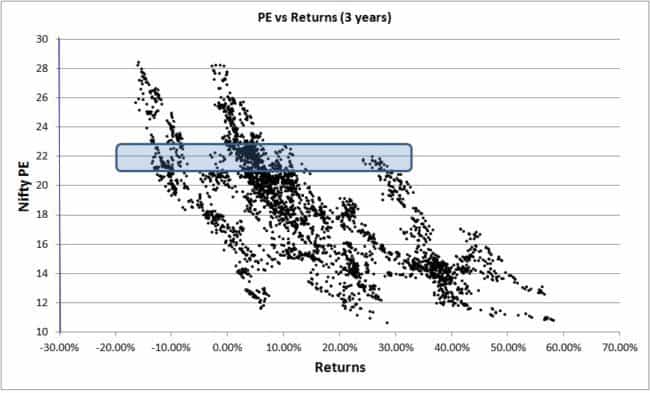
A negative 3 year return and a PE of 22 or above occurred only 42.7 times out of 100! The rest of the times, the negative returns came when PE was between 15 and 22! Please don’t bet that a high PE implies a low return …. at least over 3Y!
Notice the spread in returns possible corresponding to the PE on the date of investment. Current PE is close to 22. So the blue box tells you what to expect or rather what not to expect.
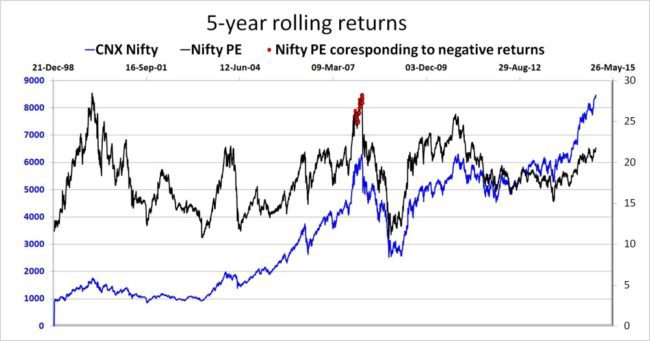
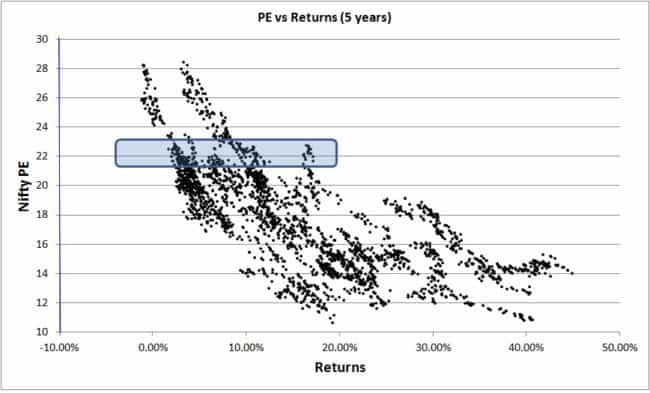
Now to 5 year returns. There is not enough negative returns data available. All points in that bunch correspond to a PE greater than or equal to 24.5.
Meaning, if you stay invested for 5 years, current PE most likely does not matter!