Last Updated on January 10, 2023 at 10:16 pm
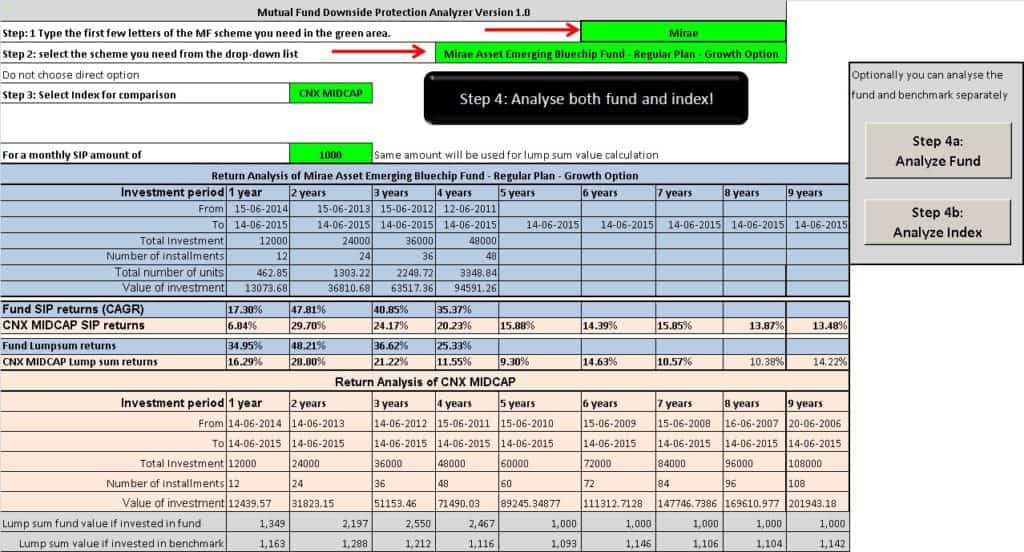
Use this sheet to calculate the downside protection offered by a mutual fund for different investment durations (last 1-9 years). It also includes an ulcer index calculator. The present version has been updated with multiple indices from the Mutual Fund SIP XIRR Tracker
This tool has been specifically designed to aid investors who would like to follow method 4b mentioned in
How to select an equity mutual fund – Making a Choice!
The idea is quite simple:
🔥Secure your future with our Robo-advisory tool trusted by over 3,500 investors and advisors. From effortless retirement planning to funding your children’s biggest dreams, turn your financial goals into reality. 🔥
Subscribe for money management solutions via email! (Link takes you to our email sign-up form) Join 32,000+ readers in our community.
👉 New Tool Alert! NaviPlan: A Privacy-Focused Multi-asset Tracker and Goal Planner 👈
1) Shortlist mutual fund based on consistent performance (as detailed here)
2) From the shortlist, choose funds which has provided investors with consistent downside protection.
This can be inferred from the downside capture ratio.
Morning Star India offers this ratio, but is always benchmarked to BSE 100.
Now users can use this sheet to calculate the downside protection ratio wrt to multiple benchmarks:
Indices available: A total of 47 Indices, including NIfty TRI, Sensex TRI, BSE 200 TRI, BSE 500 TRI,Nifty, CNX 100, CNX Mid Cap, CNX 500, Sensex, BSE Small Cap, Mid Cap, BSE 100,200, 50 etc.
The mutual fund risk and return analyzer published earlier calculated the downside protection with daily returns in a different way compared to the norm.
In this sheet, monthly returns are used and the formula used is standard. Therefor the results will be easier for the user to understand.
This is the method I advocate in the investor workshops.
The main advantage of this model is that it does not depend on modern portfolio theory (MPT) ratios which are applicable only for normal or Gaussian distributions. It is quite possible (in fact easy to pve)that they may not work with mutual funds and stocks! This means all star ratings are on shaky ground!!
People use MPT metrics because alternatives are tough to evaluate (more on this soon).
Upside capture
For a given period, how much of the benchmarks gains has the fund captured? Higher the better.
1) We calculate the net CAGR of the fund with only those months when the benchmark returns are greater than or equal to zero. This is the Upside CAGR of the fund
2) Similarly, we calculate net CAGR of the benchmark with only those months when the benchmark returns are greater than or equal to zero. This is theUpside CAGR of the benchmark.
Upside capture ratio = Upside CAGR of fund/Upside CAGR of benchmark
For example, if upside cagr of the benchmark is 35% and upside cagr of the fund is 34%, the fund has captured 97% of the benchmark returns when it was positive.
Upside capture ratio can also be more than 100% – meaning the fund has outperformed the benchmark when the going was good (benchmark returns were positive)
Downside capture
For a given period, how much of the benchmarks losses has the fund captured? Lower the better.
Suppose we have a set of month returns for say, 5 years.
1) We calculate the net CAGR of the fund with only those months when the benchmark returns are lesser than zero. This is the Downside CAGR of the fund
2) Similarly, we calculate net CAGR of the benchmark with only those months when the benchmark returns are lesser than zero. This is the Downside CAGR of the benchmark.
Downside capture ratio = Downside CAGR of fund/Downside CAGR of benchmark
For example, if downside cagr of the benchmark is -15% and downside cagr of the fund is-10%, the fund has captured only 66% of the benchmark losses.
Lower the downside capture ratio, the better downside protection.
Downside capture ratio with be positive only if both downside cagr of fund and benchmark are negative.
If the downside cagr of benchmark is negative while downside cagr of fund is positive, the downside capture ratio will be negative, This is a pretty good thing! It will only be observed over short durations.
However, downside capture ratio can also be negative if downside cagr of fund is negative while downside cagr of benchmark is positive! This means something is wrong with the fund! This is pretty rare.
From what I have seen, consistent downside protection is the source of alpha.
Results for HDFC Top 200 and Quantum Long Term Equity were published earlier:
Understanding Upside and Downside Capture ratios
Video: How Mutual Fund Upside and Downside Capture Ratios are calculated
Capture ratio
Capture ratio = upside capture ratio/downside capture ratio.
Higher the better (unless downside capture ratio is negative)
Here is a screenshot with results for Mirae Emerging Bluechip fund
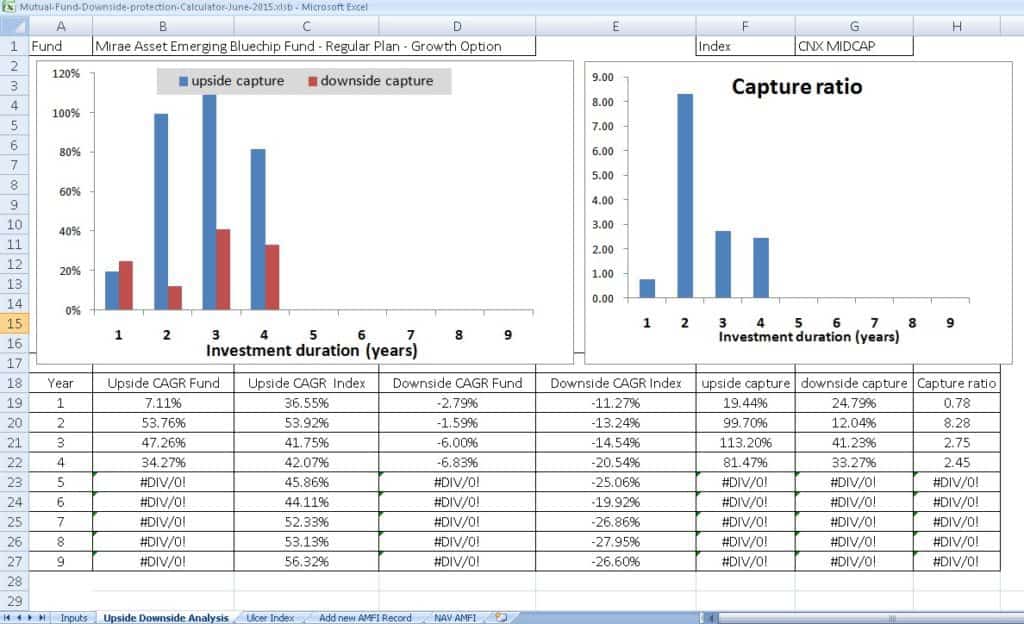
The fund has performed extremely (low downside capture and high capture ratio) expcept for the last year.
The #DIV/0! represnts lack of data. Too bored to hide it.
Ulcer Index
The Ulcer Index is another measure of downside risk.
The Ulcer index is designed in such a way that it penalizes downside (fall from the maximum) much more than other ratios. It was first published by Peter Martin and Byron McCann in their book The Investors Guide to Fidelity Funds(1989).
At that time pretty much everyone thought stomach ulcers were caused by stress. We later came to know that stomach Ulcers are caused by bacteria – a Nobel prize winning discovery. Of course, the name Ulcer index stuck!
Suppose the maximum NAV over a 2-week period is 15. If the NAV decreases from this maximum, the Ulcer index value increases pointing to an increase in investor stress! If the NAV increases further, the index decreases reflecting a decrease in stress!
Higher the ulcer index, lower the downside protection and higher the investor stress.
As long as the long-term ulcer index of the fund is lower than the benchmark, I think we should be pretty happy.
This how Mirae Emerging Blue Chip has fared
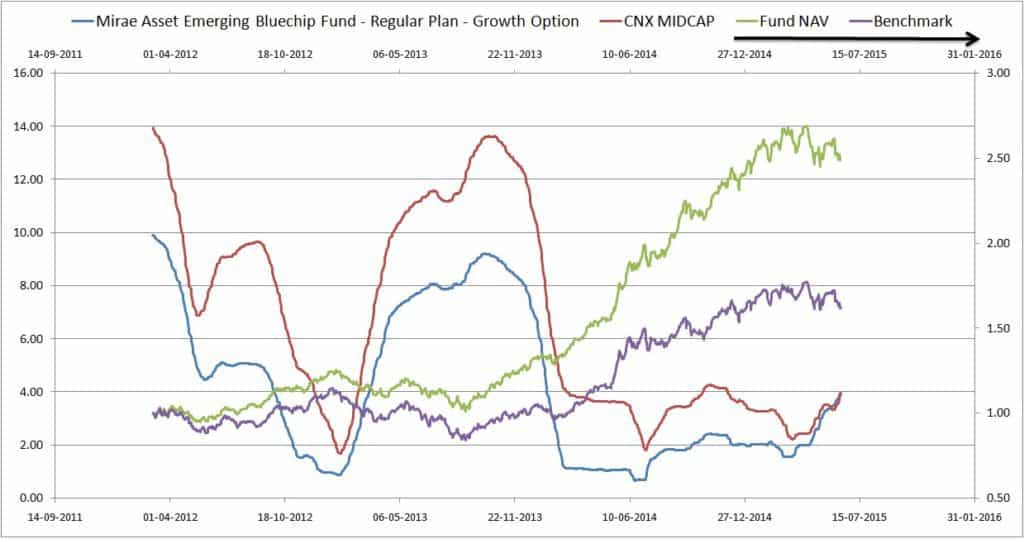
The funds ulcer index has been consistently below that of the index.
ICICI Pru Dynamic Equity
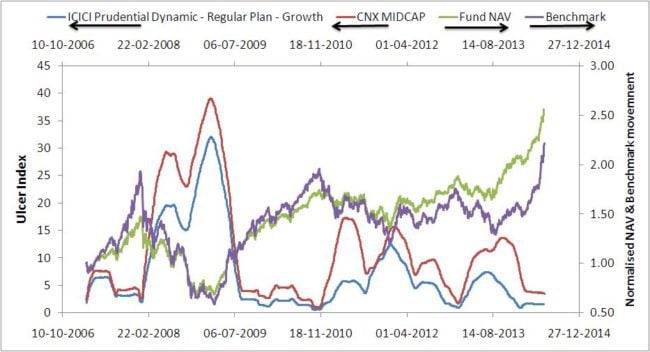
Now how is that for a terrific performance!
The sheet also provides lump sum and SIP returns for the fund and benchmark for the 1-9 year periods.