Last Updated on August 30, 2021 at 3:53 pm
Upside and Downside capture ratios are easy-to-understand mutual fund performance measures. Consistent downside capture ratios can be combined with consistent returns (try the mutual fund screener) to select and review mutual funds.
Regular reader may be aware that I am a fan of the downside capture ratio. In this post, I present a video that describes how these ratios are calculated with an example.
What is upside capture ratio?
Over a given period, a benchmark (index) could have given a set of positive or negative monthly returns.
🔥Secure your future with our Robo-advisory tool trusted by over 3,500 investors and advisors. From effortless retirement planning to funding your children’s biggest dreams, turn your financial goals into reality. 🔥
Subscribe for money management solutions via email! (Link takes you to our email sign-up form) Join 32,000+ readers in our community.
👉 New Tool Alert! NaviPlan: A Privacy-Focused Multi-asset Tracker and Goal Planner 👈
Whenever the index gave a positive return, how did a fund fare? How much of those positive index returns did the fund ‘capture’?
The upside capture measures this. Obviously, higher the upside capture, the better.
What is downside capture ratio?
Whenever the index gave a negative return, how did a fund fare? How much of those negative index returns did the fund ‘capture’?
The downside capture measures this. Obviously, lower the downside capture, the better.
Sometimes the downside capture can be negative. Typically this means, that the fund gave a positive return, while the index gave a negative return!
Check out this video for an example- Mutual Fund Performance Review: IDFC Premier Equity
I had previously written by why I believe these ratios are superior to other metrics: Simplify Mutual Fund Analysis with Upside/Downside Capture Ratios
Where can I get these ratios?
At Morning Star India. See above link for an example. Please note the benchmark used for calculation before interpreting numbers. Balanced funds may give weird results.
How Upside and Downside Capture Ratios are calculated (4:30 minutes)
A more detailed explanation can be found here: Understanding Upside and Downside Capture ratios
Example:
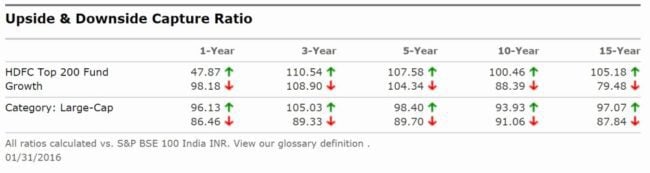
Over the last year, HDFC Top 200 has only captured 47% of BSE 100’s (its benchmark is BSE 200) positive returns and 98* of its negative returns.
Three and five-year numbers are pretty bad as the fund has captured 108% and 104% of BSE 100’s losses respectively. Hard for anyone to justify that performance!
DIY analysis: Mutual Fund Downside Protection Calculator
Check out other videos from the freefincal youtube channel