Last Updated on August 30, 2021 at 3:49 pm
Here is a National Pension Scheme NPS Calculator for government, corporate, and individual subscribers in Excel to enable better understanding of how the scheme works.
For government subscribers, the asset allocation is fixed: 15% in equity (E) and rest in fixed income (allocation to G – government bonds and C – corporate bonds is not known)
The tax on lump sum corpus withdrawn is assumed to be zero. Some argue that the NPS corpus is the same as gratuity for a government employee and is tax-free. Personally, I do not agree with this and shall await official confirmation (update see below). In the sheet, I have assumed that the gratuity is tax-free. Do not assume that this is true.
For corporate and individual subscribers, the asset allocation among E, G and C can be varied each year in the NPS calculator.
🔥Secure your future with our Robo-advisory tool trusted by over 3,500 investors and advisors. From effortless retirement planning to funding your children’s biggest dreams, turn your financial goals into reality. 🔥
Subscribe for money management solutions via email! (Link takes you to our email sign-up form) Join 32,000+ readers in our community.
👉 New Tool Alert! NaviPlan: A Privacy-Focused Multi-asset Tracker and Goal Planner 👈
Also, only 40% of the corpus at the time of retirement is tax-free.
Update 3: NPS Tier 1 Equity Scheme (E) Performance – Oct 2016
Update 2: A Guide to investing in the National Pension System (NPS)
Update 1: Budget 2016: National Pension Scheme – 40% of withdrawal made tax free!
Despite this change, I still believe that one should not Invest Rs. 50,000 in NPS For Saving Tax!
Even if above gratuity interpretation is true for government employees, it makes no sense for them to invest that 50K. In any case, as of now they cannot invest on their own in tier 1. That rule has to be changed first!
Besides, the E component is invested in a large cap index. I think one can do much better than that!
For government subscribers, 40% of the corpus is to be annuitized. Remaining is assumed to be tax-free. This is a screenshot of the memorandum from Budget 2016
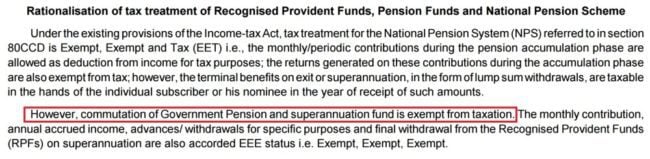
For corporate subscribers, 40% of total corpus at retirement is tax-free. Forty percent of the remaining corpus is assumed to be annuitized. The remaining corpus is taxable as per slab.
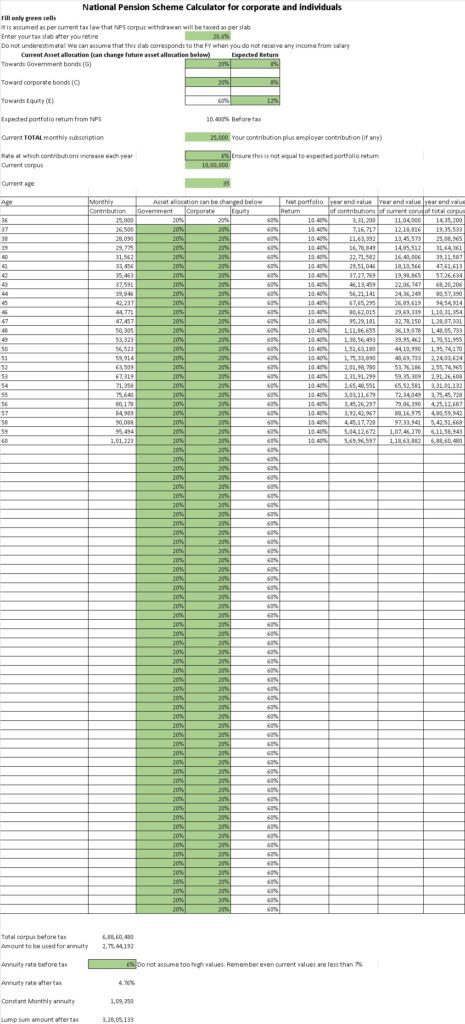
Here is a screenshot for the NPS calculator for corporates and individuals (click to enlarge).
Kindly note that this is not a recommendation for NPS. In fact you can use this calculator to understand why one should stay away from Corporate NPS, if You Wish to Retire ASAP!
Update 2: NPS: Partial Withdrawal Rules 2016 are just awful! Beware.